
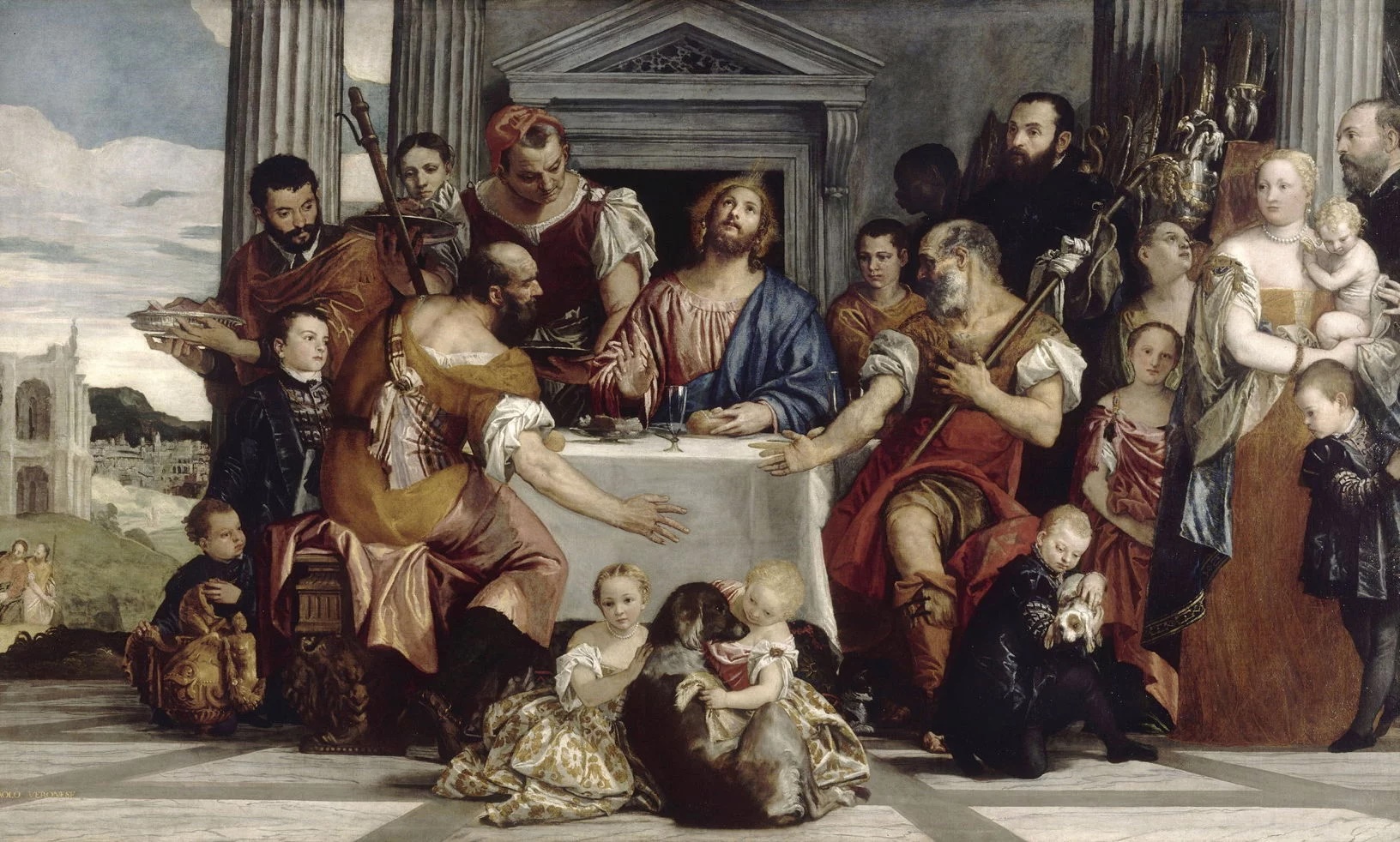

14 June 2026 • The Second Sunday after Trinity • Luke 14:16–24
In the holy Name of + Jesus. Amen.
A man reclines at the table with Jesus and says a pious thing: “Blessed is he who shall eat bread in the kingdom of God!” (Luke 14:15)
Shall eat. Someday. Out there. In a future that asks nothing of him this day. Every word of it is true. You are blessed to eat bread in the kingdom of God.
But the man saying it sits three feet from the Bread of Life and does not know it. So Jesus tells him about a supper — a supper that is not someday but now.
“A certain man gave a great supper and invited many, and sent his servant at supper time to say to those who were invited, ‘Come, for all things are now ready.’” (Luke 14:16–17) Not: get ready. Not: mark your calendars. Ready. Now. And now comes the answer to that now: “But they all with one accord began to make excuses.” (Luke 14:18) A piece of ground. Five yoke of oxen. A wife.
You know these excuses. They are yours and, obviously, those absent this morning. But, pastor! The cows don’t milk themselves. The field won’t wait — there’s rain coming Tuesday. It’s the only weekend we have up north. The kids have a tournament. We were out late Saturday. Since everyone has these excuses, it also means no one does. We think any excuse is acceptable.
But before the excuses can accuse you, hear what they are not. Jesus is not condemning farming, buying or selling, or marriage. Fields, oxen, and wives are gifts of God, given from His own hand. Abraham had fields. Jacob had livestock past counting. God Himself instituted marriage in Eden. The sin is not in the things. The sin is in the ranking. Each man looked at the gift in his hand and the Giver at his door, and he feared losing the gift more than he feared the Giver.
There is a word for that, and the catechism taught it to you: We should fear, love, and trust in God above all things. Above the field. Above the oxen. Above the wife. Latch onto that word fear because it is the key to Jesus’ parable. Every commandment’s explanation begins the same way: We should fear and love God. So also the Third: That we do not despise preaching and His Word, but hold it sacred and gladly hear and learn it. “Despise” sounds too strong, doesn’t it? Surely, nobody here despises God’s Word. But the catechism’s word despise wears work clothes. It looks like a field that won’t wait. It sounds like “please have me excused.” Where the fear of God goes, the hearing of His Word goes with it.
And what happens to a congregation when that fear dies? An old churchman, Tertullian, watched it happen and named the disease in one line: “Where God is not feared, He is not present; and where He is not present, there is no truth” (On the Prescription of Heretics, 43).
Let’s turn that sentence inward onto ourselves today. Christ is present here not as a mere memory or feeling, but with His true body and His true blood, in, with, and under the bread and wine, on that altar, within the hour. His presence does not depend on our fear — His Word puts Him there. But the three men in the parable show you what happens where the fear of God has died: a feast can be prepared, stand ready, complete, paid for, and a man can be absent from it while sitting in his own kitchen, certain he has done nothing wrong. The Lord will not suffer Himself to be second in your world, not to anything. He won’t compete for your attention. If He’s in the second spot, He considers it simply an RSVP in the negative.
And the master answers that RSVP. “For I say to you that none of those men who were invited shall taste my supper.” (Luke 14:24) That is no idle threat but an indicative word from fearful Almighty God. Our Confessions list this verse among Scripture’s powerful rebukes and warnings (FC SD XI 51). Luther says the Gospel is like a passing rain shower: when the Word is rejected in one place, it moves to another. Drive through the county. You will pass churches where the table was set every Sunday for a hundred years, and now the doors are locked. The Supper does not wait for the guests, but the guests are always invited.
But hear what the master does with his anger. He does not cancel the supper. He flings the doors wider. “Go out quickly into the streets and lanes of the city, and bring in here the poor and the maimed and the lame and the blind.” (Luke 14:21) And when there is still room: “Go out into the highways and hedges, and compel them to come in, that my house may be filled.” (Luke 14:23)
Do you see who fills the hall today? We are the poor. We are the maimed. We are the blind. We are the lame. We had no field to offer, no oxen, no standing — nothing to weigh against the invitation and nothing to lose by accepting it. He went out to the waysides and the hedgerows — even Sherman Center, Sheboygan County — and dragged us in. Not by force but by His Word, which does what it says. The same Word that made light out of darkness makes guests out of beggars.
And that servant’s call is older than the parable. Solomon heard it: “Wisdom has built her house… she has slaughtered her meat, she has mixed her wine, she has also furnished her table.” (Proverbs 9:1–2) Wisdom built her house: the eternal Son took on true human flesh, born of the Virgin Mary. She slaughtered her meat and mixed her wine: Good Friday — body given into death, blood poured out. And she has sent out her servants to call from the highest places of the city, and every preacher since Pentecost has carried the same sentence: “Come, eat of my bread and drink of the wine I have mixed.” (Proverbs 9:5)
The same chapter names the door into her house: “The fear of the LORD is the beginning of wisdom.” (Proverbs 9:10) There it is again — fear. The thing the three men lacked. Or as the Psalmist says: Come, you children, listen to me; I will teach you the fear of the LORD. What does it teach? Not terror at a distance. “The LORD is near to those who have a broken heart.” (Psalm 34:18) Do you see? The fear of the Lord is not what kept the maimed and the blind out of the hall. It is what brought them in. The three men filed His invitation with their other appointments, but without fear. The beggars heard come from the master of the house, and nothing in their hands outweighed Him, because their hands were empty. That is the fear of the Lord: empty hands and a rush to Wisdom’s door.
But maybe you feel neither — no fear, no hunger for the Sacrament, no thirst, no sense of need. The catechism appointed for this very week answers you. Touch your body: do you still have flesh and blood? Then believe what Scripture says about the flesh. Look around: are you still in the world? Then there is sin and trouble enough. And the devil is around you, lying and murdering day and night, granting you no peace within or without. Your need is not measured by your appetite. The man who feels no hunger is not the man who needs no food. He is the man closest to starving.
And ahead of your hunger, ahead of your fear, ahead of everything you feel or fail to feel, stands the first answer: the command and the promise of Christ the Lord. He says come. He says given and shed for you for the forgiveness of sins. The worthiness is in the invitation, not the guest. And His Word is enough.
So think back to the man at the table, the one who started all this. He said, “Blessed is he who shall eat bread in the kingdom of God.” Try this on for a corrected sentence: “Blessed are you who eats that bread now.” The Lord is having Supper today, and everything He earned for you by the complete life He delivers to you, into your mouth. And tomorrow or a thousand, million years from now, as you feast at the marriage supper of the Lamb, whatever it was that seemed more important this morning — I promise you, it won’t be.
“Come, for all things are now ready.” (Luke 14:17)
The peace of God, which surpasses all understanding, guards your hearts and minds through Christ Jesus. Amen.
Rev. Christopher R. Gillespie
St. John Ev. Lutheran Church & School — Sherman Center
Random Lake, Wisconsin