

03 June 2026 • Wednesday of Holy Trinity • 1 Corinthians 15:12–23 • Luke 20:27–40 • Psalm 29
In the Holy Name + of Jesus. Amen.
The Sadducees have a question. A good question.
Not a foolish question. A philosophically precise one. The levirate law required that when a man died without children, his brother must marry the widow and raise up offspring in the dead man’s name. Seven brothers marry the same woman. All seven die without children. At the resurrection, whose wife is she?
It is a fantastic trap, and it works on exactly one assumption: that resurrection means the continuation of this life but different — the age to come as simply this age extended. If that is what resurrection is, then Moses himself assumed it was impossible because he wrote a law that makes sense only in a world where death is the end.
That is the wrong assumption. And Jesus does not answer the question but undermines it.
“The sons of this age marry and are given in marriage, but those who are considered worthy to attain to that age and to the resurrection from the dead neither marry nor are given in marriage.” (Luke 20:34–35)
The Sadducees asked whose wife she would be. Jesus says that the question does not carry over. You built your entire case on the premise that the age to come is an extension of this age — same social structures, same biological necessities, same legal provisions. That premise is false. The age to come does not answer to this age’s terms. You are asking about a world that does not exist.
But He goes further. He goes to Moses, the only authority the Sadducees would accept, and finds the resurrection there.
“That the dead are raised, even Moses showed, in the passage about the bush, where he calls the Lord the God of Abraham and the God of Isaac and the God of Jacob. Now He is not God of the dead, but of the living, for all live to Him.” (Luke 20:37–38)
I Am the God of Abraham. Present tense. Not: I was associated with him once, back when he lived. Not: I remember him with fondness. I Am. Abraham is alive to God. Isaac is alive. Jacob is alive. God speaks His Name at the burning bush — I Am who I Am — and that Name is incapable of being the name of a God of the simply dead. Wherever He names Himself as God of someone, that someone lives. Moses had been testifying to the resurrection from within their own Pentateuch the entire time. They just had not heard him.
Last Sunday, Nicodemus came to Jesus in the night. A ruler of the synagogue, a teacher of Israel, a man who had read the Scriptures his whole life. He heard Jesus say “born from above” and translated it into the only world he had. “How can a man be born when he is old? Can he enter a second time into his mother’s womb and be born?” (John 3:4)
That is not what Jesus means. But it is what Nicodemus could hear from inside his assumptions: that every word from the kingdom must fit inside the categories of this age. Born again has to mean another womb. Resurrection has to mean another version of now. Take a word from the kingdom of God, run it through the grid of what we already know, and come up with nothing but an absurdity.
Jesus does not negotiate with the premise, again He undermines it. “Truly, truly, I say to you, unless one is born of water and the Spirit, he cannot enter the kingdom of God.” (John 3:5)
There is a birth that requires no womb. There is a life that is not this life prolonged. The same move the Sadducees made — the same one Nicodemus made — we make when we reduce the resurrection to a metaphor for legacy, or eternal life to a way of describing the comfort we feel at funerals. We take a word from the kingdom and translate it into the only world we can manage. And we come up with something far smaller than what God is offering.
The font is where Nicodemus’s question died. Where the Sadducees’ question died. You went into that water still carrying the old premise — still asking what resurrection could possibly mean, still uncertain whether the age to come is anything more than this age with the dying removed. And you came out having been given something you did not generate, extra nos, outside yourself, from the One whose Name was spoken over you. The Holy Spirit begot you. The old Adam did not survive. You are already a son of the resurrection before you have died — not because of what you brought to the water, but because of whose Name is on you.
St. Paul said in our Epistle, “If in Christ we have hope in this life only, we are of all people most to be pitied.” (1 Cor 15:19)
Most to be pitied. Not most principled, not most admirable — most pitiful. Because if there is no resurrection of the dead, then not even Christ has been raised. And if Christ has not been raised, then the forgiveness you received is not real. The preaching is empty. The sins are still there. The bodies committed to the ground are decomposing, and that is all that is happening to them.
That is where the Sadducees’ premise leads. That is where every reduction of the faith to this life leads. Not a small theological error, but the collapse of everything.
But the Word does what it says. And Paul does not end there.
“But now Christ has been raised from the dead, the firstfruits of those who have fallen asleep.” (1 Cor 15:20)
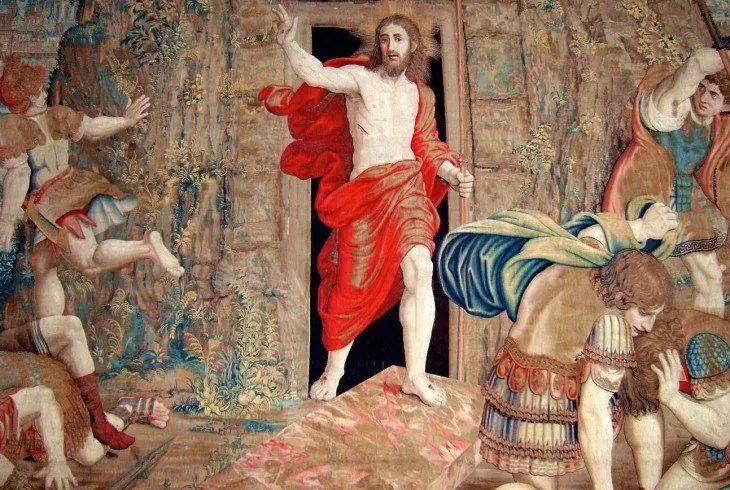
But now. All the hypotheticals collapse. Not if, not what would follow if — now. He is raised. Not as a spiritual notion. Not as a living memory. Not as an idea that outlasted a crucifixion. As a body. A body that ate fish on the shore. A body with nail marks you could touch. A body that belongs to the age to come, already present in the age that is passing away.
He is the firstfruits, the first evidence of more to come — the first peonies that tell you what the whole garden will be. First installment of the harvest. His body is the preview of what the harvest will look like. Not more of this life. Not the present age but running longer. But something the age to come contains, and this age cannot yet hold. And you, buried with Him in Baptism, are part of that harvest. Not because of what you brought to the font. Because the One who is the firstfruits has named you as His own.
The Sadducees were silenced. Even the scribes had to acknowledge it: “Teacher, you have spoken well” (Luke 20:39). But silence is not faith. They came back. They ran the high priesthood. They were the ones who needed Jesus gone — who pushed for the crucifixion, who required that the man who kept insisting on the resurrection be put into the ground and kept there.
They sealed the tomb. Three days. And the question was decided for good.
He is not the God of the dead. He named you at the font. Present tense. He is your God now, which means you are His now, which means you live to Him — even when you die. Especially then. That is not a sentiment for the grieving. That is what the far side of Calvary looks like: the risen body of the Son, and in that body, all who are His.
And now He gives you what Calvary won. Here. At this table. His body and His blood, in, with, and under the bread and wine. For you. For you — the one who has carried the Sadducees’ premise into this nave, who has wondered whether the resurrection is really more than a comfort for funerals, who has translated the kingdom into the only world you can manage. For you. The firstfruits are placed into your hands. The age to come arriving in this age, located, given out, with these words, at this altar. He is not the God of the dead, but the God who has made you alive in Christ.
In the name of the Father and of the + Son and of the Holy Spirit. Amen.
Rev. Christopher R. Gillespie
St. John Ev. Lutheran Church & School — Sherman Center
Random Lake, Wisconsin