
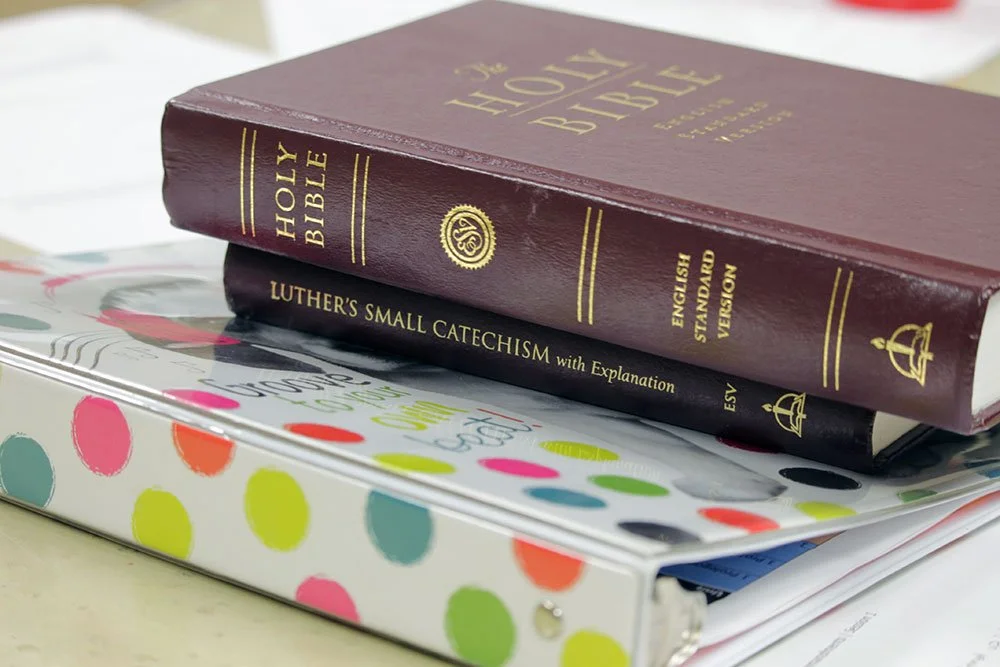
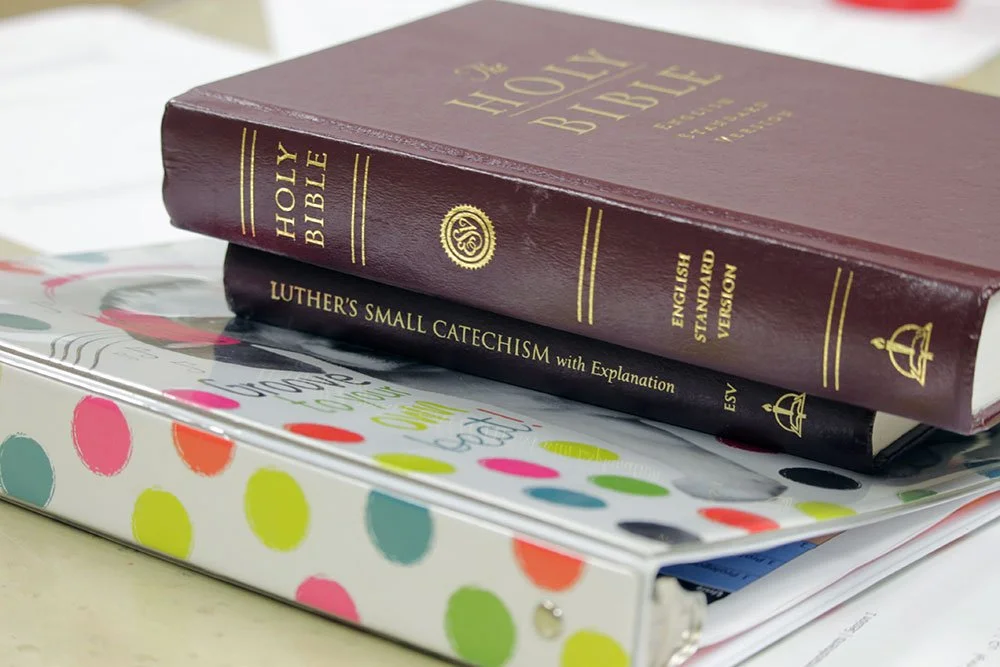
At St. John Evangelical Lutheran Church & School, catechesis is not a program or a hoop to jump through. It is the church’s ordinary work of handing over the faith once delivered to the saints to the next generation (Jude 3). We teach our children to confess what God has said, to trust Christ crucified for them, and to live from His gifts in His church.
What We Teach
We do not invent the content. We receive it.
Our catechesis centers on:
-
Holy Scripture – the inspired, inerrant Word of God, the final authority for faith and life.
-
Luther’s Small Catechism – the church’s “handbook” for the Christian home and congregation, focusing on the six chief parts:
-
The Ten Commandments
-
The Creed
-
The Lord’s Prayer
-
Holy Baptism
-
Confession and Absolution
-
The Sacrament of the Altar
-
-
The Divine Service – what we teach in class is the same faith we sing, pray, and hear on Sunday.
We do not reduce Christianity to “values,” “life skills,” or vague spirituality. We teach sin and grace, Law and Gospel, death and resurrection, the cross and the sacraments. Children are baptized into the real thing, not a diluted version.
“Age-Appropriate” – What It Really Means
“Age-appropriate” does not mean hiding parts of the Bible or avoiding doctrine because it might offend modern sensitivities. All of God’s Word is for God’s people, including children.
“Age-appropriate” does mean:
-
We adjust how we teach: length, vocabulary, and level of detail.
-
We sequence difficult texts: younger children get the basic story and clear right/wrong; older students receive more explicit detail and fuller explanation.
-
We speak plainly but not graphically about sexual sin, violence, and judgment with younger children, and more directly with older ones.
-
We never lie, euphemize sin into “mistakes,” or pretend judgment is not real.
We refuse to entertain children for 45 minutes and then call it “catechesis.” They will sometimes be bored. So will adults. The old Adam is always bored with the Word. We are not training them to chase constant stimulation; we are training them to hear and hold fast to Christ and His promises.
How We Teach
We use a variety of methods, but the content remains the same:
For younger children:
-
Short, clear Bible narratives
-
Repetition of simple Catechism lines
-
Songs, hymns, and liturgical responses
-
Concrete examples from family, church, and daily life
-
Brief prayers and blessing
For older children and youth:
-
Direct reading and discussion of Scripture
-
Detailed work with the Small Catechism and its Explanation
-
Honest conversation about sin, sexuality, identity, anxiety, suffering, and death in light of God’s Word
-
Connection to the Divine Service, confession/absolution, and the Lord’s Supper
-
Memorization that leads into understanding and confession, not just recitation
We will use questions, discussion, storytelling, and yes, sometimes Q&A. But catechesis is not a workbook or a test. It is immersion in Christ’s Word and gifts.
The Role of Parents and Teachers
God gives children first to parents, not to schools or programs. The Catechism is written “as the head of the family should teach it in a simple way to his household.” The school and congregation support the home; they do not replace it.
We expect:
-
Parents to bring their children to the Divine Service, pray with them, review memory work, and model repentance and faith.
-
Teachers (especially in religion and catechesis) are to be faithful in doctrine and life, confessing the faith they teach, and participating in Word and Sacrament.
Where parents or teachers do not share our confession, we still love and serve them—but we do not let their doubts, indifference, or different theology dictate what or how we teach.
When Catechesis Is Called “Boring” or “Not Age-Appropriate”
We take honest criticism seriously:
-
If teaching is sloppy, unclear, or lazy, we will repent and do better.
-
If there is no engagement, no Scripture, no prayer, and no real connection to life, that is on us, and it must change.
But we will not:
-
Remove or soften the Law because it offends.
-
Silence the cross, blood, atonement, or hell because they are “too heavy.”
-
Turn the Sacrament of the Altar into a vague symbol so no one feels uncomfortable.
-
Trade doctrine for entertainment to keep everyone happy.
If a child says, “This is boring,” we listen. If an adult says, “This is boring because you talk too much about sin, grace, and sacraments,” that is a deeper spiritual problem. The answer is not to change Christ. The answer is to preach and teach Christ more clearly.
Our Goal
The goal of catechesis here is not that students “had fun” or “liked the class,” but that they:
-
Know by heart the words of the Small Catechism.
-
Recognize their sin and flee to Christ for forgiveness.
-
Expect to meet Jesus where He has promised to be: in preaching, in Baptism, in Absolution, and in His Supper.
-
Continue to live in Christ’s church long after the class is over.
In short, we aim for children who can say, with the whole church:
“This is most certainly true!”