"The One who is going to Jerusalem to die is the one who feeds you" Laetare 2026
15 February 2026
Laetare
John 6:1=15
This is the Word of the Lord that came to me, so that you may believe that Jesus is the Christ, the Son of God, and that by believing, you may have life in His + Name. AMEN.
Rejoice, Jerusalem. Rejoice. That is the word of the day. Laetare. We are halfway through Lent, and the Church pauses, draws breath, and says: rejoice. Not because the suffering is over. Not because we have earned it. But because the one who is going to Jerusalem to die is the one who feeds you. And He is not running out. He never runs out.
Look at the scene. The Passover is near. That matters. Jesus has gone up a mountain — that matters too. A great crowd has followed Him, because they saw the signs He worked on the sick. They are hungry. The disciples look at the crowd and see an impossible problem. Philip runs the numbers: “Two hundred denarii worth of bread is not sufficient for them.” That's eight months' wages. Not enough for everyone to get even a little.
Andrew finds a boy with five barley loaves and two fish. And then he says the thing that is almost funny, except that he's not joking: “But what are they among so many?”
What are they among so many. That is the question, isn't it. What is so little — so embarrassingly, ridiculously little — among so great a need. The disciples are not wrong about the math. They are just wrong about who is doing the arithmetic.
Jesus says: make them sit down. He takes the loaves. He gives thanks. He distributes. And five thousand men — plus women, plus children — eat until they are full. Twelve baskets of fragments remain. Not scraps. Fragments. From what was never supposed to be enough.
The crowd sees it. They say: “This is truly the Prophet who is to come into the world.” They are right, though they don't know how right. They want to make Him king by force. He withdraws. He doesn't need their coronation. He already has a crown coming — and it is not the kind they have in mind.
Consider where He was born. Bethlehem. The name means bread-house in Hebrew. It is not an accident. In the bread-house, the true Bread was born. The one who would say of Himself: “I am the living bread that came down from heaven. If anyone eats of this bread, he will live forever.”
The birth in the manger, the feeding on the hillside, the altar where His body and blood are given — these are not three separate stories. They are one continuous act. God feeds His people with the Bread that does not fail. God feeds His people. That is the story from the beginning.
When Israel murmured in the wilderness — “the whole congregation of the people of Israel grumbled against Moses and Aaron” (Exodus 16:2) — they had left Egypt and they were hungry and they were afraid. And they were sure they were going to die. And the Lord said: I will rain bread from heaven. Every morning, manna. Enough for the day. No more, no less. When they tried to hoard it, it rotted. When they gathered what was needed, it was exactly enough.
For forty years. In the desert. “He who gathered much had nothing left over, and he who gathered little had no lack” (Exodus 16:18). God does not run out.
But here is the hard thing. Here is what you need to sit with, before the joy gets too comfortable.
The crowd on that hillside was fed with barley bread. Their bellies were full. And what did they do? They tried to make Jesus a king on their own terms. They wanted a bread-king. A king who would solve the problem they could see — the immediate, material, aching, daily problem of not having enough.
Jesus refused. Not because the hunger was not real. Not because the need was not genuine. But because they were looking at a sign and mistaking it for the thing itself. They were eating the bread and missing the Bread.
“Do not work for the food that perishes,” He will say to them the next day, “but for the food that endures to eternal life, which the Son of Man will give to you” (John 6:27).
And we are exactly like them. Let's not pretend otherwise. We come to God hungry. Always hungry. And we bring our list. Our needs. Our five barley loaves and two fish. We lay them down before Jesus and we say: here, this is what I have, it is not enough, fix it. And God does not always fix what we point at.
This is where many people abandon the faith. They conclude that God is not real, or not good, or not paying attention. But look at what Jesus actually did on that hillside. He did not give the crowd the king they wanted. He gave them what they needed — Himself. The bread He distributed was a sign pointing to His body, which would be broken. The giving of thanks He offered — the eucharistia — was a foretaste of the night in which He was betrayed, when He took bread, gave thanks, broke it, and said: “This is My body which is given for you” (Luke 22:19).
The Passover was near. He knew what He was doing. This is the mystery of heaven and earth that the Lord's Supper holds. And it is a genuine mystery — not a puzzle to be solved but a depth to be entered.
On one side of it: Jesus is true man. He was hungry in the desert. He was thirsty on the cross. He wept at Lazarus's tomb. When He fed five thousand people, He fed real human stomachs with real bread that really filled them. The body and blood given in the Supper are the body and blood of the one who really died. There is no escaping the earthiness of all of this. The incarnation means God showed up in flesh, and the flesh is not a disguise — it is the point.
On the other side of it: Jesus is true God. He holds the universe in existence at every moment. Every photon, every breath, every heartbeat exists because He sustains it. When He gave thanks and distributed the loaves, creation itself obeyed Him. The bread multiplied not because of some hidden cache, but because the Author of all things was giving it. And when He says over bread and wine, “This is My body... this is My blood,” He means it with the same authority with which He said let there be light, and there was light.
Heaven and earth meet in Him. And they meet in what He gives you at this altar.
What you receive here is not a symbol. Lutherans have said this plainly, and we will not retreat from it. The bread and wine do not merely represent Christ's body and blood. They give them. “The cup of blessing that we bless, is it not a participation in the blood of Christ? The bread that we break, is it not a participation in the body of Christ?” (1 Cor 10:16). Participation. Real sharing-in. The Greek is koinonia — communion, fellowship, actual union with the thing itself.
You come to this rail hungry. You may not feel hungry — you may feel fine, comfortable, untroubled. That is actually more dangerous than feeling the hunger. The crowd in John 6 who tried to seize Jesus to make Him king were the ones who thought they knew what they needed. They were wrong.
You are a sinner. Your need is not primarily political, or financial, or emotional, though it is all those things too. Your primary need is this: you are dead in trespasses and sins (Eph 2:1), and the only thing that can give you life is the body and blood of the Son of God, given for the forgiveness of your sins.
That is what is here. That is what you are receiving.
In Bethlehem, the bread-house, the true Bread was born. He who fed Israel manna in the wilderness — food that perished — was Himself the bread that does not perish. He came from heaven. He took on flesh. He was broken. He was given. And He continues to give Himself, again and again, to sinners who do not deserve it, in bread and wine, at this altar, in this bread-house, on this day.
“I am the bread of life; whoever comes to Me shall not hunger, and whoever believes in Me shall never thirst” (John 6:35).
The disciples looked at five loaves and two fish and asked: what are these among so many? Not enough. Clearly not enough. By every measure of human arithmetic, insufficient. And they were right.
But Jesus does not operate by human arithmetic. He takes what is insufficient, and He gives thanks, and He distributes until everyone is full and there are twelve baskets left over. He does not run out. He will not run out. Not on that hillside, not at that Upper Table, not at this rail.
You come here with five barley loaves. You come here with your meager faith, your half-hearted repentance, your distracted prayers, your sin-worn soul. And He takes it and gives thanks and gives Himself in return. What you leave with is not a reward proportionate to what you brought. What you leave with is Christ — body and blood, poured out for you, placed into you, uniting earth to heaven in this small piece of bread and this small cup of wine.
This is the fourth Sunday of Lent. Laetare. Rejoice. Not because suffering is done. But because the one who will suffer it all is already here, already feeding you, already enough.
Rejoice, O Jerusalem. The Lord feeds His people, and He does not run out.
This is the Word of the Lord that came to me, so that you may believe that Jesus is the Christ, the Son of God, and that by believing, you may have life in His + Name. AMEN.
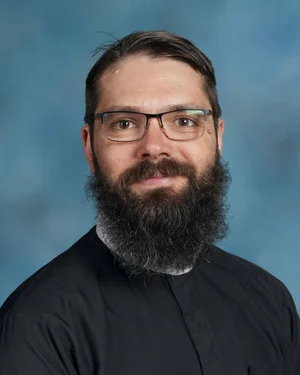
Rev. Christopher R. Gillespie
St. John Ev. Lutheran Church & School - Sherman Center
Random Lake, Wisconsin