"You get Jesus only, and Jesus is enough." Transfiguration 2026
25. December 2026
Transfiguration
Matthew 17:1-9
In the Name of the Father and of the Son and of the Holy Spirit. Amen.
There are two kinds of “seeing” in the Church, and two kinds of “hearing.”
One kind of seeing wants the show. It wants the glare. It wants the religious thrill, the spiritual goosebump, the “mountain-top moment.” The other kind of seeing is content with what God actually gives: Christ hidden under His promise.
And one kind of hearing is restless and picky: too long, too slow, too much reading, too much preaching. The other kind of hearing is hungry for the Word. It is the hearing the Father commands: “This is My beloved Son… listen to Him.”
The Transfiguration is not a bonus scene on Jesus’s way to the cross. It is not Jesus trying out His glory like a new robe. It is the Father teaching the Church what to do with Jesus—and what not to do with Him.
Peter, James, and John go up the mountain with Jesus. They do not climb their way up into heaven. Jesus takes them there. And what they “see” is not a new Jesus but the same Jesus—only now the curtain is pulled back for a moment. His face shines like the sun. His clothes are as white as light. Moses and Elijah appear, the Law and the Prophets, standing there as witnesses, not rivals.
And then the bright cloud. The Sinai cloud. The tabernacle cloud. The temple cloud. The glory-cloud that says, “God is here.” And from the cloud the Voice: “This is My beloved Son, with whom I am well pleased; listen to Him.”
And the disciples do what sinners always do when God stops being merely a religious idea and becomes the living God: they fall on their faces, fearful. Not bored. Not reviewing the service folder. Not critiquing the delivery. Terrified.
Then Jesus comes, touches them, and says, “Rise, and have no fear.” He does not calm them with an explanation. He calms them with Himself, with His word, with His touch. The glory is real—but it is mercy that makes them alive. And when they lift up their eyes, Matthew says it directly: “They saw no one but Jesus only.”
That is the feast. Not “Jesus plus Moses.” Not “Jesus plus Elijah.” Not “Jesus plus my bright ideas.” Not “Jesus plus my spiritual experiences.” Jesus only. Now put that mountain into the Divine Service.
Because you already know how the heart works. We pretend we want God, but what we often want is control. We want God on our terms: measurable, manageable, and preferably brief. So we say it—maybe out loud, maybe only in our heads: “The readings are too long.” “The sermon is boring.” Or, “Why does communion need all the singing and praying?”
That is not mere criticism of practical matters. That is contempt for Christ’s Word. And it is not contempt for the pastor’s personality. It is contempt for Christ’s voice. If the Father says, “Listen to Him,” and we say, “Meh—speed it up,” we are not being practical; we are being faithless. We are treating the Son of God like background noise.
If we say, “one hour or less” while despising the Word that gives you Christ, you are not honoring the Sacrament—you are gutting it. The Supper is not magic bread for the impatient. It is Christ’s testament delivered with His words. The same Lord who gives His body and blood is the Lord who speaks His Gospel into your ears.
You cannot separate Christ into parts: “I’ll take the edible Jesus but not the audible Jesus.” That is not piety. That is picking apart God’s Word and works.
Consider Moses in Exodus. Moses comes down from the mountain, and his face shines because he has been speaking with the LORD. The people cannot take it. It frightens them. So Moses covers his face with a veil when he speaks to them. Then—and this detail matters—when Moses returns to speak with the LORD, he removes the veil.
Glory is there. But it is handled with mercy. Hidden, so sinners are not destroyed. That is not just Moses’ story. That is the pattern of God with His people. Because when God comes unhidden, sinners do not say, “How interesting.” They fall down and die. So God hides His glory inside gifts. He covers it over with means. He wraps it in promise. He gives it to be received, not gawked at.
That is exactly what He does in Christ. On Tabor, for a moment, the veil is pulled aside, and you see what the Apostles will confess later with blood: this man is true God. Not a religious teacher. Not a moral coach. God in the flesh is manifest.
But the normal way you get Jesus is not Tabor. It is Calvary. It is the cross. It is His Word. It is the preaching. It is water and absolution and bread and wine—glory hidden, mercy delivered. That is why the Father’s command is not, “Build something.” Peter wants to build. Three tents. Three shrines. He wants to capture the moment, preserve it, curate it. He wants to do a religious project.
The Father interrupts him. Not “Speak about your experience.” Not “Tell your truth.” Not “Follow your heart.” “Listen to Him.”
So, hear St. Peter in his own words. He says: we did not follow cleverly devised myths. We were eyewitnesses of His majesty. We were there. We heard the Voice. We saw the glory. And then Peter does something that surprises modern Christians, who are addicted to “the spectacular.” He says the prophetic Word is more sure. Not less sure. Not second-rate compared to visions. More sure.
So: if you want certainty, don’t chase the shiny. Don’t chase private revelations. Don’t chase new voices. Don’t chase the latest religious influencer. That is how you get duped. Peter points you to the Scriptures read aloud in the congregation, preached into the ear, and delivered with Christ’s promise. No private myths, no “God told me” that outranks the apostolic Word.
So, let’s bring this back to what we are doing here today. The Service of the Word is not a warm-up act. It is not filler until the “real” deal. It is Christ addressing His Church. Old Testament. Epistle. Holy Gospel. Creed. Sermon. Not a performance; an address. Not religious chatter; the Lord speaking.
And the Creed? The Creed is the Church’s “Amen” to God’s mercy covered revelation. It is not you announcing your personal brand of spirituality. It is you saying, with the whole Church, “Yes—this is the Jesus we have heard; this is the Jesus only.”
And then the Gloria and the Alleluia—those are not cute traditions. They are the Word on your lips. They are glimpses. They are echoes of heaven’s worship breaking into earth’s poverty. They are the Church learning to sing the way the angels sing: not about ourselves, but about the Lamb.
So the Transfiguration teaches you how to be in church. It teaches you what to expect: not entertainment, not novelty, not spiritual fireworks—but Christ, hidden and given. It teaches you what to fear: not long readings, not a slow sermon—but ignoring the Son. It teaches you what to desire: not the pastor’s charm, not the congregation’s warmth, not a fog machine of “experience”—but the clear, saving voice of Jesus.
And it teaches you what renewal looks like. Not gimmicks. Not a trend. Not “making worship relevant.” Renewal is simple and direct: a renewed congregation becomes Word-hungry. It wants the Scriptures. It wants the preaching to be grounded in Christ. It wants to gather together to study that Word. It wants to pray the Word it has heard back to God. It starts judging everything in church life with one question: “Is this what Jesus says?”
That will irritate people who want religion as therapy, as politics, as entertainment. Good. Let it. Because the Church is not built on our preferences. She is built on the beloved Son whom the Father commands us to hear.
Now the last and best thing: After the Voice, after the fear, after the touch, after the command—what remains? Jesus only. Not Jesus, the dazzling spectacle. Jesus, the one who walks down the mountain toward the cross.
He tells them to keep quiet until after the resurrection because the glory must be read through the Passion. Otherwise, you misunderstand it. Otherwise, you turn Jesus into a powerful hero instead of the Lamb who takes away the sin of the world.
And that is what the Divine Service gives you week after week: Not a vague God, but Jesus only. Not a law that flatters you, but the Law that drives you down on your face. Not a gospel that leaves you guessing, but the Gospel that touches you: “Rise, have no fear.” Not a glory that kills you, but the Glory that saves you—hidden under words you can hear, under water you can feel, under bread and wine you can taste.
Listen to Him. Because when you listen to Him, you get what the disciples got at the end of the vision: You get Jesus only, and Jesus is enough.
In the Name of the Father and of the Son and of the Holy Spirit. Amen.
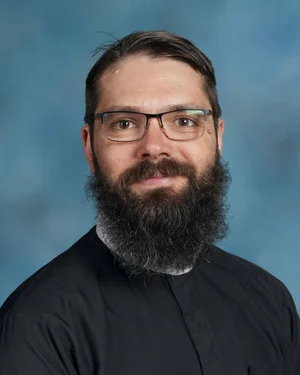
Rev. Christopher R. Gillespie
St. John Ev. Lutheran Church & School - Sherman Center
Random Lake, Wisconsin