

17 June 2026 • Friday of Trinity 2 (observed) • Luke 8:41–56
This is the Word of the Lord that came to me, so that you may believe that Jesus is the Christ, the Son of God, and that by believing, you may have life in His + Name. AMEN.
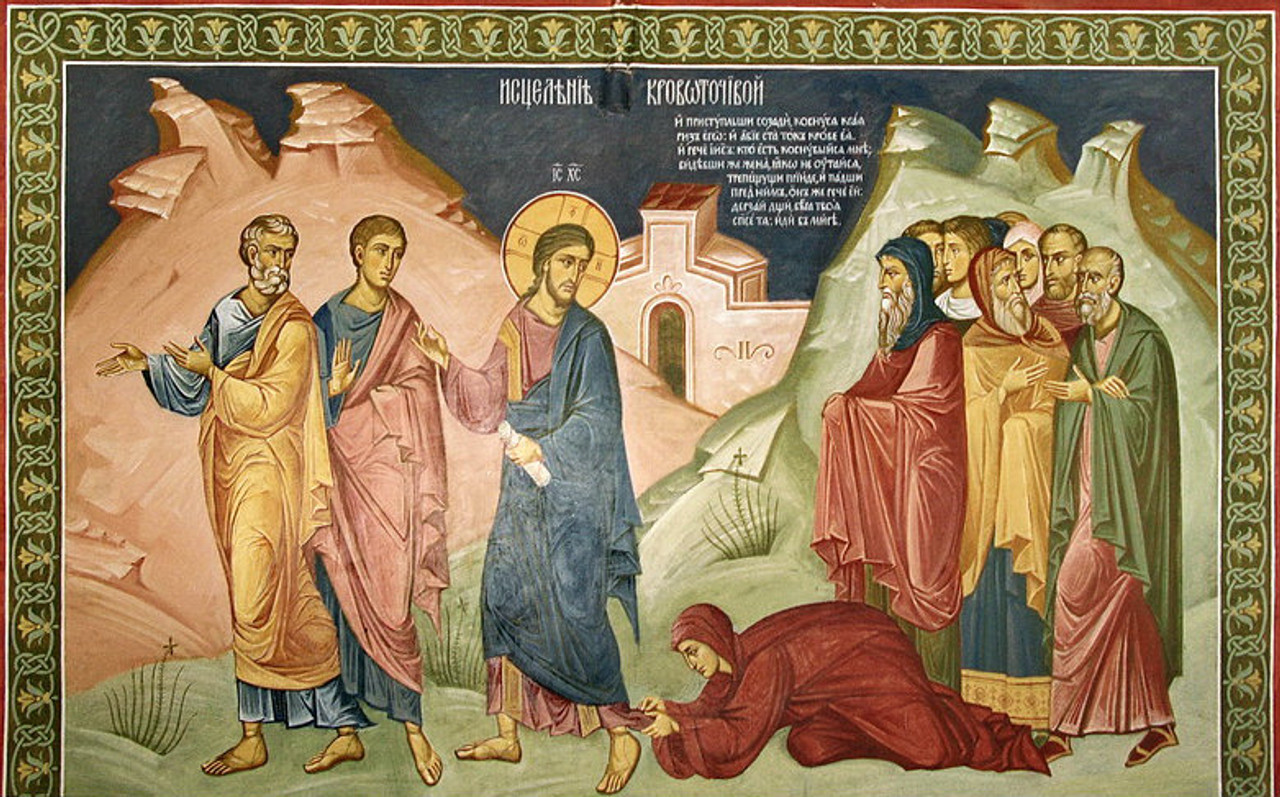
For twelve years, she had been unclean. But not sick in a way that drew sympathy. Unclean in a way that emptied the room. The Law in Leviticus was exact about a woman with a flow of blood: whatever she sits on is unclean, whatever she touches is unclean, and anyone who touches her is unclean until evening (Lev. 15:25–27). For twelve years, no one had touched her without paying for it. No husband’s embrace. No place in the assembly. The disease was in her body; the exile was in her whole life. She had spent everything she had on physicians, and Luke, who was a physician himself, records the verdict without softening it: she “could not be healed by any” (Luke 8:43).
So she has learned how earthly help works. You pay, and it runs out. You pay again, and it runs out again. She has no reason to think God’s mercy runs on a different principle. That is why she does not come to ask. She comes from behind, for the edge of His garment, hoping to take what she needs and slip back into the crowd before anyone notices the withdrawal. She expects God’s mercy to be like everything else that has failed her: limited, scarce, and under guard.
She touches the fringe. “And immediately her flow of blood stopped” (Luke 8:44).
And then the thing she planned against, Jesus noticing: “Who touched Me?” (Luke 8:45).
Peter thinks the question makes no sense. The whole crowd is pressing on every side; everyone is touching Him. But Jesus isn’t adding the people up, and He isn’t annoyed. He felt one touch among the thousand because something happened in it. “Somebody touched Me, for I perceived power going out from Me” (Luke 8:46). The word is δύναμις, power, and it went out from Him into her body, and He knew that it had gone.
The disciples cannot imagine a gift the Giver feels leaving Him and the crowd cannot exhaust. They only know a mercy you could use up. That is the god the woman came to rob, the god of the physicians who takes your money and gives his help in measured doses until there is none left. Jesus is not that god. His mercy is not a supply that a desperate woman could drain. It is a Person, and the moment His life flows out of Him, He turns, not to recover it, but to find her.
She sees that she is not hidden. She comes trembling. He has not drawn her out to shame her. He draws her out so that what happened in secret can be said out loud, so that a word can be spoken over her in front of everyone who had kept their distance for twelve years.
“Daughter, be of good cheer; your faith has saved you. Go in peace!” (Luke 8:48).
Daughter. He has not called anyone else in the Gospels by that name. For twelve years, she had been a problem to be avoided, a source of contamination, a woman with no place. He gives her a place with Him in one word. Daughter. She is restored to the family of God, readmitted to the assembly she had been shut out of, given back the belonging the Law had taken. The healing of her body matters. But this matters more. She came to steal a cure and leave a stranger. She leaves a daughter.
He said, “Your faith has saved you!” The verb is σέσωκέν, a Greek perfect. The perfect tense names something done in the past whose effect does not stop. Not “your faith is saving you,” while you keep at it. Not “your faith will save you,” if you hold on tightly enough. Has saved you. Finished, and standing. It is the same word Jesus speaks in the previous chapter over the woman weeping at His feet. Hear what the Augsburg Confession says of this woman:
“Christ did not mean that the woman had merited forgiveness of sins by that work of love. That is why He adds, ‘Your faith has saved you.’ But faith is that which freely obtains God’s mercy because of God’s Word” (Apol. IV, 31–32).
Forgiveness is received by faith, not earned by it. Notice what her faith actually did. It did not heal her. It sought Him out. If the faith itself had been the cure, she would not have needed to touch Him at all; she could have stayed home and believed. But she came, and she reached, because faith is the empty hand that takes hold of Christ. Faith is not the power. He is the power. Faith is the hand that receives what the power gives.
He is still speaking to her when the messenger arrives from the ruler’s house. “Your daughter is dead. Do not trouble the Teacher” (Luke 8:49).
Remember that poor Jairus has been standing there the whole time. He had come first. His daughter was dying, and Jesus had agreed to come, and then this woman interrupted, and Jesus stopped the whole procession to draw out one more sufferer while his little girl ran out of time. The delay killed her, or at least, that’s how it looks. But the delay was not a waste. Jairus has just watched a woman who touched the hem of Christ’s garment in faith be told, “Your faith has saved you.” He has just seen, with his own eyes, what faith receives.
And now, at the exact moment the news comes that it is too late, Jesus turns to him with the only thing that can hold a man up when the worst has already happened: “Do not be afraid; only believe, and she will be made well” (Luke 8:50).
Do not be afraid. That command runs through the whole of Luke 8 like a thread. Earlier in the chapter, the disciples are in the boat in the storm, and they are afraid. On the far shore, the people of the Gerasenes watch a demoniac set free and are afraid, so afraid of what God’s power might cost them that they beg Jesus to leave. The woman comes trembling, afraid. Jairus stands in the road, afraid. The mourners at the house will laugh, which is its own kind of fear, the kind that has given up. Fear is the enemy that faith is always fighting. And into all of it, Jesus speaks the same word He spoke over the woman: do not be afraid. It isn’t advice. It’s absolution. It means: your doubt, your unbelief, your trembling are not held against you. I am here, and I am for you.
He comes to the house. The professional mourners are already at work, weeping and wailing. He says, “Do not weep; she is not dead, but sleeping” (Luke 8:52). And they laugh at Him. The laughter is not cruelty. It is the bitter laugh of people who know what they know. They are right about the girl. She is dead, and they have stopped hoping, and when hope is gone, the soul mocks to protect itself.
He puts them all outside. He takes her by the hand, and He says, “Little girl, arise” (Luke 8:54). The hand and the word together, one act, the same as the hem and the woman. The same δύναμις that stopped a hemorrhage now reaches into death itself and turns it back. Her spirit returned. She got up. And He told them to give her something to eat.
Of course, she will die again. This is the thing to be honest about. Jairus’s daughter is not raised the way Christ is raised; she will grow old and be buried, and her parents will stand at her grave a second time. This is not the resurrection. But it is a preview of it. Augustine drew the three raisings of the Gospels together and read them as one truth: the ruler’s daughter still lying in the house, the widow’s son already being carried out the gate at Nain, Lazarus four days in the tomb and stinking. Three depths of death, and over all three the same word and the same power (Tractates on John 49.3). The degree of death is nothing to Jesus. Newly dead, long dead, it makes no difference to the One whose life goes out and is not diminished.
This is why the Church learned to call the death of a Christian sleep. We prepare for death the way we prepare for sleep. Every night the same small liturgy: we ask forgiveness, we make peace with those we love, we commend ourselves to God’s keeping, and we close our eyes in the sure expectation of opening them again at the rising of the sun. On the last night, it will be no different. The same preparation. The same sure hope. The hand that took a dead girl by the hand will take yours, and the same voice will say, arise.
Joel saw the shape of it centuries before any of it happened. “You shall eat in plenty and be satisfied, and praise the name of the Lord your God… My people shall never be put to shame” (Joel 2:26).
The woman in our text is among those put to shame. Twelve years outside the temple, outside every human touch, twelve years of the Law’s relentless accounting: spend everything, receive nothing. And then she “ate” from the fringe of His garment, and not in scarcity. His life went out of Him, and nothing was subtracted from Him. She ate plenty.
You keep the same accounts she kept. You believe Christ’s grace is finite. You might think that you have drawn on it too often, reached for it the wrong way, come too late, while He was occupied with someone who asked for it properly. That the window of opportunity has closed. That is the god of the physicians, and they aren’t the Lord.
Maybe you came tonight hoping to sneak off with a bit of grace from Jesus’s hem. But you receive far more! The word of absolution is spoken over you, the same finished word laid on a woman who reached from behind: your sins are forgiven, you are saved. His body and His blood are placed into your mouth, for you, for the unclean, for the cold hand. The power still goes out from Him. To you. And there’s always more where that came from.
This is the Word of the Lord that came to me, so that you may believe that Jesus is the Christ, the Son of God, and that by believing, you may have life in His + Name. AMEN.
Rev. Christopher R. Gillespie
St. John Ev. Lutheran Church & School — Sherman Center
Random Lake, Wisconsin