

11 November 2026 • Friday of Trinity 23 (observed) • Mark 7:1–8
When they come from the marketplace, they do not eat unless they wash. (Mk 7:4).
This is the Word of the Lord that came to me, so that you may believe that Jesus is the Christ, the Son of God, and that by believing, you may have life in His + Name. AMEN.
Before the Pharisees arrive, St. Mark tells us where Jesus has been. He crossed the sea to Gennesaret. As soon as He stepped out of the boat onto the shore, the people knew Him. They ran, Mark says, through the whole region and carried the sick on their beds to wherever they heard He was. “Wherever He entered, into villages, cities, or the country, they laid the sick in the marketplaces, and begged Him that they might just touch the hem of His garment. And as many as touched Him were made well” (Mark 6:56).
Remember that word. Marketplaces. We’re going to come back to it. That’s where Jesus was. In the market, where everything and everyone gets handled. Fish and grain and coins. Strangers. The sick laid out on their mats in the street, begging alms from the people passing by. Everything that could make a man unclean was there in the marketplace. And Jesus stood in the middle of it and let them touch Him.
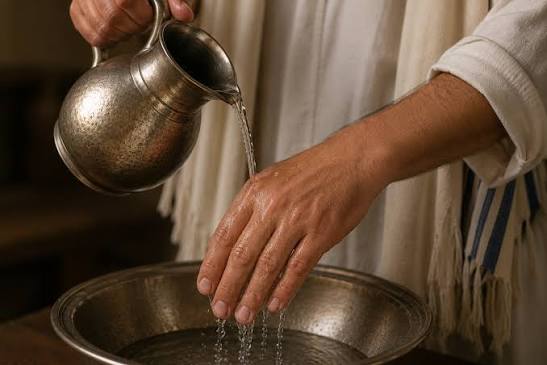
Then the Pharisees come from Jerusalem, all the way to Gennesaret, to the market. And Mark stops to explain something. It’s rare in the Gospels to get a long side excursion like this, to tell us about a tradition. “When they come from the marketplace, they do not eat unless they wash” (Mark 7:4). The word Mark uses for that washing is the Greek word for baptism. They baptize themselves when they come home from the market. They baptize their cups and their pitchers and their copper vessels, even the couches they eat on.
So here are two ways to deal with the marketplace. The Pharisees go into it, and when they leave, they wash it off. Jesus goes into it, and the unclean touch Him and are made clean by Him. Both are about washing, about clean and unclean. But in our Gospel they run in opposite directions. The Pharisees are careful to keep the uncleanness away from themselves. Jesus goes right into it, takes it on Himself, and in exchange gives the sick His health. And the word Mark uses for “made well” is better translated “saved.” They were saved.
Now, you can understand the Pharisees a bit. They love the Law. They want not only themselves but all Israel to be holy, to be clean. The Lord had said, “You shall be holy, for I am holy” (Leviticus 11:44), and they took Him at His Word. Seriously. The priests washed before they went into the tabernacle. Why shouldn’t every Israelite wash before he eats? They weren’t taught, as we were, to wash their hands before a meal. But the priests did. So they washed before they ate, and they washed everything they used. They were building a fence around the commandment to be holy, so that they would never get close enough to break it. It sounds like devotion. It looks like faithfulness. And the elders handed it down, father to son, so it carried the weight of generations. The tradition of the elders, they called it.
But because they were so diligent to stay clean, they easily found fault in others. They looked at the disciples, men who had been out in that marketplace with Jesus, and what did they see? Dirty hands. They didn’t see the sick made well. They didn’t see the crowd at Gennesaret pushing and pressing in on Jesus. All they could see was unwashed hands. “Why do Your disciples not walk according to the tradition of the elders, but eat bread with unwashed hands?” (Mark 7:5).
Here’s something you might never think a pastor would notice: the hands that are put forward at the rail to receive the Lord’s body. Hands that work heavy machinery. Hands that are permanently stained. Dirty hands, yet made clean in Christ.
Jesus answers the Pharisees and their concern about unwashed hands with Isaiah. “This people honors Me with their lips, but their heart is far from Me. And in vain they worship Me, teaching as doctrines the commandments of men” (Mark 7:6–7).
Listen to whom Isaiah is talking. He didn’t say this about the pagans, the unwashed masses. He said it about the people who came to the temple and sang the psalms and kept the feasts. Jesus isn’t saying it about the tax collectors either. He says it to the most devout men in Israel. Their lips, maybe even their hands, are near. But their heart is far from the Lord.
So this is a Word for us. For you who are here on a Wednesday night. We are less like the people out in the marketplace and more like the Pharisees. You came. I even had you sing the Introit. You’ll confess the Creed and pray the Our Father. These are good. They are God-pleasing. They are God’s own words in your mouth, on your lips. But the Lord hears the difference between lips that are near and a heart that is far. We know that, because it’s exactly what happens in the Gospel.
What does that look like here? It looks like the Pharisees’ washing. You go out into the marketplace all week. You work beside people who curse. Maybe you have a neighbor whose life is a wreck. Maybe you have family who stopped coming to church a long time ago. You watch the news, the election, and shake your head at the state of the world. And when you come here, it’s easy to come the way the Pharisees came home from the market. Maybe we should put a bowl by the door. Wash your hands of everything that happened this week, and you’ll be clean. Wash off the world and be a Christian again. Be glad you’re here. Be glad you’re not out there.
Then, as for the Pharisees, the uncleanness is always somewhere else. In someone else. In the market. In the people who didn’t come to church this week. Your own heart, you leave alone. That’s the fence. And the fence doesn’t only keep out uncleanness. It fences you off from others, and even from God. You honor God with your lips and keep your heart a safe distance from Him. The heart that only washes off the world has not yet received the cleansing it needs. It has never been exposed for the sinful heart that it is.
“For laying aside the commandment of God, you hold the tradition of men” (Mark 7:8). You hold it. You grab it, seize it, keep a grip on it. The Pharisees had plenty to do. Their religious observance was strict and strenuous. They had their hands full. They held so tight to the traditions they received from their fathers that they set down the commandment of God. And what is the commandment Jesus has in mind? “You shall love the LORD your God with all your heart” (Deuteronomy 6:5). With the heart. The very thing that, according to Isaiah, is far away. And the second is like it: love your neighbor as yourself. Even the one lying sick in the marketplace. Even the one who would force you to get your hands dirty to care for him.
You can scrub the cups. You can scrub the hands. And still have a heart that is filthy.
So it needs to be exposed. That is what St. Paul says in our Epistle: “All things that are exposed are made manifest by the light” (Ephesians 5:13). If you see a thing for what it is, a light has shone on it. God’s Word is that light. It finally tells the truth about who we are and how much we need our Lord. It shines on your heart and shows what’s really there. Jesus did that when He quoted Isaiah. No doubt the Pharisees went away sorrowful, or mad. He exposed them, not to harm them. And tonight He exposes you. The way you keep your distance. The way you don’t want to get your hands dirty. The washing that keeps you clean in your own eyes.
But hear what Paul says next: “for whatever makes manifest is light.” Everything the light shows becomes light. That is the gift of having your heart exposed by the Word of the Lord. It tells you what your heart is apart from Christ. It shows you the shame and the guilt. But God exposes it so that He can take it and make it His own, so that now His light dwells there.
And that brings us back to the marketplace. Jesus didn’t wash the market off. He went into it. He let the sick touch Him and make Him unclean. And He carried all of that outside the city, outside the gate, to the place that belongs only to the unclean, to Golgotha. “Jesus also, that He might sanctify the people with His own blood, suffered outside the gate” (Hebrews 13:12). On the cross He carried all the uncleanness He received in those marketplaces. And yours. Your hard heart. Your distance. The fences you set up against others who might make you dirty. Your lips that were near while your heart was far. He was made unclean for you, so that you would be made clean in Him.
Then He gave you a washing the Pharisees never had, one they hadn’t received from their fathers. Their baptisms were for cups and pitchers and copper vessels and couches and hands. All the stuff on the outside. Jesus’ Baptism reaches all the way down to the heart. “Awake, you who sleep, arise from the dead, and Christ will give you light” (Ephesians 5:14). If you look in your Bible, it’s printed like a hymn. Most scholars believe, and I agree with them, that this was one of the songs sung at the font at the baptism of a Christian in the first decades of the Church. And after the washing of water with the Word, what do the baptized receive? A burning light. You were asleep, dead in sin. Christ raised you, shone on you, put His own Name on you. Now you shine with Him.
So when you come home from the marketplace, you don’t have to pretend you kept yourself clean. You didn’t. Neither did I. Come and confess it. Christ’s absolution is the true washing. It doesn’t make you look clean, the way the Pharisees did. It makes you clean, all the way down into your heart.
And tonight He does what He did at Gennesaret. The sick there begged that they might just touch the hem of His garment. You receive far more than His hem. He puts His own body into your mouth and His blood on your lips. Lips that honored Him while the heart was far away, He now fills with Himself. As many as touched Him were made well. As many as receive Him tonight are made well. Saved. Forgiven.
That changes the whole way you, as Christians, live in the marketplace. You don’t have to be like a Pharisee and stay away from the unclean, unwashed masses. You have Christ’s light on you, a light that shines even there in the world. Your neighbor whose life is a wreck needs the same Jesus you need. The family member who stopped coming years ago needs the same washing you were given, and needs you to forgive and encourage him. You go out as one whom Christ has touched, made well, and truly cleansed.
And that means He isn’t far from you. He is with you. He came near, all the way into your marketplace, all the way to the cross, all the way into the water that washed you and into the bread and wine, His body and blood in your mouth. He did all of that for you.
This is the Word of the Lord that came to me, so that you may believe that Jesus is the Christ, the Son of God, and that by believing, you may have life in His + Name. AMEN.
Rev. Christopher R. Gillespie
St. John Ev. Lutheran Church & School — Sherman Center
Random Lake, Wisconsin