

14 October 2026 • Friday of Trinity 19 (observed) • Mark 13:3–13
And you will be hated by all for My name’s sake. But he who endures to the end shall be saved (Mk 13:13).
This is the Word of the Lord that came to me, so that you may believe that Jesus is the Christ, the Son of God, and that by believing, you may have life in His + Name. AMEN.
“Tell us, when will these things be?” (Mk 13:4). Of course, you have to ask: what things? What has He been talking about? They’re sitting on the Mount of Olives, across from the temple, looking at the great stones Jesus has just said will all come down. He’s talking about the destruction of Jerusalem, and lamenting it. Peter, James, John, and Andrew want the date, and they want the sign. Something to watch for, probably so they’ll know when to start worrying.
But Jesus gives them neither. He begins, “Take heed” (Mk 13:5). Four verses later He’s going to say it again. Our English Bible has “Watch out for yourselves” (Mk 13:9), but it’s the same word in His mouth both times. Take heed. Look. Look out. The disciples asked when. And instead, Jesus tells them how to stand.
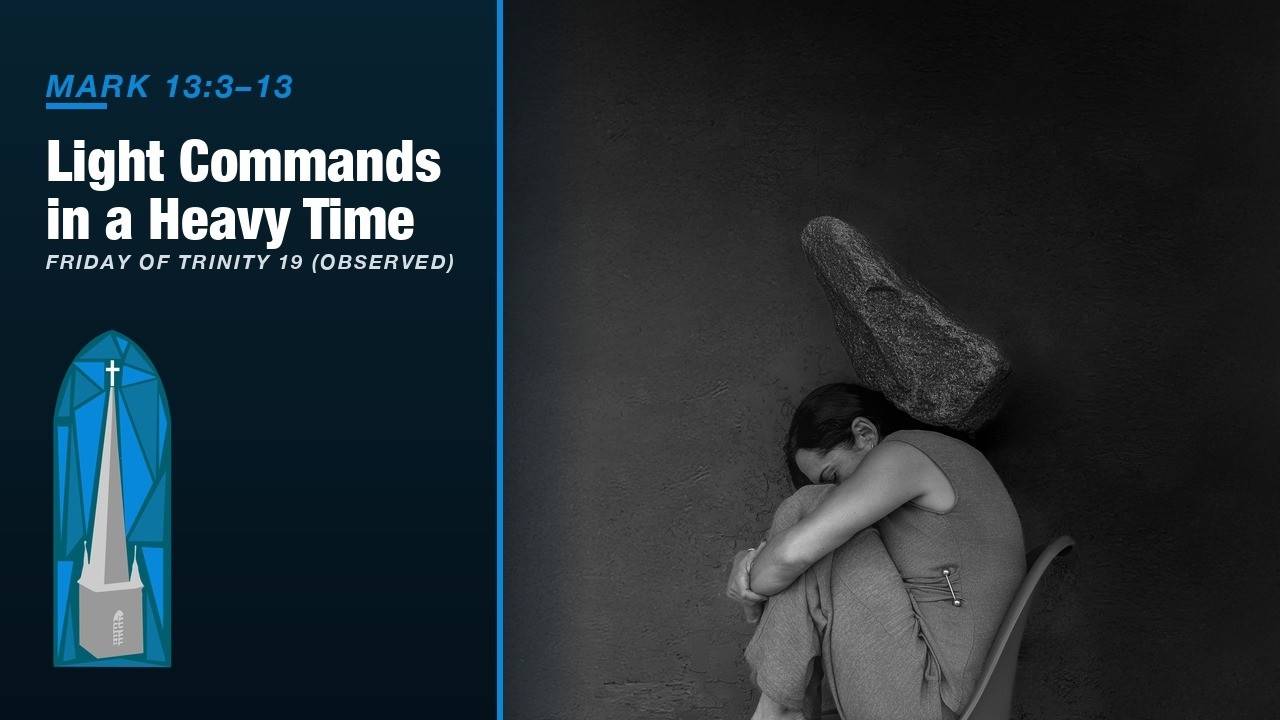
Then St. John says something tonight that sounds almost foolish next to Jesus’ words in Mark 13. John says, “His commandments are not burdensome” (1 Jn 5:3). The word there is “heavy.” His commands are not heavy. Really? But listen to what Jesus lays on His disciples. Councils. Beatings in the synagogue. Standing before governors and kings. Your brother handing you over to be killed. Your own children. “You will be hated by all for My name’s sake” (Mk 13:13). That doesn’t sound light at all, does it? If anything in the Gospel is heavy, that word from Jesus is.
So which is it? What the world does to you, of course, is heavy. What Jesus gives you to do, John says, is light, because every command He speaks here comes with Himself attached.
So take the first command. He says, “Take heed that no one deceives you. For many will come in My name, saying, ‘I am He,’ and will deceive many” (Mk 13:5–6). Take heed: the first command. Jesus warns about the lie before He warns about the sword. The first danger to a Christian is not that someone will kill you, but that someone will convince you.
And the lie comes, Jesus says, “in My name.” In other words, it’s not obvious. It’s not wearing horns. The lie sounds like Jesus. It promises what only He can promise. “I am He. I am the one who will fix it. Put your trust in me.” Sometimes it’s a man on TV, or now the internet, I suppose, with a chart of the last days and how all the signs are lining up. Sometimes it’s the voice that says this election, or this market correction, or this diagnosis, or this harvest, will finally decide whether you’re safe. And sometimes the one saying “I am He,” of course, is ourselves. The oldest liar is in there. From the garden we heard that lie: “You will be like God” (Gen 3:5). In other words, I don’t need Jesus. I can handle this. I’ve got it from here. Surely I could see the signs.
So you think deception is only for the gullible, for somebody else? But that’s actually how deception works, isn’t it? You always think it’s other people who will fall for it. And of course nobody who is deceived knows it until it’s revealed to him. And then the Lord’s word: repent.
So then Jesus says, “When you hear of wars and rumors of wars, do not be troubled” (Mk 13:7). Commandment two here. That’s a command too. Don’t be troubled. Now, how is that a light command, an easy burden? It sounds like telling a man whose barn is on fire to just relax. But hear the reason Jesus gives: “for such things must happen, but the end is not yet.” Must. Wars, earthquakes, famines are not loose in the world. They are inside that word from Jesus. They must happen. And He has told you about them ahead of time. Later in the same chapter He says again, “See, I have told you all things beforehand” (Mk 13:23). The One who tells you the storm is coming is the One who promises to see you through it, and to be with you through it.
And then we get another “take heed” command. This one comes a bit closer to home, I suppose. “Watch out for yourselves, for they will deliver you up to councils, and you will be beaten in the synagogues. You will be brought before rulers and kings for My sake” (Mk 13:9). The first warning was about lies. The second is about those who won’t believe them.
Most of us aren’t going to be called to stand before rulers and kings and give testimony. Of course, we’re going to recognize here in a week or so that in 1521 a monk named Martin Luther stood before the emperor at the Diet of Worms. But maybe you know the smaller kinds of rulers and kings, the little councils. The family dinner table, where nobody brings up church anymore. The coworker who thinks you’re a fool for keeping the Sabbath. The son or daughter who has decided that the faith you hold dear, the faith they heard and received from their parents, is just a crutch for weak people. “Brother will betray brother to death, and a father his child” (Mk 13:12).
Now there it’s heavy. It gets heavy because we want to answer. We want to be prepared, so that it doesn’t happen. We rehearse ahead of time what we’ll say when these things come. We lie awake building an argument that we hope will win them back to the faith. But Jesus warns us against that too. He says, “Do not worry beforehand, or premeditate what you will speak. But whatever is given you in that hour, speak that; for it is not you who speak, but the Holy Spirit” (Mk 13:11).
So again: don’t worry beforehand. Ah, it’s another command, isn’t it? Don’t worry. And it’s a light one. We’re to believe it, because, as Jesus says, you’ve already been given the words to speak. You learned them. What do you believe? “I believe in God, the Father Almighty.” “Our Father, who art in heaven.” Or something simple, like “Christ died for your sins.” Or even better yet, the Gospel word “I forgive you.” You don’t have to invent a whole fancy way of speaking, or some kind of incredible testimony. The Holy Spirit has already been putting the words in your mouth. He will remind you, and put them there again in that hour. You just say what you’ve been given.
But look again at the word “deliver.” Yes, you will be delivered up to councils. They will deliver you up. Brother will deliver up brother. Mark keeps using that word again and again, and he’ll keep using it all the way until we get to the cross. Judas, “one of the twelve,” went to the chief priests “to betray Him” (Mk 14:10). It’s actually the same word: to deliver Him up. The council “delivered Him to Pilate” (Mk 15:1). And Pilate, “after he had scourged Him,” delivered Him “to be crucified” (Mk 15:15).
Do you see it? Everything Jesus lays out here in chapter 13 as what will happen to His disciples, He Himself walks through in chapters 14 and 15. He is the one who is handed over by one of His own brothers. He’s the one who stood before the council, before kings and rulers. He’s the one who is beaten. He is the one who stands before Pilate. He’s the one hated by all. And when the high priest asks, “Are You the Christ, the Son of the Blessed?” He gives the true answer that all those deceivers only steal. He says, “I am” (Mk 14:61–62). And it is for that word, that divine name, that they finally condemn Him to death.
So Jesus isn’t showing you today how to be brave. He was already delivered up in your place. Every council you could be dragged before, He has already stood before, and the sentence, the judgment they rendered, was put on Him. That’s what makes His commands not heavy. He already carried the weight.
Then that really comforting word at the end: “He who endures to the end shall be saved” (Mk 13:13). Now that might seem to be the heaviest of them all. To endure, to the end, through thick and thin, famine, weakness, poverty, shame, everything. Who could promise to do that? You’ve probably all seen once-strong Christians grow cold. Maybe you know your own heart. You know that faith can be lost, and it is lost by the one who keeps sinning against his conscience and tells himself it doesn’t matter. Jesus said, “He who endures to the end shall be saved.” Well, if being saved hangs on your strength to hold on, maybe that’s actually the heaviest command in the Bible.
But again, who endured to the end? When they shouted, “Descend now from the cross, that we may see and believe” (Mk 15:32), who was the one that stayed there, crucified? Jesus, who endured to the end for you. And St. John tells you where that puts you. “Whoever believes that Jesus is the Christ is born of God” (1 Jn 5:1). Born. Nobody does his own being born. God did it for you, at the font, with His water and His Word, as we just sang.
“For whatever is born of God overcomes the world. And this is the victory that has overcome the world—our faith” (1 Jn 5:4). Has overcome. Already, past tense. The victory was won on Good Friday, sealed on Easter morning, and now is given to you in Holy Baptism. Your faith is the hand that holds it. And you confess who keeps that hand closed. We say it in the Catechism: “I cannot by my own reason or strength believe in Jesus Christ, my Lord, or come to Him.” Or you could say this: I cannot endure to the end and be saved, “but the Holy Spirit has called me by the Gospel, enlightened me with His gifts, sanctified and kept me in the true faith.” He keeps you the same way He called you: by His Word, at this altar. And He promises to keep you there until the end.
So now we can hear all those commands a bit differently, now that you know who has already carried them, and completed them. He says, “Take heed.” Well, He’s already told you everything beforehand. Do not be troubled. It must happen, and it’s in His hands. Don’t worry about what you’re going to say. The Spirit has already given you His words. Endure to the end. He’s already endured it for you, and He will keep you.
Here, then, are the words given you for this hour. Christ was delivered up for you. Christ endured to the end for you. Your sins are forgiven. You are born of God, and the victory He won is already yours. In the name of the Father, and of the Son, and of the Holy Spirit. Amen.
Rev. Christopher R. Gillespie
St. John Ev. Lutheran Church & School — Sherman Center
Random Lake, Wisconsin