"Destroy this temple, and in three days I will raise it up!" Good Friday Chief Service 2026
03. April 2026
Good Friday Chief Service
John 18-19
"Destroy this temple, and in three days I will raise it up." (John 2:19)
This is the Word of the Lord that came to me, so that you may believe that Jesus is the Christ, the Son of God, and that by believing, you may have life in His + Name. AMEN.
We prayed this afternoon for steadfast faith in the One who bore our sins upon the cross — that we fear not sin, death, or the devil. That prayer is the spine of this hour. Because what is happening here, on this cross, is construction. Not destruction. The building of the Church.
Hear what the Prophet announced this day: "Come, let us return to the LORD; for He has torn us, that He may heal us; He has struck us down, and He will bind us up." (Hosea 6:1) Torn. Struck down. Those are not the words of a church growth consultant. They are the words of a God who builds by wounding, who raises by killing, who gathers His people precisely through the ruin of the one Man who stood in their place.
"Destroy this temple, and in three days I will raise it up."
The Jews heard those words and reached for the obvious meaning. Herod's great restoration of Solomon’s temple — forty-six years in the making and still not finished — and this Galilean from nowhere claims He could rebuild it in seventy-two hours? They mocked. But the Evangelist tells us plainly: "He was speaking about the temple of His body." (John 2:21) The temple is Jesus. The house where God dwells among His people is this flesh, this body, now nailed to beams and raised between earth and sky.
You came here this afternoon with your own ideas about building. We all do. The sinful mind never stops building — strategies, programs, visions, five-year plans for growing the congregation. Pack the pews with better music, or more relevant preaching, or slicker media, or a warmer welcome culture, or a stronger felt community, or a sharper confessional identity. Some of those instincts are not entirely wrong. But when any of them become the foundation, when human ingenuity and effort and creativity become the cornerstone on which the Church is supposed to rise, you have exchanged the living God for an idol, however Lutheran-sounding that idol may be.
The song from Habakkuk sang this truth with trembling lips: "O LORD, I have heard Thy speech, and was afraid: I considered Thy works and trembled." There is no triumphalism here. There is no church growth manual spread open. There is only a man shaking before the God who moves in ways that look, to every human calculation, like catastrophe. "In wrath remember mercy." That is Habakkuk's entire theology of the Church pressed into four words. Wrath. Mercy. And in the cross is both at once.
Our Lutheran Confession, the Augsburg Confession, when it confesses the Church, does not begin with ecclesiology (the Church). It begins with God. One true God. Then it confesses original sin — that we are born turned inward upon ourselves, dead toward God, bent away from Him by nature, deserving condemnation. Article after article builds. The Son of God, true God and true man. Justification by grace through faith in Christ alone. The Office of the Ministry, by which the Gospel is preached and the Sacraments administered. The Church — and here is the definition that does not waver: the assembly of saints in which the Gospel is rightly taught and the Sacraments rightly administered. Brick by brick, article by article, the Confession builds its argument, and every brick is laid on the same foundation: what God has done in Christ alone, given out by Word and Sacrament alone, received by faith alone.
Thus, we confess that the Church does not build herself. She is built passively. You do not produce your own faith, or your neighbor's, or the congregation's. "I believe that I cannot by my own reason or strength believe in Jesus Christ, my Lord, or come to Him." That is the Third Article of the Small Catechism — your catechism, the one Luther wrote for households, for ordinary Christians, for you. The Holy Spirit calls by the Gospel, enlightens with His gifts, sanctifies and keeps the whole Christian church on earth in the one true faith. He gathers. He enlightens. He sanctifies. He keeps. Every verb belongs to God.
This is why what happens on this cross is not defeat. It is the cornerstone being laid.
"The stone that the builders rejected has become the cornerstone." (Psalm 118:22) The Psalmist sang it long before the nails went in. The builders — every system of human religion, every scheme for making yourself right with God, every program for moral improvement and social uplift dressed up in vestments and liturgy — they looked at this Man dying and saw failure. Saw a movement ended. Saw the temple destroyed.
They were right about the destruction. The body of Jesus was torn. His flesh was burst open. The temple fell, and no one who stood at Calvary had sufficient faith in that moment to believe it could be raised. Even the disciples scattered. The Tract cried for the right person: "Deliver me, O LORD, from the evil man: preserve me from the violent man." Those are the words of Christ praying Psalm 140 from the cross, words that belong to Him before they belong to anyone else.
But the cornerstone is not laid despite the cross. It is laid by the cross. "O Love, how strong You are to save! You lay the One into the grave who built the earth's foundation," our hymn confesses. The One who built creation is buried in creation, and that burial is the foundation of the new creation, the new temple, the Church.
And you are in it. "You yourselves like living stones are being built up as a spiritual house." (1 Peter 2:5) You did not choose your place in this building. You were placed. In Holy Baptism, a stone was cut from the quarry of Adam's race, shaped by the chisel of the Word, and set into the building that Christ raises. You bear His name. You are marked with His cross. The Church is not a voluntary association of like-minded religious seekers who found the right denomination. She is a building under construction by the Holy Spirit, mortared together by the blood of the Lamb, set on the cornerstone of the crucified and risen Christ.
The Lord's word through Hosea stings precisely because it is true of us: "Your love is like a morning cloud, like the dew that goes early away." (Hosea 6:4) You know it is. Your faithfulness evaporates. Your resolve to pray, to attend, to confess, to love your neighbor — it goes like mist. You have stood here before, in Lent, in Good Friday services past, and vowed privately that things would be different. Then they were not. You are not a stone that holds its own shape by willpower.
But Jesus holds it for you. That is what is happening on this cross. He bears the torn flesh so that yours might be healed. He is struck down so that you might be bound up. "After two days He will revive us; on the third day He will raise us up." (Hosea 6:2) This is not vague religious optimism. This is a promise anchored to a specific body, in a specific tomb, on a specific morning three days from now.
The Church that gathers in this place is not your achievement or mine. That’s the old deception of the serpent and his Pharisees. The Church is Christ’s. She is His. She stands not because her members are faithful enough, or her programs strong enough, or her confession loud enough. She stands because He who said "Destroy this temple, and in three days I will raise it up" (John 2:19) kept His word. The temple of His body was destroyed. On the third day, the Father raised it. And in raising it, He raised you with Him.
You are here this afternoon because the Holy Spirit has not finished building. He still calls by the Gospel. He still places stones. The cornerstone holds. The building rises. The Church endures — not by your effort, not by any human strategy, not by the wisdom of her architects — but by the blood of the Lamb laid into the earth's foundation, and raised again on the third day.
"Destroy this temple, and in three days I will raise it up."
He did. He is. He will.
This is the Word of the Lord that came to me, so that you may believe that Jesus is the Christ, the Son of God, and that by believing, you may have life in His + Name. AMEN.
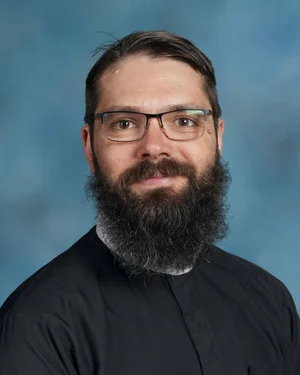
Rev. Christopher R. Gillespie
St. John Ev. Lutheran Church & School - Sherman Center
Random Lake, Wisconsin