"God comes all the way down, down to the floor, down to the cross" Holy Thursday 2026
02. April 2026
Maundy Thursday
John 13:1–15 | Exodus 24:3–11 | 1 Corinthians 11:20–32
In the Name of the Father and of the Son and of the Holy Spirit. Amen.
God is Most High. Nothing is above Him, no one more exalted, so His eyes have no need to look up. They look down. Down to earth. Down to you.
And what does He see when He looks down? He sees creatures who spend their whole lives looking up. Up toward honor. Up toward the good opinion of their neighbors. Up toward whatever might make life feel like it amounts to something, whatever might get us above where we actually are. "Everyone strives after that which is above him" — this is simply what we do. We strain upward because what is below us, what is actually in us, is too painful to face. The poverty of our hearts. The weight of things done and left undone. The self we actually are when no one is watching. "Dust you are, and to dust you shall return" (Gen. 3:19). That is the truth, and it is unbearable, so we look away. We look up.
God looks down and sees all of it.
On the night He was betrayed, Jesus rose from supper, laid aside His garments, took a towel and a basin, and got on His knees. The God who created the universe, whose feet rest on sapphire as on the clarity of heaven, bent down to the floor of a Jerusalem dining room and began to wash the dirt from His disciples' feet. The Most High came down as the Most Low. He took the position of a slave, the lowest position in that room, the lowest anyone in that culture could occupy — and He did it knowing exactly what was coming. He knew who would betray Him. He knew who would curse and swear in a courtyard within hours that he had never met the man. He washed their feet anyway. The God who only looks down kept looking down, all the way to the floor, all the way to the filth between a fisherman's toes.
Peter pulled back. "Lord, are You washing my feet?" (John 13:6). The question is outrage barely held together with grammar. You — You, the Lord and Teacher — washing my feet? This is not how the order of things ought to work. There should be more dignity than this. More distance. Peter is doing what we do: he is looking up, trying to preserve the proper hierarchy, trying to keep God where God belongs — above, exalted, not down here in the muck. He does not want God to come this low. He does not want to be found this far down.
"If I do not wash you, you have no part with Me" (John 13:8).
That is the Law in one sentence. You cannot wash yourself. You cannot scrub your own conscience clean, no matter how hard you look upward for a better version of yourself, no matter what resolution you reach for. If He does not come down to where you are and do the washing, you have no part with Him. That is your condition. Look down at it. See it clearly.
But here is where the looking down and the looking up trade places.
The elders of Israel looked up. They went up Sinai with Moses — Aaron, Nadab, Abihu, and seventy of the elders — and there on the mountain they saw God. Under His feet was something like a pavement of sapphire, like the very heavens in its clarity. They looked up and they saw the Most High. And He did not raise His hand against them. The blood of the covenant, which Moses had just sprinkled on the altar and on the people — "This is the blood of the covenant which the LORD has made with you" (Exod. 24:8) — covered them. So they saw God, and they ate and they drank.
That blood was a shadow. It pointed forward and downward. God was going to come down much further than Sinai. He was going to come all the way down to a basin on a floor. All the way down to a cross. All the way down to a tomb. The blood of bulls sprinkled on the people by Moses was the shadow; the body and blood of the Son of God given at this altar is the substance.
"This cup is the new covenant in My blood" (1 Cor. 11:25). Paul received this from the Lord and delivered it. Not as history, not as memorial, but as gift. This is delivery, not description. The forgiveness of sins was won at Calvary — but you cannot receive it by staring at the cross from a distance, reaching upward toward a vague idea of redemption. At Calvary forgiveness was won. Here, at this altar, it is given out. The words are the same words spoken in that upper room: given and shed for you, for the forgiveness of sins. The Most High is still looking down. He is looking down at you, here, now, and He is giving.
That is why Paul's warning cuts where it cuts. "He who eats and drinks in an unworthy manner eats and drinks judgment to himself, not discerning the Lord's body" (1 Cor. 11:29). The Corinthians had turned the Supper into something they reached for rather than received — a meal for those already satisfied, where the hungry went without and the body of Christ was treated as common food. They were looking up in the wrong direction, looking at their own appetites, their own social standing, their own spiritual condition. They had stopped looking down at what they actually were before God. When you stop looking down at your own poverty, you stop needing the gift. And when you do not need the gift, you eat and drink judgment. Examine yourself — not to manufacture a clean conscience by rummaging through your sins, but to come knowing that you are needy, that without His washing you have no part with Him, that the gift is everything.
And you are needy. Some of you came here tonight carrying things you have not spoken aloud. Some of you have been away from this Table longer than is good for you. The distance grew, slowly, the way distance always grows — a reason here, a hesitation there, a slow retreat from the place where God looks down and gives. You pulled back your feet like Peter. You decided the lowness of it was not quite right, that God ought to be reached for up here rather than received down there. But "if I do not wash you, you have no part with Me."
He has been looking down the whole time you were looking away.
He washed the disciples' feet and then told them: "He who is bathed needs only to wash his feet, but is completely clean" (John 13:10). You have been bathed. Once, completely, in the water of Holy Baptism — His name on you, His death and resurrection given to you, His blood in the water. That bath does not need to be repeated. But feet get dirty walking through this world. The baptized sin. The baptized wander and turn and drift back toward the far country of the self. So He kneels again. He washes again. The absolution spoken in this place is His hands on your feet. And the body and blood placed in your mouth at this altar is the restoration of the erring and wayward to the feast — the feast of the new covenant, the meal on the mountain where God lets the covered and the cleansed look up and see Him, and eat, and drink.
What you receive here is not a symbol and not a metaphor and not a spiritual impression. Natural food is taken into the body and transformed into the body. This food is different. "My flesh is true food, and my blood is true drink. Whoever feeds on my flesh and drinks my blood abides in me, and I in him" (John 6:55–56). You do not transform this into yourself. This transforms you. The body and blood of the Son of God taken into the dust of your flesh raise the dust. The Most Low poured into the lowest gives the highest thing there is: forgiveness, life, and salvation — the very life of the Most High, lodged in you.
God is Most High. His eyes look down. He sees what you are — the poverty, the squalor, the weight of it all. He sees it, and He does not look away. He comes down. He comes all the way down, down to the floor, down to the cross, down to this altar. The Most High becomes the Most Low so that the lowly might be raised to the Most High.
Come and eat. Come and drink. Come to the lowly God who has joined you in your lowliness — to lift you up, in Himself, to the place He came down from.
In the Name of the Father and of the Son and of the Holy Spirit. Amen.
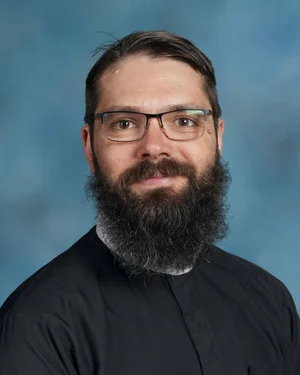
Rev. Christopher R. Gillespie
St. John Ev. Lutheran Church & School - Sherman Center
Random Lake, Wisconsin