"Mercy is asked. Mercy is given. Sight is restored!" Quinquagesima 2026
15. February 2026
Quinquagesima
Luke 18:31–43
This is the Word of the Lord that came to me, so that you may believe that Jesus is the Christ, the Son of God, and that by believing, you may have life in His + Name. AMEN.
Our Lord says, “Behold, we are going up to Jerusalem, and all things that are written by the prophets concerning the Son of Man will be accomplished” (Luke 18:31). He ascends toward the cross with purpose. Every word of the prophets converges here. He does not drift toward the cross. He ascends to it. Deliberately. Knowingly. Willingly.
“He will be delivered to the Gentiles and will be mocked and insulted and spit upon. They will scourge Him and kill Him. And the third day He will rise again” (Luke 18:32–33).
This is the center of the Church’s life: the Son of Man handed over, suffering, dying, and rising.
Yet the Twelve hear it and do not grasp it. “They understood none of these things” (Luke 18:34). The cross is spoken plainly, and still it remains veiled to them. Eyes open, but hearts slow.
Then comes the blind man at Jericho. He cannot see, but he hears that Jesus is passing by. He cries out, “Jesus, Son of David, have mercy on me!” (Luke 18:38).
The crowd rebukes him. He cries out all the more. He knows what the disciples do not: this is the promised King. This is the One who bears mercy in His flesh. “Lord, that I may receive my sight” (Luke 18:41).
And Jesus answers, “Receive your sight; your faith has made you well” (Luke 18:42). Mercy is asked. Mercy is given. Sight is restored. And the man follows Him, glorifying God. This is the pattern of the Christian life.
The same Son of David who goes up to Jerusalem now comes among His people and says, “This is My body which is given for you” and “This cup is the new covenant in My blood, which is shed for you” (Luke 22:19–20). The body given into death is given into your mouth. The blood poured out on the cross is placed on your lips.
And this is where renewal actually happens. Not by strategy. Not by mood. Not by a vague call to “be more loving.” It flows from the altar… from frequent, reverent, joyful reception of Christ’s body and blood. Why? Because the altar is where mercy is not discussed but distributed.
The blind man did not analyze mercy; he received it. He cried for it and received it. So also here. At the altar, mercy is distributed in the most concrete way possible. At the altar, sinners who confess, “Have mercy on me,” are given Christ. Sins are forgiven. Faith is strengthened. Eyes are opened again and again. And this changes you.
St. Paul’s words in 1 Corinthians 13 stand in the middle of this. “Love suffers long and is kind… does not seek its own… thinks no evil” (1 Corinthians 13:4–5). These words first describe Christ. He bears with His disciples. He endures their slowness (blindness). He carries their sins. He keeps no record of wrongs because He has borne them to the cross.
But now hear this clearly: that love is not a floating abstraction. This love is given to you in the Supper. Paul writes, “The cup of blessing which we bless, is it not the communion of the blood of Christ? The bread which we break, is it not the communion of the body of Christ?” (1 Corinthians 10:16). Communion means participation. Sharing. A common life in the same Lord.
You cannot kneel beside your brother and receive the same Lord and then nurse quiet hatred. You cannot receive the body given for you and then withhold forgiveness as though you were not forgiven.
A congregation that kneels together at the altar is bound together in the body of Christ. Each receives the same mercy. Each is fed by the same sacrifice. From that shared gift flows patience, kindness, and endurance. Love grows where Christ is given. You have been forgiven. Therefore, you forgive. You have been fed. Therefore, you feed others with patience and kindness.
Renewal begins here: at the place where Christ gives Himself. We catechize again on what and who the Supper is. It is not a symbol of our devotion. It is not our act of remembrance in isolation from His giving. It is the Lord Himself. “The Lord’s words are plain: “This is My body… This is My blood.” He gives His crucified and risen body and blood for the forgiveness of sins. This is His promise. This is His gift.
When this gift is understood, the desire for it deepens. The Supper strengthens faith. It comforts troubled consciences. It steadies the weary. It gathers the scattered into one body. Frequent communion becomes a natural expression of hunger for Christ’s mercy.
We would never say, “I will hear the Gospel only once in a while.” Yet the Supper is the Gospel in its most concentrated form: body given, blood shed, for you. Encouraging frequent reception is pastoral care. The Christian life is lived under pressure—temptation, conflict, fatigue, distraction. The Lord feeds His people for this life. He places into their mouths the very sacrifice that reconciles them to the Father.
And from that gift, love takes on flesh in daily life. St. Paul says, “If I have all faith, so that I could remove mountains, but have not love, I am nothing” (1 Corinthians 13:2). Love here is not a vague feeling. It is shaped by the cross and sustained by the Supper. Those who receive forgiveness learn to forgive. Those who are borne with learn to bear with one another. Those who are fed learn to serve.
You are not strong enough to live on last month’s forgiveness. You are not immune to pride, envy, resentment, and division. “If I have not love, I am nothing” (1 Corinthians 13:2). And love does not grow in a vacuum. It grows where Christ is given.
When a congregation drifts from the altar, love becomes thin. People begin to measure one another. To compete. To withdraw. But when they gather often, reverently, joyfully to receive Christ, something happens. Not emotionally dramatic. The altar forms a congregation over time. Quietly. Steadily. It teaches humility, because every communicant comes as a beggar. It teaches gratitude, because every communicant receives what he could never earn. It teaches unity, because all share in one Lord.
Quinquagesima places us on the road to Jerusalem. The Lord goes ahead of us toward suffering and glory. The blind man receives sight and follows Him. So also we. Having received Christ at the altar, we follow Him in faith and love.
Soon Lent will begin. The Scriptures will draw us into Gethsemane and Golgotha. As we walk that road, the altar remains the place where the cross is delivered to us in the present tense. The body once given is still given. The blood once shed is shed for you.
So we pray as the blind man prayed: “Lord, that I may receive my sight.” And Christ answers by giving Himself. From that gift flows renewal. Hearts softened. Consciences comforted. A congregation shaped by mercy. Faith, hope, and love abiding together.
“And now abide faith, hope, love, these three; but the greatest of these is love” (1 Corinthians 13:13). That love has a name. It has a body. It has blood. It is Christ for you.
Receive Him. Return often. Rejoice in His mercy. And as you are fed, so live—following Him together toward the cross and into life.
This is the Word of the Lord that came to me, so that you may believe that Jesus is the Christ, the Son of God, and that by believing, you may have life in His + Name. AMEN.
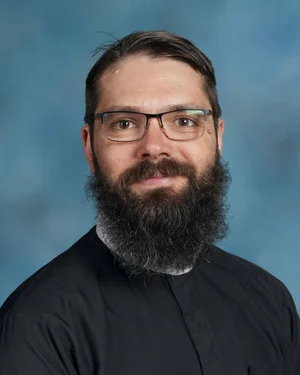
Rev. Christopher R. Gillespie
St. John Ev. Lutheran Church & School - Sherman Center
Random Lake, Wisconsin