"Your father Abraham rejoiced to see My day, and he saw it and was glad" Judica 2026
22. March 2026
Judica
John 8:46-59
This is the Word of the Lord that came to me, so that you may believe that Jesus is the Christ, the Son of God, and that by believing, you may have life in His + Name. AMEN.
"Which of you convicts Me of sin?" (John 8:46). That is no small question. It is not the sort of question a man asks. A man who knows himself, who has looked honestly at his own heart even once, does not stand in the middle of the temple and dare anyone to find fault with him. You would not do it. Neither would I. We would be found out in five minutes. Less, if our wives were present.
But Jesus asks. And nobody answers. They have accusations. They have insults. They call Him a Samaritan, a man with a demon. What they do not have is a sin to name. Not one. They cannot convict Him because there is nothing to convict. He is without spot. Without blemish. The Lamb that the whole sacrificial system has been waiting for since God first shed blood to cover Adam's nakedness in the garden.
This is where the whole Old Testament has been driving. For centuries, the blood of bulls and goats was poured out. Morning and evening, the smoke of the burnt offering rose from the altar. Once a year, on the Day of Atonement, the high priest passed through the veil into the Most Holy Place, carrying the blood of the sacrifice for himself and for the people. All that blood. All those animals. All that smoke. And none of it could take away a single sin. The sacrifices covered. They pointed forward. They were a constant reminder that something else was needed, someone else was coming. The blood of animals could purify the flesh, could make a man ritually clean. But it could not touch the conscience. It could not reach the place where sin lives.
And now the One to whom it all pointed stands in the temple, and they cannot name His sin.
"If I tell the truth, why do you not believe Me? He who is of God hears God's words; therefore you do not hear, because you are not of God" (John 8:46b–47). There is the accusation turned back. They came to judge Him. He judges them. Not with fury but with truth. And truth is worse. You can argue with fury. You cannot argue with truth. You can only receive it or refuse it.
They refuse it. Of course they do. That is what sin does. Sin does not hear the Word of God and weigh it carefully. Sin stops its ears. Sin rages. Sin calls the truth a lie and the holy One a demon. And look at what happens next. Jesus tells them that whoever keeps His Word will never see death. And they are outraged. Abraham is dead! The prophets are dead! "Who do You make Yourself out to be?" (John 8:53).
That question is the Passiontide question. It is the question of the whole Gospel of John. Who is this man? What right does He have to speak this way? And Jesus gives them an answer that will either save you or destroy you. There is no middle ground with this answer.
"Your father Abraham rejoiced to see My day, and he saw it and was glad" (John 8:56). Abraham saw it. Not dimly, not as a vague hope. He saw Christ's day. When? On Mount Moriah, when the old man bound his only son, his beloved Isaac, on the wood of the altar. When the knife was raised and the angel stayed his hand. When the ram appeared, caught in the thicket by its horns, and Abraham offered it up in place of his son. Abraham saw it and was glad because in that moment on the mountain, in that substitution, he saw the shape of what God would do. The beloved Son would carry the wood up the hill. The beloved Son would be laid upon the altar. But there would be no angel to stay the hand. The knife would fall. The Son of God would die in the place of sinners. The ram caught in the thorns would wear them as a crown.
Abraham saw that day. He rejoiced. And the One who arranged the whole thing, who gave the ram, who made the promise, who would Himself be the sacrifice, stands in the temple and says so. And they are furious. "You are not yet fifty years old, and have You seen Abraham?" (John 8:57).
And then comes the word that fills the temple and shakes the foundations: "Before Abraham was, I AM" (John 8:58).
Not "I was." I AM. The Name. The very Name that God spoke to Moses from the burning bush. "I AM WHO I AM" (Exodus 3:14). The Name that Israel would not even say aloud. The Name that the high priest whispered once a year in the Holy of Holies. Jesus claims it for Himself because it is His. He does not grab at divinity. He has it. He has always had it. Before Abraham, before Moses, before the world was made, He is. He is the eternal Son of the Father, the Word through whom all things were made, and He is standing in the temple, in the flesh, asking them to listen.
So, they pick up stones.
That is what happens when God shows up in the flesh, and you want a different God. They wanted a God they could manage. A God who fit their categories, who confirmed their righteousness, who stayed safely behind the veil. They did not want this. They did not want God standing right in front of them, calling them liars, telling them they did not know the Father they claimed to worship. They wanted religion. They got the living God, and it terrified them.
We should not be too quick to shake our heads at them. We do the same thing. We want a God we can handle. A God who approves of us. A God who makes suggestions rather than commands, who overlooks rather than judges, who lets us keep a corner of our lives unexamined.
And when the Word of God comes close, when it names what we have tried to keep hidden, our first instinct is the same as theirs. Stones. Maybe not literal ones. We stop listening. We stop coming. We find a church that tells us what we want to hear. We take up stones against the truth every time we shut our ears to God's Word and decide that we know better.
But Jesus hid Himself and went out of the temple.
He goes out. Not because He is afraid of their stones. Because His hour has not yet come. The stones will not kill Him. Not today. He has a death to die, and it will not be by stoning. It will be on a cross. He goes out of the temple because He is headed to Calvary, and no mob of religious men with rocks in their hands will interrupt what the Father has appointed.
He goes out of the temple to become the sacrifice. The One whom no one could convict of sin is about to be made sin. He who is the I AM, the eternal God, will be handed over to mortal men. He will be scourged. He will be nailed to the wood. The beloved Son who carried no guilt will carry yours and mine. Every sin you have committed, every sin you have tried to hide, every sin you cannot stop committing, He carries to the cross. He is the guilt offering that Isaiah saw, the One who pours out His life in death and is counted among the transgressors even though He alone is righteous.
And His blood does what the blood of bulls and goats could never do. It does not merely cover. It cleanses. It reaches the conscience. It purifies from dead works. It makes you clean, not in a ritual sense that wears off, but before God, forever. This sacrifice is offered once for all. It is not repeated because it does not need to be repeated. It is finished. He said so.
And that is the difference between every other religion and the Gospel. Every other religion tells you to keep trying. Keep sacrificing. Keep working. Keep climbing. The Gospel says it is done. The blood has been shed. The high priest has entered the true Holy of Holies, not made with hands, and He has entered it with His own blood, not the blood of animals. And having done so, He has obtained an eternal redemption. Eternal. Not temporary. Not provisional. Not conditional on your performance. Eternal.
This is what it means that He is the Mediator of a new covenant. Not like the old one, which required blood again and again and again. This covenant is sealed with His death, and by means of that death, the transgressions committed under the old covenant are redeemed. The whole weight of sin, all the centuries of it, the whole groaning creation, all of it laid on one man's shoulders. And He bears it. He bears it to death. And He bears it away.
So Caiaphas was right, even though he did not know what he was saying. It was better that one man should die for the people than that the whole nation perish. One man. This man. The I AM in human flesh. The sinless One made sin. The living God who dies. And by His dying, He gathers together in one the children of God scattered abroad. You among them. Brought near by His blood. Reconciled. Covered. Forgiven.
You who were far off, are now brought near. That distance between you and God, the distance your sin created, the distance you could never cross by any effort or offering of your own, He crossed it. He crossed it in His flesh, on the cross. And He delivers the fruit of that crossing to you here, now, at this altar, where He gives you His body broken for you and His blood shed for you.
The I AM is here for you. In your Baptism. In the bread. In the wine. In the Word spoken into your ears. He does not hide Himself from you. He comes to you, as close as a word, as close as wine on your lips and bread on your tongue. Let Him come. He is your redemption.
This is the Word of the Lord that came to me, so that you may believe that Jesus is the Christ, the Son of God, and that by believing, you may have life in His + Name. AMEN.
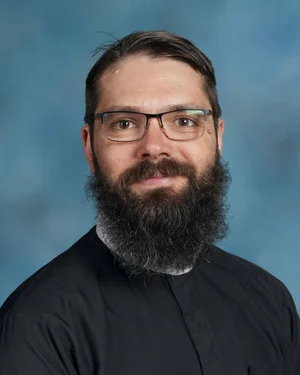
Rev. Christopher R. Gillespie
St. John Ev. Lutheran Church & School - Sherman Center
Random Lake, Wisconsin