

16 August 2026 • Trinity 11 • Luke 18:9–14 · 1 Corinthians 15:1–10
In the holy Name + of Jesus. AMEN.
When the cathedral of Notre Dame in Paris reopened in December of 2024, five years after the fire on its roof, the crowds returned to church — thirty thousand people a day, most of them with cameras. And while they shuffle around the outer aisles — if you have ever been there — at the high altar, a priest is saying Mass. It is almost as if there were invisible ropes separating the ones who came to look from the ones who came to receive. Two kinds of people stand in the same building at the same hour. For one of them, something is happening there. For the other, it is a spectacle.
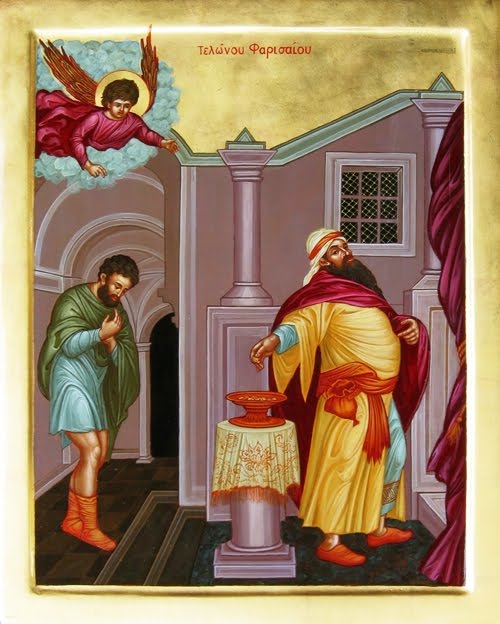
Our Lord tells of two men in one building. “Two men went up into the temple to pray, one a Pharisee and the other a tax collector” (Luke 18:10). If you know anything about the temple, it was not a quiet room like ours with lined-up pews. It was a hustling, bustling place, people moving forward and backward, side to side — and, most importantly, a place God had appointed for the shedding of blood. Every morning and every evening, a lamb was offered on the altar there — every day, without interruption, for centuries (Exodus 29:38-39). The hours of prayer were the hours of the sacrifice (Luke 1:10). These two men came at the hour of the lamb. As each prayed, blood was being shed for the people’s sins a few steps away, right there in plain sight.
Now the Pharisee deserves more credit than we give him. You may have come to think of the Pharisees as frauds, but they are not. When he says he fasts twice a week, he is telling the truth. The Law of Moses required only one fast a year. When he says he tithes on everything, he is telling the truth — and scarcely one of us here in Wisconsin could say the same, ten percent plus gifts, or anything near that degree. He was actually the sort of man every congregation wants more of. Always present, always giving. So if we condemn him too quickly, we won’t notice that he is standing in our place.
But listen to his prayer. “God, I thank You that I am not like other men, extortioners, unjust, adulterers, or even like this tax collector. I fast twice a week; I give tithes of all that I get” (Luke 18:11-12). That was his prayer. You notice what is missing? There is no petition in it. He asks for nothing because, in his mind, he lacks nothing; he confesses nothing because nothing accuses him. And notice what is missing from a prayer offered at the hour of the sacrifice, standing in the midst of the smoke of the burning lamb: the lamb. He does not mention it. He does not need it. His religion is complete without the blood. He conducts himself as though nothing is happening there. The temple is the backdrop for a portrait of himself; God is his audience. He stands at the appointed place of atonement and has no use for atonement.
It is probably no secret to you that that sort of religion is alive in Sheboygan County. Our neighbors who will spend this morning at the lake or tomorrow in the barn believe in God — nearly all of them. Just look at the polls and the demographics. Ask what God is like, and they will tell you: “God is love.” They are right, as far as the sentence goes. But press on it, and you find a love that costs nothing, asks nothing, sheds no blood, and needs no church. “God is love,” for them, means God is satisfied with us on the whole. He grades on the curve. But He is not the Father of our Lord and Savior Jesus Christ. It is basically the same god as the Pharisee’s — thank God I am not like other people — just without the fasting and the tithing.
And of course, before we congratulate ourselves for being here instead, the same religion can sit in the pew and even climb into the pulpit. Whenever we come to this building because coming is what respectable people do; whenever we run the numbers on our attendance, our offerings, our years, the way a man checks his balance — we have prayed the Pharisee’s prayer without even moving our lips. Thank God, I’m not like other people. Even a pastor can preach the sermon, administer the Word and Sacrament, and then inwardly thank God that he is not like other men. The Pharisee is not only in Jerusalem.
So now let us consider the other man, who stands afar off, at the back of the church, at the distance a man keeps when he knows what he is. He cannot even lift his eyes. He beats his breast, the way men of that country grieved their dead — except the death he grieves is his own. And he says one sentence. Our English Bible says it this way: “God, be merciful to me, a sinner” (Luke 18:13). It is a good prayer. It is a petition. But the translation is even a bit too weak, because the word he uses is not the ordinary word for mercy. It is the mercy-seat word — the atonement cover on the ark.
Inside that ark, there in the temple, lay the two tablets of the Law, the very words this man confesses he has broken. Over those tablets, a lid of pure gold; on the gold, the sprinkled blood of the sacrifice; and above it, the presence of God, who said, “There I will meet with you” (Exodus 25:22) — the mercy seat. The Law lies in the box, accusing. The blood lies over the Law, answering. God does not meet His people in the box. He meets them upon the cover, above the blood. And that is what this man asks. He prays: “God, let the blood be over me. Let the sacrifice burning on this altar at this hour count for me — for me, the sinner, as though there were no other.” So the theologian at the front of the temple has missed the whole point of the building, and the altar, and the sacrifices. And the traitor at the back has heard it, understood it, and believes it is for him.
And notice what he does not bring. No restitution — we will hear more about restitution later, with Zacchaeus, in the next chapter. It will come in its time, for no one who receives this mercy of Christ stays as he was. But not here. Here there are no promises made by the man, no plan for self-improvement. He does not even lay before God his humility as a payment — as if humility were the coin; then it would be just the same religion as the Pharisee’s, only written backward, humility instead of pride. No. He brings his sin, and he points at the blood.
And there is Jesus — on His way to Jerusalem, just a few chapters from His own death — pronouncing the verdict: “I tell you, this man went down to his house justified, rather than the other” (Luke 18:14). As you have heard before, justified is a courtroom word: not a description of improvement, but a sentence handed down from the bench. Nothing has changed yet inside this tax collector — his ledgers are still crooked, his trade still waiting in the morning. What changed was the verdict of God upon him, passed outside of him, for the sake of the sacrifice he claimed. And the verdict went home with him — down from the temple mount, down into his home, into his kitchen, into his bedroom, a justified man. God’s acquittal does not stay there in church. It follows the man home.
So where in this parable is the cross of Christ? Did we hear anyone dying in it? And yet the whole of it stands in the smoke of the temple and its sacrifices — the lamb of that morning, and the lambs of every morning, centuries of them, all of them not quite sufficient, every one of them pointing forward. The Epistle today said where these sacrifices were pointing: “Christ died for our sins in accordance with the Scriptures” (1 Corinthians 15:3) — namely, the sacrificial death of the Lamb. Saint Paul reaches for this very picture: God put forward Christ Jesus “as a propitiation by His blood” (Romans 3:25). And there is that same word the tax collector used for mercy, now used by Paul himself: a propitiation, a mercy seat, blood.
So where is the mercy seat for you? It is not a golden lid in a room no one may enter, halfway around the world. Today, the mercy seat is a Man. Jesus. The Law that accuses you lies beneath His blood, and God meets you there, in Jesus — nowhere else, for there He has nothing for you but mercy. When Jesus died, that temple curtain was torn in two from top to bottom (Matthew 27:51). Within a generation, the daily lambs ceased to be offered. But the Lamb of God did not cease. What He offered once, He now distributes.
And He distributes it to you, here. The mercy-seat mercy is here for you. The absolution you heard this morning — I forgive you all your sins — is not my opinion of you. It is the verdict, the justifying word of Luke 18:14, spoken in the stead and by the command of Christ, over you. And at this altar, the body and blood that answered for the sin of the whole world are placed into your mouth. The tax collector stood at a distance and begged that the sacrifice might count for him. Your Lord invites you forward to kneel at this rail, and there the Sacrifice Himself is placed upon your tongue. This is His answer to the prayer: not a feeling, but His own self, given and shed for you. He takes the sentence; you get the verdict — His verdict.
Which does make this place different from the temple. There is no rope, invisible or otherwise, in this church. No cordon between the lookers and the communicants, because the curtain that kept sinners at a distance was torn down twenty centuries ago, and God has never sewn it together again or hung it back up. Which means something fantastic is happening here — the thing that tax collector longed to see. And it is for you, a sinner too. Come like that man in the parable — bringing nothing, pointing at the blood — and you too go down to your home justified. And when the last morning comes, and you go down from this world to your own long home, that verdict will still be over you, and the angels will not say, this one went down. They will say: this one went up, to the house of God, justified.
Thanks be to Jesus, in His holy + Name. AMEN.
Rev. Christopher R. Gillespie
St. John Ev. Lutheran Church & School — Sherman Center
Random Lake, Wisconsin