
9 August 2026 • Trinity 10 • Luke 19:41–48
In the holy name of Jesus. Amen.
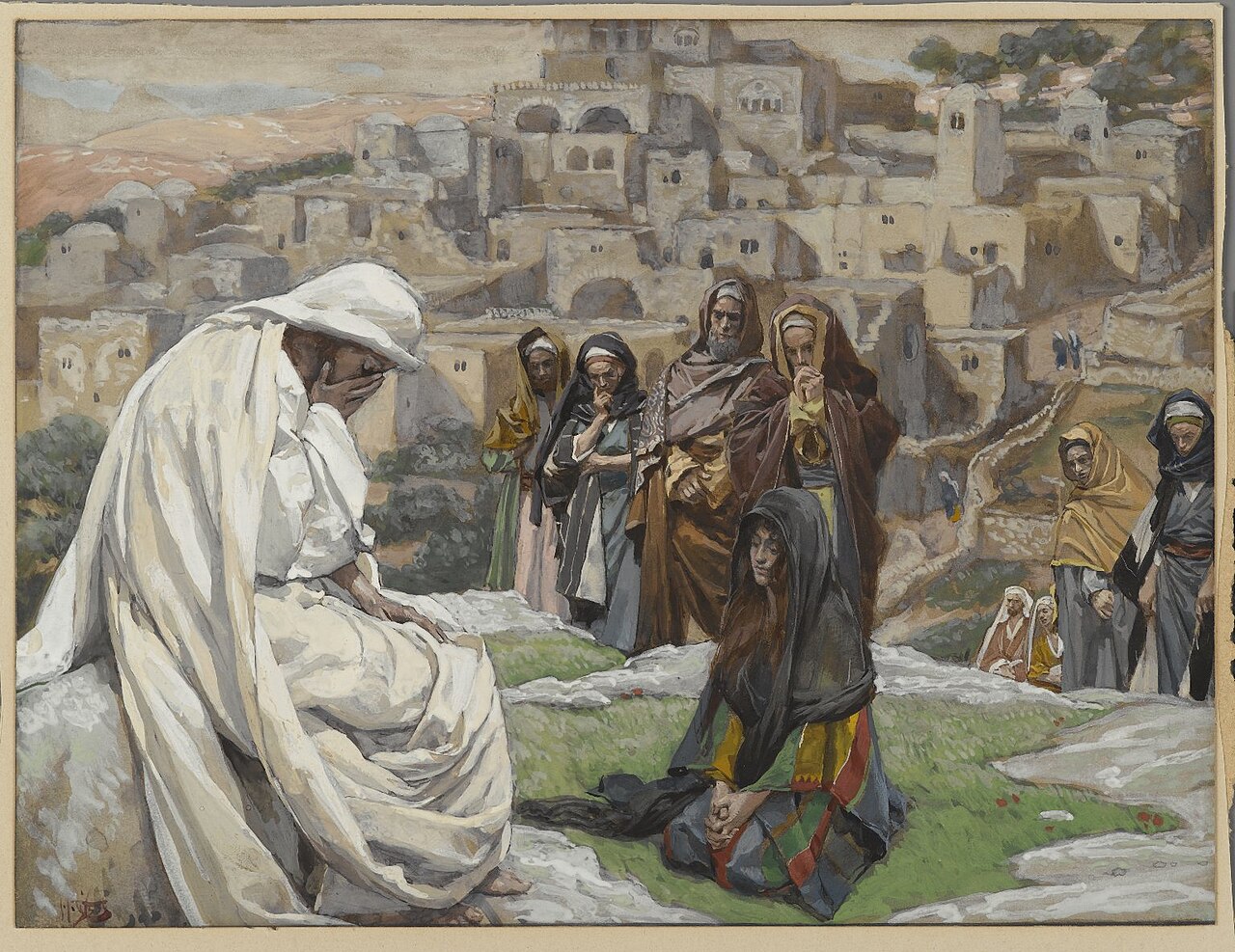
In the Gospels, Jesus cries twice. Once at the tomb. And once today, outside the church.
The grave story we all know. Bethany, His friend Lazarus four days dead, coming to the tomb, and famously, “Jesus wept” (John 11:35). Every one of us has stood in that spot with a tissue balled up in our fist. That kind of crying makes sense to us. Today He cries outside a church, and that one maybe doesn’t make any sense to us at all. It is also the worst of the two.
We cry about the scan that comes back wrong. We cry about the child who stops calling. We cry in the receiving line, and at the sound of the first hymn, and back in the car in the parking lot where nobody can see. We even cry about lesser things — the price of milk, or the rain that won’t come, although I think today it will. All of these are real tears, and Jesus doesn’t scold us for a single one of them.
But look at what He does not cry about. He’s up on that road looking down into a city that has everything wrong with it. Corruption in the priesthood. Poor people nobody is feeding. An occupying army in the streets. Every sin you can name being committed behind those walls that morning. And He weeps for none of it. Those are only the symptoms. He weeps as He looks at the root disease.
This is what He cries about. He tells us. “If you had known, even you, especially in this your day, the things that make for your peace! But now they are hidden from your eyes” (Luke 19:42). He weeps because they had Him. He was standing on the road close enough that any of them could touch Him, and they would not have Him. That is the only thing in that whole city actually worth crying about, and He is the only one in the city crying that day.
He can also see what’s coming as a consequence. “For days will come upon you when your enemies will build an embankment around you, surround you and close you in on every side, and level you, and your children within you, to the ground; and they will not leave in you one stone upon another, because you did not know the time of your visitation” (Luke 19:43–44).
Thirty-seven years later, a Roman general named Titus threw a wall of earth and timber around that city so that nobody could get out. He starved them for long years, and then he burned it, and when he finally entered the city he took the temple apart stone by stone until there was nothing left upon another. Our grandfathers in this church had the whole account of the destruction of Jerusalem read aloud on this Sunday — it was printed in our old German hymnals — so that nobody could pretend Jesus was speaking figuratively. He was not. He was quite literal about what would happen. And He gives the reason in the same breath, and the reason is not the Roman army that finally did the deed. “Because you did not know the time of your visitation.”
And then He stops walking. Notice where He stops. He goes down the road, through the gate, up the steps, and into His own house — and now there is no more weeping. The tears are finished. He sheds no tears in the temple. St. Luke doesn’t record one. He picks up not a handkerchief but a whip.
Outside the gate, outside the city, there could still be ignorance. Inside the gate, inside that house, there could be none. That’s the house that’s supposed to have His Word in it. The covenant promises in it, and the altar, and the sacrifices, and the absolution, the forgiveness of sins. That’s the house where they knew better. Which is why He doesn’t weep there. He’s too angry to weep there. He braids a whip and starts turning over the furniture: “My house is a house of prayer,” but you have made it a “den of thieves” (Luke 19:46).
Now watch who He actually goes for. Not the world, which is ignorant of Him and acts like it. There’s a whole courtyard of people in that house, and He goes straight after the ones running the place. The ruin of the people came “chiefly from the guilt of the priests.” The prophets and the priests are at fault. It was their job to preserve the Word in that place. So He starts right at the front. Well — that would be me. He starts with the man standing where I’m standing.
And then He comes for the rest of the room. He knew what He’d find there too. Luther, preaching on this text, saw his own church and said it out loud: “What is the church today but a house of merchandise, where people sell everything, even the forgiveness of sins? Woe to us!” We’ve brought the booth inside and set up a stall in the sanctuary. Everything becomes transactional. Quid pro quo. I did this for the church, so now you, church, have to give me that. We come to make the trade. An hour on Sunday for a decent week. An offering for a decent year. Confirmation for the grandchildren so they turn out one day. We come to church the way we go to the co-op — to get something we can use, and to offer something in exchange. Buying and selling. A den of thieves.
Underneath the trading is what actually kills the Word in us. Luther had a good German word for it. Bauchsorge. Care of the belly. Caring about the flesh more than the work of the Spirit. The grinding daily arithmetic about whether there’s going to be enough. What kind of child, he asks, cannot trust God for a single day, but trusts instead in the guilder — that is, the currency? Jerusalem didn’t fall because it hated God. Jerusalem fell because it was too busy. Their bellies ruled. The needs of the body, not the Word.
The tears of Jesus do not just evaporate. We hear them again today, accusing us. And on the last day, the tears of Christ will stand up and testify against everyone who watched Him cry, who heard that Word read again on the Tenth Sunday after Trinity, and then went back to the old life of buying and selling in the booth. It’s like pouring oil on a fire: what makes the burning worse is knowing how tenderly you were loved and how cheaply you sold it.
So hear where He’s looking when He cries. Again, the eyes. “But now they are hidden from your eyes” (Luke 19:42). The eyes are the source of sin, and have been ever since the garden. “So when the woman saw that the tree was good for food, that it was pleasant to the eyes” (Gen. 3:6). The belly is fed by the eyes. She looked. She wanted. She took. And the prophet Jeremiah says it exactly: “Death has entered through our windows” (Jer. 9:21). We heard that in Bible study a few weeks ago. The windows are your eyes. Everything you have ever wanted that you shouldn’t have wanted came in through those windows.
Now look at Jesus on that road. “Now as He drew near, He saw the city and wept over it” (Luke 19:41). Clearly His eyes are different from ours. He lifts up the only pair of eyes that ever looked at anything without wanting to own it. He beholds the city, and they fill. Those are not sad tears. Those are tears that make payment. He weeps out of His eyes what came in through ours.
And there is more in those eyes than payment. Long before that road, God put Himself under oath about this exact thing — and we sang it just a moment ago. “‘As I live,’ says the Lord GOD, ‘I have no pleasure in the death of the wicked’” (Ezek. 33:11). You can read an oath like that and still lie awake wondering whether He meant it about you. But the tears of your Savior settle it. Tears come up out of a wounded heart the way blood comes up out of a wound, and there is no faking them. So when you want to know what God actually feels about your destruction — not what you’re afraid He feels, what He actually feels — look at today’s Gospel. Look at His face on that road. He weeps because He is not willing to lose you. He never was.
And He doesn’t stop at the eyes. That same week the whip He carried into the temple came down, not across the temple, but across His own back. The hands that turned over the tables were the hands they nailed. The house He finally cleaned out was His own body. “Destroy this temple, and in three days I will raise it up” (John 2:19). In the body of Christ there is nothing for sale. Just a body that was killed for you, and raised up again for you, and given to you.
And that is precisely the temple you’re sitting in this morning. Not the building. Over here at the font, He didn’t ask you to clean yourself up first and then He would come to you. He took the whip to the old Adam and drowned him there, and He washed you, and He put the family Name on you, and He built you into the house. As the Scripture testifies, you are living stones, Christ the cornerstone. He carried you in, and He has built you up.
And He has not left, either. “And He was teaching daily in the temple” (Luke 19:47). The whip cleared the floor so the Word of God could again be the thing. And St. Luke won’t end this on the priests, either. They wanted Him dead that week, and they had the standing and the votes to do it, and they still couldn’t manage it, “for all the people were very attentive to hear Him” (Luke 19:48). The priests could not shut Him up. The people gathered, they leaned in, and they listened. That is what He is still doing in this house, out loud, to you, this morning. They couldn’t stop Him that day, and nobody has managed to stop Him yet.
And then up here He does what no market on earth could ever do. Nothing on this altar is for sale. There is no quid pro quo, no transaction. Even if you could, you couldn’t afford it — and you don’t have to. He gives Himself to you. He lays Himself down on your tongue, His body and His blood, in with and under the bread and the wine, and He comes near and touches you, healing you from the inside out.
And as He gives you a new heart, He also gives you new eyes. So lift up your eyes and see. Behold. Everything you ever wanted and couldn’t have is here for you today. Bring and lay before this altar the trading, and the arithmetic, and the Bauchsorge, the aching belly. Bring the week you cried about the wrong things. Bring the week you cried about the right ones. Put all of it into the holes in His hands and leave it there. His tears have already paid for it. His blood already washes it. His body already makes you a house He is glad to live in. He stood outside the gate and cried so that you would never stand outside the gate again.
In the holy name of Jesus. Amen.
Rev. Christopher R. Gillespie
St. John Ev. Lutheran Church & School — Sherman Center
Random Lake, Wisconsin