
28 October 2026 • Sts. Simon and St. Jude • Jeremiah 26:11–15
“This man deserves to die! For he has prophesied against this city, as you have heard with your ears.” (Jer 26:11).
In the Holy + Name of Jesus. AMEN.
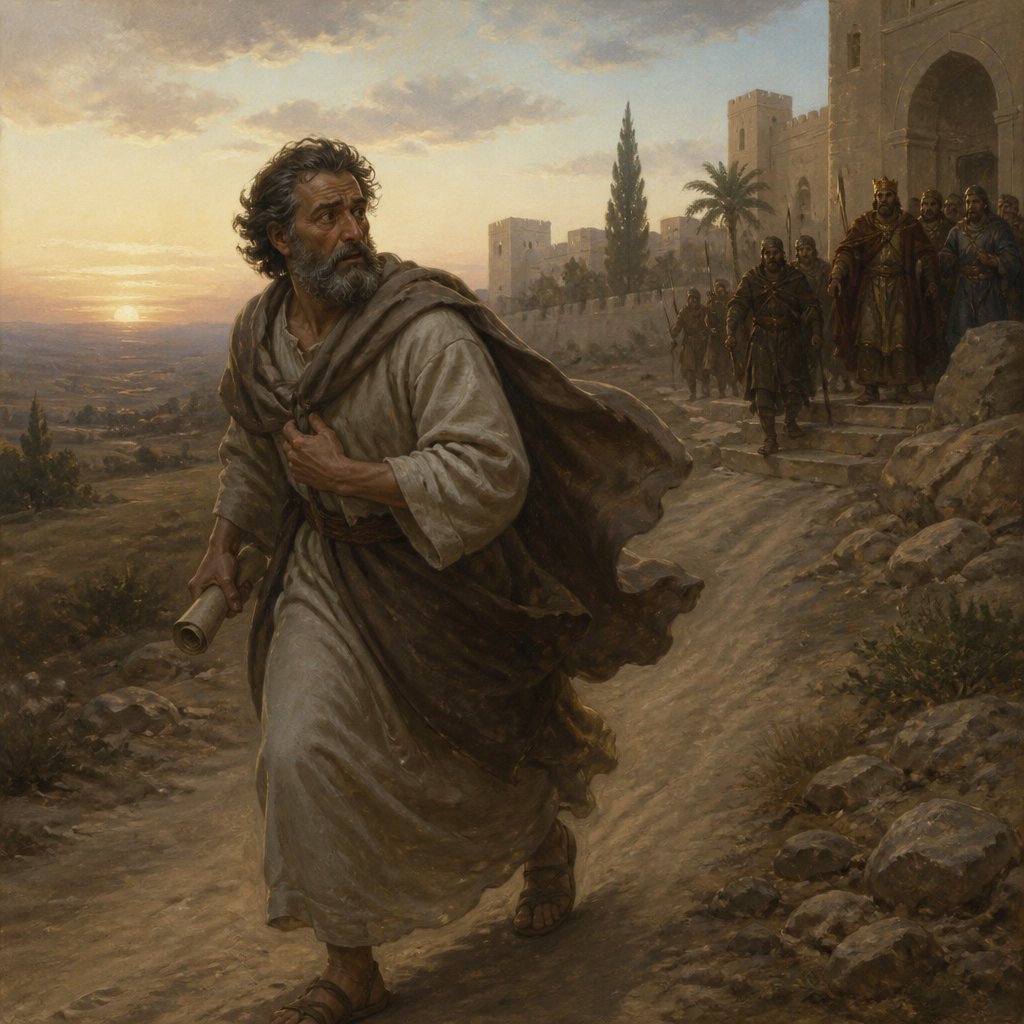
“This man deserves to die!” It’s going to be our Bible class material for Sunday, so I felt compelled to preach on it too. Notice who said those words. It wasn’t the Babylonians. It wasn’t the pagans. It was the priests and the prophets. The men who wore the vestments and spoke in the Lord’s name stood in the Lord’s house and told the princes and all the people, “This man deserves to die! For he has prophesied against this city, as you have heard with your ears” (Jer. 26:11).
Jeremiah’s crime was that he spoke what God had given him to say. The temple would become like Shiloh. The city would be a curse. Repent, or it will all come down. That would probably be a hard word to hear in church. So the church people did what church people still do when they hear a hard word. They go after the one who said it.
Now Jesus told His disciples to expect the same sort of treatment. On the night He was betrayed, at the table, with Simon and Jude sitting there, He said, “If the world hates you, you know that it hated Me before it hated you” (John 15:18). And then, “A servant is not greater than his master. If they persecuted Me, they will also persecute you” (John 15:20).
Now we know almost nothing about Simon and Jude. Simon, of course, is called the Zealot. Jude is the other Judas, the one Scripture adds the little postscript to: “not Iscariot,” in case you were concerned. The Church remembers that they went out preaching the word that Christ gave them, and then they died for it. All the details about their deaths, though, are from tradition, not from Scripture. But this much is in Scripture: they sat at that table, and Jesus told them the world would hate them, because it hated Him first.
Now, I don’t live in Jerusalem in the days of Jehoiakim. Nobody in Sherman Center is putting me on trial, at least not right now. I’m not the priests or the prophets either. I would never call for the preacher’s head, and I hope you wouldn’t either. And as for being hated by the world, I’m not sure that I really have that problem either. I keep my head down. I don’t bring up religion too much if I can help it, only when I’m wearing the collar. I want people to think well of me. I want my neighbors to like me, and so I don’t make it awkward. I would rather be the one that nobody minds and everybody leaves alone.
But as Jesus said, that is the servant wanting to be greater than his master. Johann Gerhard, preaching on this Gospel four hundred years ago, put it as a question: “Why should the members be more fortunate than the Head?” Why should the members be more fortunate than the Head? I would rather have a Christ who is hated so that I don’t have to be. I want to be on His side without standing anywhere near Him, lest I be collateral damage.
Of course, Jesus answers my excuses before I even make them. “If I had not come and spoken to them, they would have no sin, but now they have no excuse for their sin” (John 15:22). There is no excuse. Not for the priests in Jeremiah’s day. Not for the crowds on Good Friday, in Jesus’ day. And not for me either. I have heard the word with my ears, just as they did. I know what the Lord has said. And when His word comes against my house and against my ways, I’m just like them. I would rather go after the word than amend my ways and my doings. Maybe even crying out, “This man deserves to die!”
Now, we know the verdict was wrong about Jeremiah. Jeremiah was doing what the Lord had given him to do, speaking the word he had been given to say. No wonder, then, that before Christ came he was hated for the sake of Christ. But the verdict, “This man deserves to die,” is right about me. Not because I have prophesied against this city, but because I have heard and not listened. Because I want the world’s love, or even more simply the congregation’s love, more than I want His. The Law does not let me hide behind the priests. This verdict is for me.
And Jeremiah answers them when they cry out. “As for me, here I am, in your hand; do with me as seems good and proper to you” (Jer. 26:14). Good and proper. We could use air quotes, I suppose. “But know for certain that if you put me to death, you will surely bring innocent blood on yourselves” (Jer. 26:15). Jeremiah, incredibly, doesn’t run. He doesn’t argue his case. He puts himself in their hands, but warns them: this will be innocent blood.
And God spares him. The princes say, “This man does not deserve to die” (Jer. 26:16). And as we’ll hear in Bible study, a man named Ahikam keeps him out of the hands of the people. Jeremiah gets to walk out of the temple court alive, at least on that day.
But six hundred years later, another court meets in Jerusalem. Again the priests are gathered. The high priest hears Jesus confess who He is and tears his robes. “Look, now you have heard His blasphemy! What do you think?” And they answer, “He is deserving of death” (Matt. 26:65–66). The same verdict they proclaimed on Jeremiah, they now proclaim against the One who speaks for God. “This man deserves to die!”
When it happens again with Jesus, there is no Ahikam there for Him. Pilate says it out loud: he finds no fault in Him. But he doesn’t rescue Him. He just washes his hands and hands Him over to them anyway. Judas brings back the silver and says, “I have sinned by betraying innocent blood” (Matt. 27:4). Sounds like Jeremiah. And the crowd answers Pilate, “His blood be on us and on our children” (Matt. 27:25).
Jeremiah said, “Here I am, in your hand.” And Jesus says it too. He doesn’t run. He doesn’t argue. Jesus puts Himself into the hands of sinners, priests and prophets and princes and all the people, and lets them do with Him as seems good and proper to them. “They hated Me without a cause” (John 15:25), He said. Without a cause in Him. All the cause was in us.
So the verdict that is right about me lands on the one Man it was never right about. “This man deserves to die!” They said it of Him. It wasn’t true. But He took it, and He died.
That’s why St. Paul could stand in the courtroom of Romans 8 and ask who is left to accuse. “Who shall bring a charge against God’s elect?” Me? You? “It is God who justifies. Who is he who condemns? It is Christ who died, and furthermore is also risen, who is even at the right hand of God, who also makes intercession for us” (Rom. 8:33–34). The charge was brought. The sentence was carried out. But on Him, not on you. There is no charge left against you.
That’s also why the world’s hatred is not actually the worst thing that could happen to you. The worst thing that could happen to you already happened, to Him, for you. What reaches you now is not that verdict. It is the shape of the One who bore it. “For whom He foreknew, He also predestined to be conformed to the image of His Son” (Rom. 8:29). The Head wore the crown of thorns. The members are not more fortunate. But they are not condemned either. So when you are mocked for His name, and you will be, God is just making you look like His Son. He is finishing what He started when He chose you, called you, elected you.
So it was for Simon and Jude, whom we remember on this day. They didn’t choose to be hated by the world. They didn’t get to choose what words would be put in their mouths either. They didn’t choose Jesus at all. “You did not choose Me, but I chose you” (John 15:16), Jesus said. He chose two men we remember for little more than their names. He put His word in their mouths and sent them into a world that would treat them the way it treated Him. But nothing the world did to them separated them from Him. “Shall tribulation, or distress, or persecution, or famine, or nakedness, or peril, or sword?” (Rom. 8:35). The answer is no. Nothing.
Which means this is all true for you too. He chose you before the foundation of the world, and at the font He put His name on you. That name is why the world will not always love you. It is also why nothing in this world can take you from Him. “Neither death nor life, nor angels nor principalities nor powers, nor things present nor things to come, nor height nor depth, nor any other created thing, shall be able to separate us from the love of God which is in Christ Jesus our Lord” (Rom. 8:38–39).
When they accused Him, the crowds cried out, “His blood be on us and on our children.” Of course, the crowd meant it as a curse. They were saying, we’ll carry the guilt. And Jeremiah had warned of exactly that: innocent blood on yourselves.
But here at this altar Jesus says it back to you, and turns it inside out. “This is My blood of the new covenant, which is shed for many for the remission of sins” (Matt. 26:28). Innocent blood, put on you. But not to condemn you. To cleanse you, you and your children with you.
So back to that verdict. “This man deserves to die!” It was spoken of Jeremiah and of our Lord. And that verdict was really on me and on you. But this Jesus, who did not deserve it, died instead. And His blood is now on you, and for you.
Thanks be to Jesus. In His holy Name. AMEN.
Rev. Christopher R. Gillespie
St. John Ev. Lutheran Church & School — Sherman Center
Random Lake, Wisconsin