
6 September 2026 • Trinity 14 • Luke 17:11-19
“Were there not ten cleansed? But where are the nine?” (Luke 17:17)
In the Holy Name of + Jesus. Amen.
Two sermons were preached that day.
The first one was quite short. Ten men stood at the edge of a village, their skin peeling off, and they yelled across the distance the Law put between them and everyone else: “Jesus, Master, have mercy on us!” (Luke 17:13). And Jesus preached them a seven-word sermon. “Go, show yourselves to the priests” (Luke 17:14). Unlike so many of the other healing miracles, there is no touch this time. No promise they could hold in their hand. Yet, as they went, they were cleansed.
The second sermon they heard was longer. We don’t have it. But we know it was preached, because we know how it ended. Nine men walked into the temple with new skin and never came back to the One who gave it to them.
Now, you probably know how this Gospel gets preached. The nine forgot to say thank you — just like grandma, always say thank you. And one remembered. Be like the one. Of course, this text is one of the options for Thanksgiving Day. No wonder. But I don’t believe it. Nobody forgets a cured body. Nobody forgets to give thanks for something like that. Something was said to the nine, and they believed that preacher.
At the start, all ten believed. They came out to meet Him. They lifted up their voices. Lepers were supposed to stand off and cry “Unclean.” Instead, they cried His name.
Then the evidence. Jesus said “Go,” and they went. Sounds like believers, doesn’t it? Still lepers. Not a spot had changed when they turned their backs on Him and started walking. Nothing but a word. No letter, no seal, no receipt. That’s faith. All ten of them had it. Nine were cleansed while they had it.
So what happened? What changed? The nine who once believed Jesus didn’t fall on their own. Somebody knocked them down. The priests examined them, and then the priests preached to them. We have to guess what they preached, but I think we can figure it out.
Here’s the first thing. Only God cleanses leprosy. They had been saying that all through the Gospels. Your medicine can’t. Your prayers didn’t. So who cleansed you? It has to be God. Give God the glory. And don’t you dare give it to that man from Nazareth. Make a god of a man, and you break the First Commandment — fear, love, and trust in God above all things, which you learned last week. Not in this man from Nazareth.
You can imagine how that sermon went. The weapon was piety. They didn’t talk the nine out of Jesus with unbelief. They did it with God’s honor. What heart wouldn’t bend to that? What Lutheran wouldn’t? It was that sermon that killed them.
Here’s the second thing they preached. Moses: “The man who acts presumptuously and will not heed the priest … that man shall die” (Deut. 17:12). In other words, listen to your priest or you die. And the priest said, “Your obedience cleansed you. Your offering cleansed you. God saw all of that. Now give thanks to Him — but not to him.”
Here’s the part that should scare you. The nine were following the Bible. The nine had a Bible verse. Jesus Himself said, “Go, show yourselves to the priests.” When the Samaritan turned back, the nine had Jesus’ own words to quote at him. “He told us to come here. You want to disobey Him?” Nine to one, and the nine had Jesus’ word. As Luther said in his treatment of this text, “They had sooner denied ten Christs than offend God and transgress the Law, and thought they did well by doing so.”
And that’s how a man loses Christ. Not by sleeping in. Not by going bad. By being told, in God’s name, with a Bible verse, by the men in charge, that the rite saved him, that his obedience saved him, and not that Man. And believing it. And thinking he did well.
So who is delivering that sermon now? The danger appears like this: You were baptized here. Your family has been part of this community for four generations. You never miss a Christmas or an Easter, and you give generously even when you’re not here. Thank God for all of that.
Or it sounds like this. The doctor was a blessing. You’ve always had a strong constitution. The crops came in, the shop stayed open. Thank God for all of that.
Notice how each of those sermons ends. They sound perfectly good, actually. They end with “Thank God!” And then, maybe like the nine, they walk right past Jesus. The nine praised God too, in the temple, with their tongues. And at the same time they blasphemed Him in Christ.
The problem here is generic God-talk. Every version ends the same way: thank God. There are people in our community and in our world who will say “God is love.” But will they say “Jesus is love”? Ask them if Jesus is Lord. Ask them if He is the way, the truth, and the life. Ask them if Jesus rose and rules right now. Usually you will hear silence. That’s the religion of the nine. Quite sure about God — I’m sure they thanked God for their healing — and unsure about the Man, Jesus.
And this isn’t about the people who aren’t here this morning, whatever they’re doing on Labor Day weekend. The nine were in the temple, in church, performing the rite and praising God, just as Jesus had told them to. The nine sat in the pew. The man in danger of losing Christ while thanking God is the man who’s sure he’s fine because he was born here, his name is still on the rolls, and he remembers to pray. But he doesn’t trust in Jesus.
Of course, I’m not preaching against the church. Jesus sent them to the priests. The office was His. It’s not the office you avoid; it’s the misuse of the office. When the priest teaches Moses, listen. When he tells you your offering cleansed you, that is a lie told in God’s name, and if you hear such a thing you leave. The rail is where He hands you His body — but being at the rail doesn’t save you. It is receiving the gifts Christ gives.
It would have been better for the nine to have stayed lepers than to be cleansed in the body and lose Christ. Better rotting flesh and Christ’s. Think about that the next time you thank God for the good year and can’t remember the last time you thanked Jesus for anything.
Now the Samaritan. Don’t make him a hero either. He didn’t have a better attitude than the nine. He just had nowhere else to put his fear, love, and trust. He had no priest of his own — he’s a Samaritan. His temple was on the wrong mountain and had long since fallen into decay. When the priests said, “Your offering did this,” he didn’t make offerings anymore. When they said, “Your obedience did this,” he had no Law to obey. All he had — and thank God for it — was a Man who spoke seven words to him, and skin that was clean. Take away everything else you could credit, and the reason he is commended to us is that what’s left is Jesus.
Luke says he saw that he was healed. All ten had eyes. But that’s how we talk about an ungrateful man: he doesn’t see what was done for him. He won’t. The thankful man can’t stop seeing it. This Samaritan looked at his hands — and the key is not that he saw the healing, but that he saw who healed him. He saw Jesus.
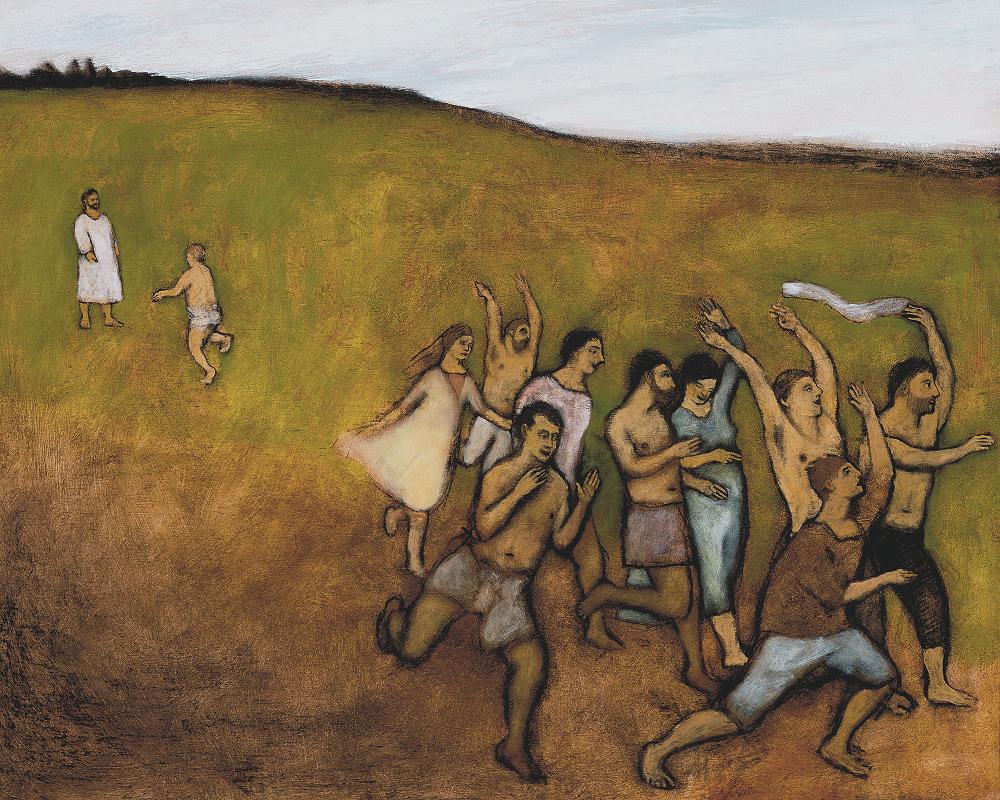
So he went back. And the nine came after him. Fool. Heretic. Let him go, he’s just a Samaritan, he doesn’t know any better. He went back anyway. Face down in the road at Jesus’ feet, giving Him thanks.
Him. Not “God” in general. This Man. In the whole New Testament, this is the only time anyone gives thanks to Jesus. Isn’t that astounding? Everywhere else it’s that generic God-talk, or to the Father, once to a couple of friends. Never to Jesus. And Jesus does not correct him. He doesn’t say, “Stand up, don’t make a god of Me!” He takes the words, because they belong to Him. The priests were right about one thing. It was God who cleansed all ten. And He was standing in the road!
Now listen to what Jesus does. Before He says one word to the Samaritan, He asks about the nine. “Were there not ten cleansed? But where are the nine? Were there not any found who returned to give glory to God except this foreigner?” (Luke 17:17-18). More words about the nine than He says about the one.
Before Christ justifies the Samaritan, He judges the nine. So the Samaritan never has to make his case. He doesn’t have to win the nine back. Christ knows. Christ counts them. Christ asks where they went. Christ calls what they did by its name: they stole God’s glory. And He does it before the Samaritan opens his mouth.
That’s for you too. You don’t have to win the argument with the man who’s sure he’s fine — one of the nine. Christ will ask where the nine went. Not you. And then the verdict for you.
“Arise, go your way. Your faith has saved you” (Luke 17:19).
Of course that’s a word of blessing. But it is not only a blessing. That is a judge’s ruling, read out loud against another court’s ruling. The priests had ruled: your offering did it. Jesus rules: NO. Not because you went. Not because of the offering. Faith — and faith has an object. Faith alone, because Jesus alone was doing the cleansing before they had walked ten steps toward the temple. Or as the prophet says, “Before they call, I will answer” (Isa. 65:24). The Word did it on the road before any priest laid eyes on them.
A blessing and a verdict — and the verdict is for you. The Word did it at the font before you could do anything. You didn’t get yourself to the water. You were carried, whether you were an adult or a child, carried by the Spirit. And He cleanses you here, today. He doesn’t hand you His body because you got yourself clean enough for the rail. He hands you His body and gives you His blood to drink because He is God in the flesh who cleanses — Jesus.
So maybe the nine did call the Samaritan a heretic. The crowd would too. But the Judge called him saved. And that ruling stands. Nobody overturns it. Not the priests, not the nine, not your own conscience when it tells you you’re fine because you were born here, or lost because you weren’t.
No, the verdict is for you too. Arise. Go your way. Your faith — your Jesus — has saved you.
Rev. Christopher R. Gillespie
St. John Ev. Lutheran Church & School — Sherman Center
Random Lake, Wisconsin