
25 October 2026 • The Festival of the Reformation • Matthew 11:12–15
In the Holy + Name of Jesus. AMEN.
Who are the violent who Jesus says take the kingdom by force?
He said, “From the days of John the Baptist until now the kingdom of heaven suffers violence, and the violent take it by force” (Matt. 11:12). Then He adds, “He who has ears to hear, let him hear!” (Matt. 11:15). He knows that He just said a hard saying. But He wants you to stop and ask what it means.
So let’s ask. Who takes the kingdom by force? First, it does seem to be a bit of an odd Gospel for a festival day. We usually prefer, actually, the alternate reading from John chapter 8. But if we do read this one from Matthew 11, it’s only once a year, and then we can nod and move on to the hymns that we love from the Reformation. Also, pastors and other scholars of the Bible have debated who these violent are for centuries. Some read it one way; others read it the opposite. And some admit that it’s both, or they can’t decide. So it’s a real question. We don’t need to soften it or ignore it, move on to another one.
So who are these violent? The first answer, of course, is the obvious one, I think. The violent are the enemies of the kingdom. When Jesus said these words, John the Baptist is sitting in Herod’s prison. Soon Herod will order his head to be delivered on a platter. Or you could think of Old Testament prophet Elijah, who ran for his life from wicked Jezebel. Luther himself lived under the emperor’s ban and hid away for years in the castle. Thus we know, wherever the Gospel is preached, there is bound to be trouble. The kingdom suffers violence. That much is true.
But if that’s the whole answer, then the Scripture today is about everybody outside. Where are you in the verse? You get to stand, maybe back, and just watch. The enemies are out there because the kingdom is in here. You’re the ones safe on the right side because, at least on this day, you’re sitting in a Lutheran church. But I think that answer too would get you off the hook.
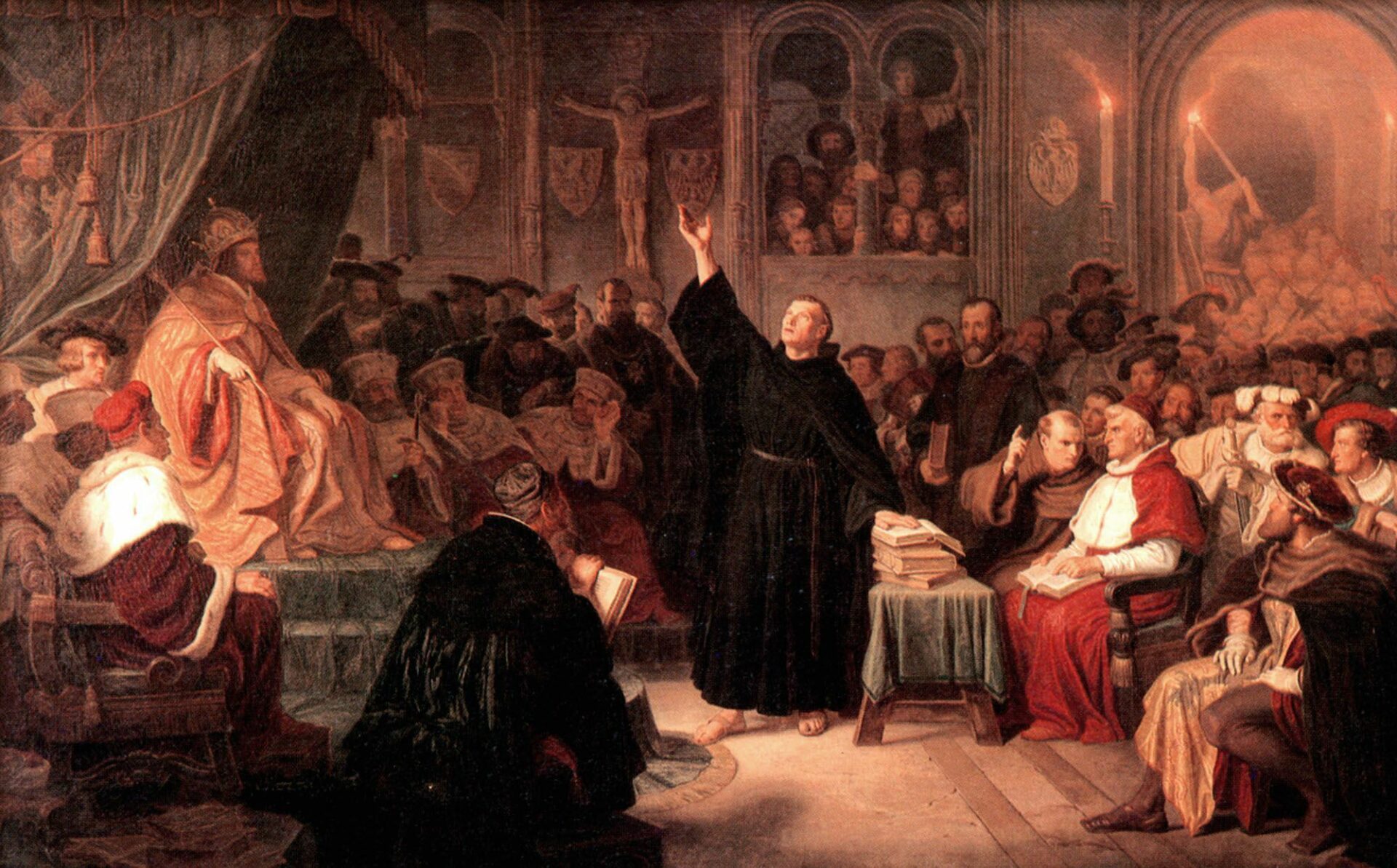
So let’s try the second possible answer about who these violent are, the other way. The violent are the strong ones, the heroes. Men of iron faith who storm heaven and will not be denied. One old Lutheran book on the propers says that Luther “stormed the very gates of heaven by the power of his faith.” That’s a nice thing to say on Reformation Day. Or on this day, as we heard in our hymn, “A Mighty Fortress,” it’s tempting to cast Luther as the strong man who overthrew the strong man, and the kingdom is Luther’s prize.
But then who gets in? Who receives the kingdom? Not you and not me. We’re not heroes. We’re not strong. Nor would it be the man in the nursing home who can barely pray, nor the mother who’s doubted Christ for years, nor even the baby at the font. Not much heroic action there. And not Luther either, really. Maybe Luther did try to storm heaven. But the church in his day handed him the tools of penance and prayer and fear of God. And he did all of them, better than probably we would. But that only made him even more afraid of God. But after he died—you’ve probably heard this story—they found a note in his pocket, and it said, “We are beggars. This is true.” We are beggars. This is true. Well, he didn’t think of himself as a hero then, did he? A beggar.
So maybe neither answer works: the violent being the enemies or the violent being the strong heroes. Let’s go back to Scripture. Jesus goes on: “For all the prophets and the law prophesied until John. And if you are willing to receive it, he is Elijah who is to come” (Matt. 11:13–14). For centuries the Law and the Prophets had pointed ahead. But with John the Baptist, the pointing now ends, because the One that they pointed to has arrived. God promised through Malachi to send Elijah before the great day of the Lord. John came in the spirit and in the power of Elijah. If John then is Elijah who is to come, then the One who comes after him is the Lord Himself, as the prophet foretold. In other words, the kingdom of heaven is the King, come near. It is Jesus standing before the crowd, opening blind eyes and preaching good news to the poor.
The old preachers of the Church saw this. Gregory the Great read this verse as good news. The violent, he said, are sinners who turn back in repentance and take hold of heaven. They take a place that belonged to someone else. Or St. Luke records it in another way: “The kingdom of God has been preached, and everyone is pressing into it” (Luke 16:16). Pressing in. Crowding the door. Trying to grab hold of it.
And who is the one who presses in? Jesus tells you Himself later in Matthew’s Gospel: “John came to you in the way of righteousness, and you did not believe him; but tax collectors and whores believed in him” (Matt. 21:32). The tax collectors and the prostitutes went in. The priests and the elders stood outside the kingdom.
And of course, St. Paul told you why in the Epistle today: “Whatever the law says, it says to those who are under the law, that every mouth may be stopped, and all the world may become guilty before God” (Rom. 3:19). Every mouth. The Pharisees’, the tax collectors’, the pope’s, Luther’s, your mouth, my mouth. “There is no difference; for all have sinned and fall short of the glory of God” (Rom. 3:22–23).
It’s the sinner who is the violent one. That means it’s us. They’re the people who have run out of arguments, whose mouths have been shut, been silenced. And their hands are empty. They have nothing to give. And then the King comes near to them with His mercy. And they don’t wait to be asked twice. They grab at Him, the hem of His garment. Take hold of Him. The Canaanite woman would not let go of Jesus either, remember? “Yes, Lord, yet even the little dogs eat the crumbs that fall from their masters’ table” (Matt. 15:27). The thief on the cross had nothing to give, and yet in his dying breath he said, “Lord, remember me when You come into Your kingdom” (Luke 23:42). Truly a violent man, a murderer, taking the kingdom.
So let’s call it hunger, not heroism. And surprise! The force to take doesn’t come from them either. It comes from the kingdom itself. The kingdom pressed in on them first, and then through John’s preaching and Jesus’ mercy, it made these beggars bold, even, we might say, violent for the kingdom.
The ones who don’t take the kingdom are the ones that think that they already own it. They already have it. The priests and elders, for example, we heard today: they had Abraham and the Law in their hands. Then John comes to them, and they’re not willing to receive the prophet whom God sent, never mind Jesus, whom he foretold. An heir thinks that inheritance is his by birth. And thus he never tries to take it. He doesn’t reach for it. He just waits until the day someone dies, and he collects. Meanwhile, strangers walk in and take what the heir despised.
So that’s the danger for us on Reformation Sunday, I think. You have the catechism. You have the hymns, maybe some memorized. You have the history of our church, this congregation, and the Lutheran Reformation. Maybe we were confirmed in the Evangelical Lutheran Church; most of you were. And you think that that makes you a member of the kingdom, that the kingdom comes by the family pew. I was joking before church. There are no plaques on the pews to tell you where you’ve purchased a place. You don’t own it. Of course, our neighbors sometimes think we’re just being judgmental by making distinctions. And that’s probably because they have met us. We look down on Catholics and Baptists and folks who never darken the church door. But remember what Paul said. There is no difference. No Lutheran difference. No St. John difference. All have fallen short of the glory of God. That means the Law should be stopping our mouths too.
Of course, then we could fall into that other ditch, thinking the kingdom then isn’t for us. You know your sins too well. You can’t remember the catechism or your prayers or the hymns or echo the responses of the liturgy, or even answer just a simple doctrinal question. So you think that the kingdom is not for you until you’ve cleaned up your act, proven yourself, and then you can come back. That’s also trying to stand before God with boasting, with something in your hands. So put that down too.
The kingdom of heaven suffers violence in another sense, of course, and it suffered it, all of it, on one Friday. The King Himself let Himself be taken. He was bound, beaten, mocked, and nailed to a cross. God “set forth \[Him\] to be a propitiation by His blood, through faith” (Rom. 3:25). In other words, every blow your sin deserved fell on Him. The thief who grabbed at Him was with Him in paradise that same day. And you too: you are “justified freely by His grace through the redemption that is in Christ Jesus” (Rom. 3:24). Freely, paying no price and putting on no performance. The kingdom of heaven is a gift to you.
And that’s what Luther finally found out, and something worth remembering today, when he stopped trying to storm the castle by his works and started listening and receiving. The righteousness of God is not something God demands from you. It’s something God gives to you. “Where is boasting then?” (Rom. 3:27). “I’m a Lutheran. I know my catechism.” Yeah. It’s excluded. Nothing is left to boast about except for Christ Himself and what He has done for you. But also nothing is left to keep you out. Everything has been taken from you, so all you have left to do is grab hold of Jesus. So take Him.
It’s the only violence that Jesus asks of you. And even that is a gift, His gift. Faith is an empty hand, and then He fills the hungry with good things. He puts His body and blood into your mouth and says, “Take, eat.” He speaks into your ears, “I forgive you all your sins,” whether you wanted to hear it or not. The water that was poured over you in the font was done probably before you could even say a word about it. So take hold of it. Hold fast to Him. It’s yours. And never let go. If you want to call that violence, I’m okay with that. Not because you’re strong, but because He was crucified for you and raised for you.
“If you are willing to receive it,” He said. And by nature no one is willing. But the One who says, “He who has ears to hear, let him hear!” is the One who has opened your ears today. Or as David said, “My ears have been opened.” He opened yours in the water and by the Word. So hear Him. The kingdom of heaven is yours. Your sins are forgiven. Take it. Hold fast to it.
In the Name of Jesus. AMEN.
Rev. Christopher R. Gillespie
St. John Ev. Lutheran Church & School — Sherman Center
Random Lake, Wisconsin