

16 September 2026 • Friday of Trinity 15 (observed) • Luke 20:1–8
It is Holy Week. He has three days to live. And He spends them in the temple, teaching.
He knows what is coming. He could have spent these days anywhere. He spends them in the temple courts, preaching the gospel of the kingdom. The last days of His life go to the thing He came to do — and the thing He came to do is put His holy Word into our ears.
While He is doing it, a delegation arrives. “The chief priests and the scribes, together with the elders, confronted Him” (Luke 20:1). That is the Sanhedrin — not a mob, not a heckler, but the standing authority of the church in Jerusalem, whose office was to watch over what was taught there.
“Tell us, by what authority are You doing these things? Or who is he who gave You this authority?” (Luke 20:2).
That is a fair question. It is, in fact, their job to find out.
We are used to hearing these men as villains — and I have been guilty of it too — and by the end of the week they will be. But it is the right question, asked by the right office. A man stands up in a holy place and teaches, the people are listening, and somebody had better find out who sent him. Our Confessions say it plainly: nobody should publicly teach or administer the sacraments without a rightly ordered call. Not bureaucracy. Mercy. It is how God protects us from the man who appoints himself.
So they were not wrong to ask. They were wrong about who was standing in front of them.
And the Epistle puts its hand on the whole scene.
“Moses indeed was faithful in all His house as a servant… but Christ as a Son over His own house” (Hebrews 3:5-6).
Hear the two little words. Moses was faithful in the house. Christ is faithful over it. Moses, a servant. Christ, the Son. And these men sit in Moses’ seat. Which makes Luke 20 this: servants in a house have stopped the Son at the door of His own house and asked Him to produce His papers.
They’re standing in a building. They want to know what right He has to be in it. And He built it.
There is the tragedy, and it is a respectable one. These aren’t men who despise holy things. They love the temple, they know its rules better than anyone alive — and they don’t know the One whose temple it is. Reverence for the house, and none for the Son. That is possible. It is possible on a Wednesday night in Sherman Center — reverence for the altar and the house, and none for the One who dwells here.
Then He answers them by not answering them.
“I also will ask you one thing, and answer Me: The baptism of John—was it from heaven or from men?” (Luke 20:3-4).
That sounds like a dodge — cornered, so He changes the subject. He isn’t dodging. He is telling them exactly where His authority comes from, in a way they will have to repent to hear.
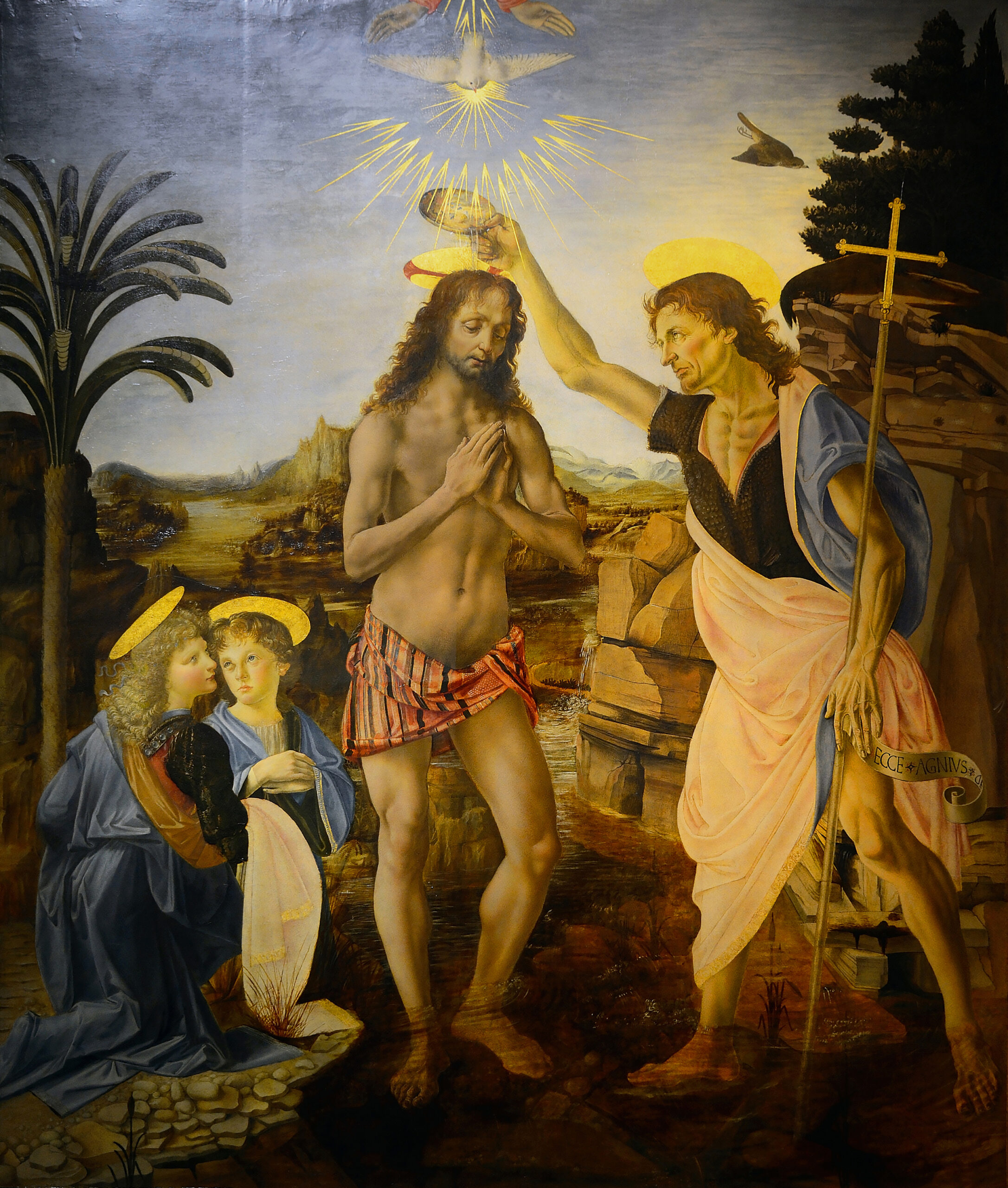
Where did it happen? At the Jordan. Go down from Jerusalem, east, through the wilderness, past Jericho, to the muddy green water where St. John the Baptist stood waist-deep, putting his hands on people. There. The heavens opened, the Holy Spirit came down on Him like a dove, and the Father’s own voice said over Him, “You are My beloved Son; in You I am well pleased” (Luke 3:22). There is the credential. The Son did not send Himself. He was sent, He was named, and it was done out loud in front of everybody. We always imagine only John was there — but perhaps there were others at the water as he laid his hands on Him.
This is what Hebrews praises in Him. “Who was faithful to Him who appointed Him” (Hebrews 3:2). Appointed. The Son takes His place in the house not by seizing it but by being given it. Everything He does these three days He does under orders. Silent before Caiaphas — obedience. Not coming down from the cross — obedience.
“And they reasoned among themselves” (Luke 20:5) — If we say from heaven, He will say, why then did you not believe him. But if we say from men, all the people will stone us.
Do you hear what is missing? Not once do they ask what’s true. They ask what it will cost. They price out both answers and take the cheaper one.
And the second half of that calculation is fear. “All the people will stone us” (Luke 20:6). Not fear of God — fear of the crowd. The men whose office exists to fear God before men have taken a vote, and the deciding consideration is what the courtyard will do to them. An office given for the truth, run on a headcount.
“So they answered that they did not know where it was from” (Luke 20:7).
That’s a lie. They knew. They had sent men down to the Jordan; they had the report. They said they didn’t know because not knowing was free. They walked away having authorized nothing, confessed nothing, learned nothing — and still holding the office. We can keep the office and lose everything the office was for.
Fear does that to us. It is the most modern thing in this text. Never commit. Keep faith at the level of an opinion we can revise. Have a warm general feeling about God and never say out loud that Jesus is Lord — because the moment we say it, it costs us something. A friendship, maybe. A child. A spouse. Most people within ten miles of this building tonight believe God is lovely. They are less sure He is Lord. They are least sure of all that His church is necessary. We do not know is a comfortable place to live.
And we live there. We audit Him. We hold an office we were never given and require the Son to satisfy us before we will trust Him. Show me the credential. Answer this about my mother’s cancer, this about the boy who will not come home, this thing that happened in this congregation that I have not gotten over — then I will believe You have the right to speak to me like that. We stand inside His house, holding His book, singing His hymns, and we ask Him for His papers.
He doesn’t give them.
“Neither will I tell you by what authority I do these things” (Luke 20:8). And then He turns, walks out of that argument, and goes to a cross.
There is the answer. Not a credential — a crucifixion. They will all see it, witness it outside the city gates. He does not prove He owns the house by winning the argument in the courtyard. He proves it with His body. He proves it by dying for the house and rising three days later, which no servant in any house has ever done or could. The authority He would not explain on Tuesday He exercised on Friday. It looked like weakness. It emptied a tomb.
“Consider the Apostle and High Priest of our confession, Christ Jesus” (Hebrews 3:1). Apostle — an interesting word for Jesus. We usually reserve it for the Twelve, but it means sent one. High Priest, the one who goes in with the blood. Both ends at once: God’s Word sent down to you, your blood-price carried up to God. Never authority to win an argument — authority to lay down His life and take it up again, for you and for me.
“He who built the house has more honor than the house” (Hebrews 3:3).
Not a ranking. Not Moses scoring well and Jesus scoring better. Nobody compares a wall to the bricklayer. Moses was a good and faithful servant, and Moses was part of the house. Christ made it. “He who built all things is God” (Hebrews 3:4).
And then the most astounding thing: “whose house we are” (Hebrews 3:6).
You are not the inspector. You are not the auditor. You aren’t a tenant — a tenant can be put out, and a tenant can leave. You are the masonry. He built you in. Back there in that font He touched you with water and tattooed you with the family name, and that is the day the stone was set, set by the Builder’s own hands. A stone doesn’t hold itself in a wall. It doesn’t grip for dear life. It is held. The wall stands because the One who laid it stands, and He doesn’t leave, and He cares for it.
So stop asking Him for His papers. He has something better than an argument. Up here, on this altar, His own body and blood, given and shed for you — laid on your tongue by a man who can give you nothing on his own authority and doesn’t have to, because as a called and ordained servant of Christ, and by His authority, your sins are forgiven you. Not by my authority — by His. And that touch is the Son of the house handing you the house.
You are the house. He built it. He built you into it. You are home. Come and eat.
In the holy name of Jesus. Amen.
Rev. Christopher R. Gillespie
St. John Ev. Lutheran Church & School — Sherman Center
Random Lake, Wisconsin