
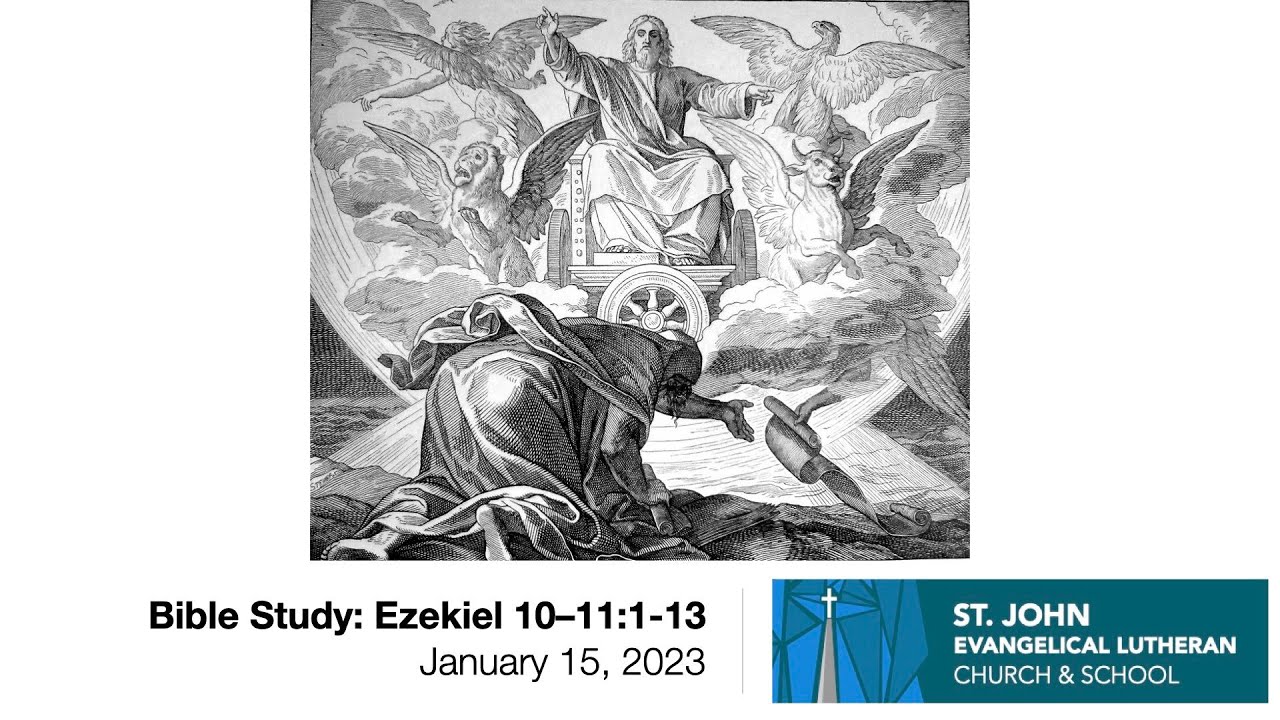
Ezekiel – 10—11:1-13
10:1 – We get the impression that Ezekiel is taking notes as he observes the scene before him, sometimes reporting the action but more often attempting to verbalize what he saw. It alternates, sometimes confusingly, between narration and description. Much of the content echoes 1:16-21,26 and 9:1-11. Chapter 10 features Jerusalem’s immanent judgment described from two perspectives, the earthly judgment, and the heavenly judgment, as seen by Yahweh’s abandonment of the temple. Recall our discussion of “vertical typology,” the correspondence between the earthly sanctuary and the heavenly prototype (Ex 25:9; 1 Kings 8; 1 Chr 28:19; Acts 7:44; Heb 8:5). Ezekiel is the only one in the OT who attempts a description of the living cherubim based on observation, much like John’s attempts (Rev 4:6-9; 5:6,8,11,14; 6:1-7; 7:11; 14:3; 15:7; 19:4). The same kind of vertical typology present in the OT underlies our entire theology of worship, as we sing in the Preface that introduces the Sanctus in the Divine Service: “with angels and archangels and with all the company of heaven…” 10:2 – “The man dressed in linen” is given to handle the sacred re, hence the priestly garb. In Is 6:6-7 a coal is used to purify Isaiah’s mouth for ministry, but in Rev 8:5, the coals are thrown down to earth for sacred judgment. The con agration to be wreaked on the city evokes comparisons with Sodom, the wicked city infamous for homosexuality (Gen 19:24; Ezek 16:46-56). Similar passages of judgment include Ps 11:6; Is 34:9; Ezek 38:22; Rev 11:5; 14:1-; 19:20; 20:9; esp. 21:8. The actual burning of the city by the Babylonians is described in 2 Ki 25:9 and 2 Chr 36:19. 10:3-4 – “The cloud” (10:3-4) is associated with Yahweh’s personal guidance of his pilgrim people in the desert (Ex 13:21), in a pre-tabernacle tent-sanctuary (Ex 33:7-10) and more permanently, at the consecration of both the tabernacle (Ex 40:34-35) and its successor, the temple (1 Ki 8:10-11), ful lled in the “tabernacling” of the Word made esh in Jn 1:14. The reference to “the cloud” here is almost ironic because, in those earlier accounts, the accent was on God’s gracious presence, especially as he became “incarnate” in the sanctuary where he had “caused his name to dwell” (e.g., Deut 12:11). 10:6-7 – Parallel to 10:2,6-7 is Rev 8:5, where the angel lls his censer with coals of re from the incense…