
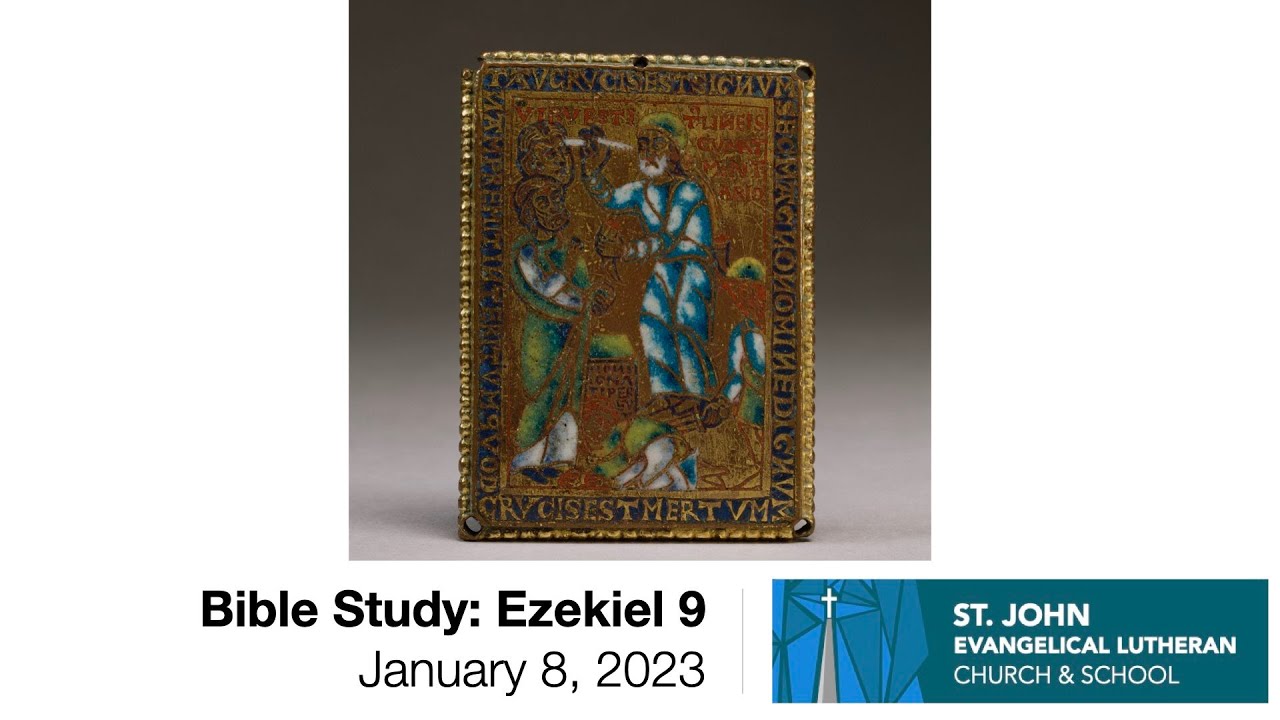
Ezekiel – 9:1-11
The Glory of God versus Four Abominations in the Temple – Chapters 8–11 relates how Yahweh’s “Glory” abandons the Jerusalem temple to destruction. The return of the “Glory” in the eschatological temple is in Ezekiel’s vision of 43:1-4. Many scenes are echoed in the book of Revelation. The work of the divine “man” in 8:2-3 compares to the appearance of the resurrected Christ in Rev. 1:13-16; 10:1-3 (also Dan 10:4-6 and Acts 9:3-7; 26:13-18). We also ought to keep in mind the promised remnant (e.g., 5:10; 6:8-10). Chapters 8–11 are a single visionary experience. 9:1 “Then He called out in my hearing with a loud voice” – This continues directly from 8:18. The divine command intimates the setting of a royal court or judicial courtroom, with Yahweh as the King and/or Judge who summons the supervisors or executors. The vision hastens toward the nal judgment of God’s apostate people. Those in charge of the city are the angelic attendants who had been stationed over the city to protect it during physical and spiritual warfare (cf. 2 Ki 6:15-17; Is 62:6; Dan 10:13-21). The eschatological city of Jerusalem will have 12 angels, each stationed over the city gates (Rev 21:12). As they are apostate, these take on a destroying role, like at the rst Passover and at Sodom and Gomorrah (Gen 19; Ps 78:49). 9:2 “the six men” – These six, plus the scribe, make a total of seven. Presumably, they are angels in the appearance of men. The “bronze altar” is the Solomonic altar (1 Ki 8:64), which Ahaz removed and placed north of the new altar he installed. This innovative but apostate altar was built to mimic one from Damascus (2 Ki 16:10-14). Perhaps Hezekiah and Josiah restored it, but it likely was removed again. These men stand with orthodoxy, not apostasy. The scribe is dressed in the garb of an OT priest. Here, this “man” serves as a priest and mediator between God and the people. In 10:2, 6-7, he will be the one charged with executing judgment. Jewish tradition understands him as Gabriel, and some Christians as a Messiah gure. But he more resembles the role of the angel in Rev 7:2-3. 9:3 “the glory of the God of Israel” – Is Yahweh in His temple on earth, or is He in His heavenly temple—or both at the same time? There are two sets…
n