

26 August 2026 • Friday of Trinity 12 (observed) • Matthew 11:20–24
In the holy name of Jesus. Amen.
Everybody knows the next few verses of the Gospel, which I think you might have preferred to hear tonight. “Come to Me, all you who labor and are heavy laden, and I will give you rest” (Matt. 11:28). Jesus, refuge of the weary. It’s beautiful Gospel, and of course it’s the part we want to hear. But it wasn’t appointed for today. You get the part right before it, and we just have to reckon with it.
Three towns. Chorazin. Bethsaida. And Capernaum. And then over each one of them our Lord spoke a word of woe.
But then He does something actually worse than declaring a woe. He starts comparing them. He sets them beside Tyre and Sidon, and then beside Sodom — still a name we use for a place that has gotten about as bad as it gets. “It shall be more tolerable for the land of Sodom in the day of judgment than for you” (Matt. 11:24). That’s referring to Capernaum.
Matthew had already told us about Capernaum. “And leaving Nazareth, He came and dwelt in Capernaum” (Matt. 4:13). Dwelt. Moved in. Took up residence. His home base. And then a few chapters later Matthew calls it “His own city” (Matt. 9:1). This is His own town. This is where He slept, and where He ate, and where the taxman came to His door. If Jesus had any mailing address throughout His years of ministry, this was it. Capernaum.
And that’s the town He says will have it harder on the day of judgment than Sodom.
Well, why is that? Sodom is notorious, a filthy place, of course. But Jesus gives the reason Himself, and it’s the same all three times, whether it be Chorazin or Bethsaida or Capernaum. “The mighty works which were done in you” (Matt. 11:21). In you. Not near you, or out in the region somewhere. Christ did His mighty works in town. The paralyzed man let down through the roof and walking home carrying his own bed — that happened in the street right in front of them. And Matthew says most of it happened there: “the cities in which most of His mighty works had been done” (Matt. 11:20). Those three.
So the arithmetic of the last day isn’t really what we are expecting. It’s about the size of what God gave you, set against what you did with it. Sodom got almost nothing and would have repented in sackcloth, Jesus says. Capernaum got almost everything and did not repent. God near can be the worst thing that ever happened to a town.
Of course, now we know who’s here on a Wednesday night. You are not dwellers of Sodom, or of Tyre and Sidon, those heathen towns. You’re not the man who never comes to church; he isn’t here to hear it. You came. This text actually has our name written on it, because there’s a temptation that belongs only to the people who come: to count your nearness as your safety. You are in Capernaum. Jesus lives there. So surely you are saved. But Jesus has you compare not to where you are, but to what you have witnessed and received.
Count what you’ve been given. Water poured over your head with the Name — Father, Son, and Holy Spirit — attached to it. A catechism, a simple teaching of God’s holy Word, that you once had memorized. Generations here who handed over to you what was handed down to them, and paid for it out of money they didn’t even have, as you know. Mortgaging the farm just to build the sanctuary. This font. This altar. You’ve heard the Words of Institution more times than you’ve had birthdays. Mighty works of God have been done in you.
So hear it plainly. There’s no amount of church that’s safe. Attendance isn’t a wall that you set up around you. The family name on a plaque somewhere, or on the gravestones, isn’t protection. Showing up on a Wednesday night when nobody makes you doesn’t save you either — at least not that alone. If nearness to Christ saved anybody, Capernaum would have been the safest town that ever stood. And then Jesus says, astoundingly, it goes down to Hades.
“And you, Capernaum, who are exalted to heaven, will be brought down to Hades” (Matt. 11:23). That first part is a question, and it is the kind that already knows its answer. Will you be lifted up to heaven? No. You won’t.
Which then begs the question: what is missing? Verse 20 tells us they did not repent. The miracles Jesus did were never just for show, nor do they convert anybody. Every one of those miracles was a summons — Jesus speaking in the only language a sick body understands, to turn around, to repent, for the kingdom of God, Jesus, has come to your street, to your town. In Chorazin we learn that they took His summons as a kind of entertainment, a party favor, a trick, and never held fast to the Word the sign was pointing at. Again, signs don’t convert anybody. But the Word attached to the sign is what converts.
So here’s really the only question that matters tonight. You’re about to come up to the rail and get closer to Christ than anybody in Capernaum ever got. He won’t be down the street from you. He’ll be in your mouth. So what makes that different than Capernaum — a mercy and not a woe?
Paul answers the question, but not by telling you how to feel. He hands over to you the evidence, and then trusts you with it. “I speak as to wise men” — that’s you — “judge for yourselves what I say” (1 Cor. 10:15). And then he puts the Word right in front of you.
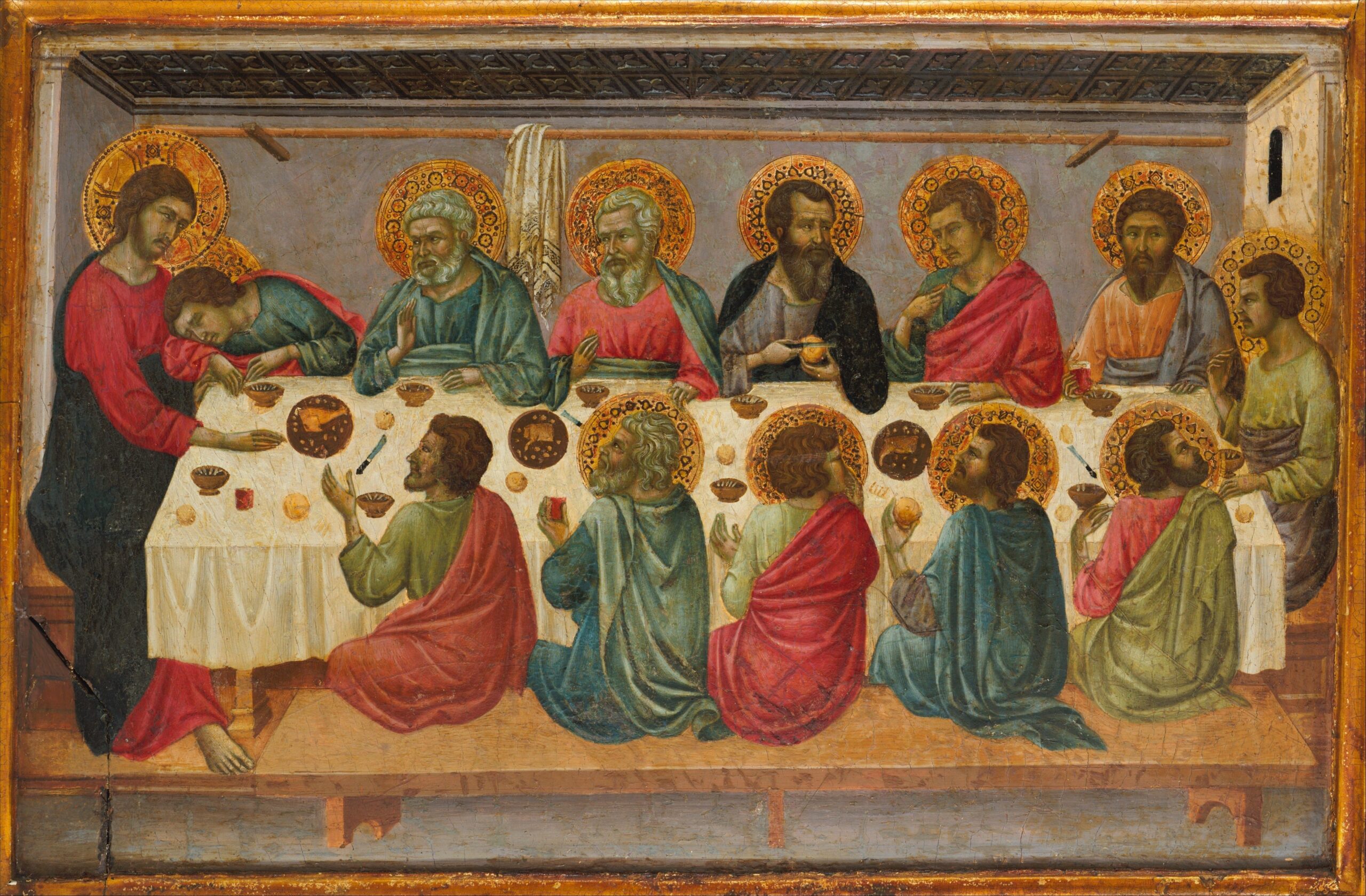
“The cup of blessing which we bless, is it not the communion of the blood of Christ? The bread which we break, is it not the communion of the body of Christ?” (1 Cor. 10:16).
Two questions. Rhetorical questions, both built to make you say, yes, it is. Capernaum got the question in a different form, but their answer was no. Jesus is impressive, but He’s not the Son of God, and I’m not being called to faith in Him, to repent and be forgiven. You get a question that expects yes.
But even the yes isn’t the nearness. Capernaum had the nearness. It’s actually the words that matter, and what’s attached.
“Take, eat, this is My body, given for you.” “Drink of it, all of you, this is My blood of the new testament, shed for you for the forgiveness of sins.”
Again, you received the catechism — it’s one of the great treasures of our church — probably when you were twelve or younger. How can bodily eating and drinking do such great things? Certainly not just the eating and drinking that does them, but the words given here: given and shed for you for the forgiveness of sins. For where there is forgiveness of sins, there is life and salvation. Life and salvation now. Not someday, but life handed to you tonight, in your hand, or on your tongue, in a piece of bread and in a cup that you can taste.
That is something Capernaum never had — even though it was for them too, would be. They had Jesus walking in their streets. But they didn’t hold fast to His words, because especially these words for the Sacrament had not yet been spoken. Not until the night He was betrayed, in an upstairs room in another city, when He took bread and put His own dying into it, and then handed it over and said, for you. Capernaum indeed had mighty works. Now you get His last will and testament.
Which makes that “for you” not just kindness. It’s something you carry with you tonight and into tomorrow, until the next time you’re gathered. It’s something more impressive than even what Capernaum saw, or Chorazin, or Bethsaida.
Remember that God’s love is not a general kind of love. Everybody in our country believes that. A general love costs nothing. It saves nobody. And that kind of love is what Capernaum believed while the Son of God lived a few doors down. General love — God is love — is not yet the Gospel. The Gospel is a Man with a name, killed under Pontius Pilate on a particular Friday and raised on a particular Sunday, who says a particular word over you for particular sins: for you. I forgive you.
Because He didn’t stay just a few doors down. He came nearer to Capernaum than they would ever let Him come. Near enough, ultimately, to be arrested. He came near enough to be handed over, near enough to be nailed down and killed. That’s how near God was willing to get to you. And the Father raised Him on the third day, and the body they buried is the body He gives to you here. That’s how near He came to you. And that crucified body and blood, raised from the dead, is your gift tonight.
Perhaps you’re afraid you’re the one who shouldn’t come — the man who eats and drinks without discerning the body, who has thought of the Sacrament only as a mighty work, like Chorazin or Bethsaida or Capernaum might. But you’re here, so you’re not like them. That fear is the repentance Chorazin never had. The fear to draw near is a godly fear. It’s the Spirit doing the very thing the woe was sent to do, which means the woe has finally finished its work in you.
So come.
“For we, though many, are one bread and one body; for we all partake of that one bread and that one cup, in Christ Jesus our Lord” (1 Cor. 10:17). One bread. One body. Not a crowd standing in the street watching a miracle, like in Capernaum. No — a body, with each of us members in it. As we look down the altar rail tonight, the man or woman kneeling next to you is getting the same Christ as you are, out of the same loaf, and that makes the two of you actually one thing. Capernaum was a crowd. This is a body. A crowd disperses when the show is over. A body He keeps.
And the way in was never that you got close enough — to be let down into the house, to be touched, to grab the hem of His garment. That certainly blessed them, but that isn’t yet the gift. He came all the way down to Capernaum, but then He kept coming, all the way down to His cross and into a grave, so that tonight He would come all the way to the altar and not even stop short there, but be placed in your mouth.
As we prayed this week: by Your gift alone Your faithful people render true and laudable service. By Your gift alone. Not by your nearness alone. Not by our record, but by His gift — with His words attached to it, put into your mouth, for you, for the forgiveness of all your sins.
In the holy name of Jesus. Amen.
Rev. Christopher R. Gillespie
St. John Ev. Lutheran Church & School — Sherman Center
Random Lake, Wisconsin