

30 August 2026 • Trinity 13 • Leviticus 19:9–18 · Galatians 3:16–22 · St. Luke 10:23–37
In the name + of Jesus. Amen.
Jesus takes His disciples aside from the crowds and says to them privately, “Blessed are the eyes that see the things you see” (Luke 10:23). Prophets and kings longed to see this moment, yet they died without it. Now it stands before them in a man, and twelve fishermen and tax collectors are looking directly at Him. Blessed are the eyes — so they see Him for who He is.
Then a lawyer stands up and asks a question. “Teacher, what shall I do to inherit eternal life?” (Luke 10:25). That’s not a stupid question for a lawyer. It is the question the Law itself teaches a man to ask, and the Psalm asks it in almost the same words — “LORD, who shall abide in Thy tabernacle?” (Psalm 15:1) — in other words, how do I get in?
Jesus doesn’t scold him for it. He asks him more questions to help him come to the answer — very lawyer-like, as you’d expect. “What is written in the law? What is your reading of it?” (Luke 10:26). The man gets it just right. Love the Lord your God with all your heart, with all your soul, with all your strength, with all your mind, and your neighbor as yourself. “You have answered rightly; do this and you will live” (Luke 10:28).
He asked a “doing” question, so he got a “doing” answer. Do this — all of it, with all of you, all the time — and you will live. Then he asks a second question. “And who is my neighbor?” (Luke 10:29). Do you hear what he did not ask? He does not ask, who is my God.
He has two tables in front of him. He just recited both. He takes the second one and starts negotiating its edges, and he never once looks up at the first. He is square with God. What he needs now is a survey map of the property line — how far out does this neighbor business go, and where can I put the fence? We call the second table commandments four through ten, and the first, commandments one through three — remember the Sabbath day, that is, listen to Jesus in His Word — but he never goes back there.
I know that man. I am that man. I suppose you know this person — I know him; I am the lawyer. I keep a short list of people I am responsible for, and I keep it short on purpose. I have my family, the ones who would notice if I stopped, and everyone beyond that is somebody else’s job. I’m busy. I’ve already given. That one made his own bed. And underneath it, where I don’t say it out loud: I am doing fine with God. I go to church. I know the catechism. I haven’t done anything that would land me in the paper. But who is my neighbor — can I limit that at least?
And this morning, before we even got to the parable, God read me the commandment from Leviticus — the corners of the field, the gleanings, and the wages of the hired man that shall not stay with you overnight. “You shall not curse the deaf, nor put a stumbling block before the blind” (Leviticus 19:14). And at the end of it, the very sentence the lawyer is about to quote back to Jesus: “You shall love your neighbor as yourself: I am the LORD” (Leviticus 19:18).
The lawyer has the words exactly right. And Luther says this about those words: “Thou shalt love God. Thou wholly and fully — not thy hands, not thy lips, not thy knees.” And there isn’t a man on earth who does so. Not the least letter of it is fulfilled, he says, even by the most holy persons in the world. We won’t let go of a nickel for God’s sake — I translated it there; it should be a penny, but you don’t have those anymore. That’s what Luther said, and he’s right. He’s just quoting Paul from the Epistle you heard.
Then Jesus tells him a story. A man traveling down from Jerusalem to Jericho. Robbers. Stripped, beaten, left half dead. Not dead — half dead, which is worse, because a dead man needs nothing, while a half-dead man needs everything and cannot ask for it.
A priest comes down that road. He sees him. He passes by on the other side. A Levite comes to the place. He looks. He passes by on the other side. And nothing in the text says either of them felt bad about it.
The old preachers saw more than two busy churchmen here, although that’s true enough. Down that road came Moses — priesthood, sacrifice, the whole apparatus — and it saw the man and kept its schedule. That’s what the Law does to you. It sees you perfectly. It names every wound. It cannot stop. It was never given to stop. And yet we refuse to listen to it.
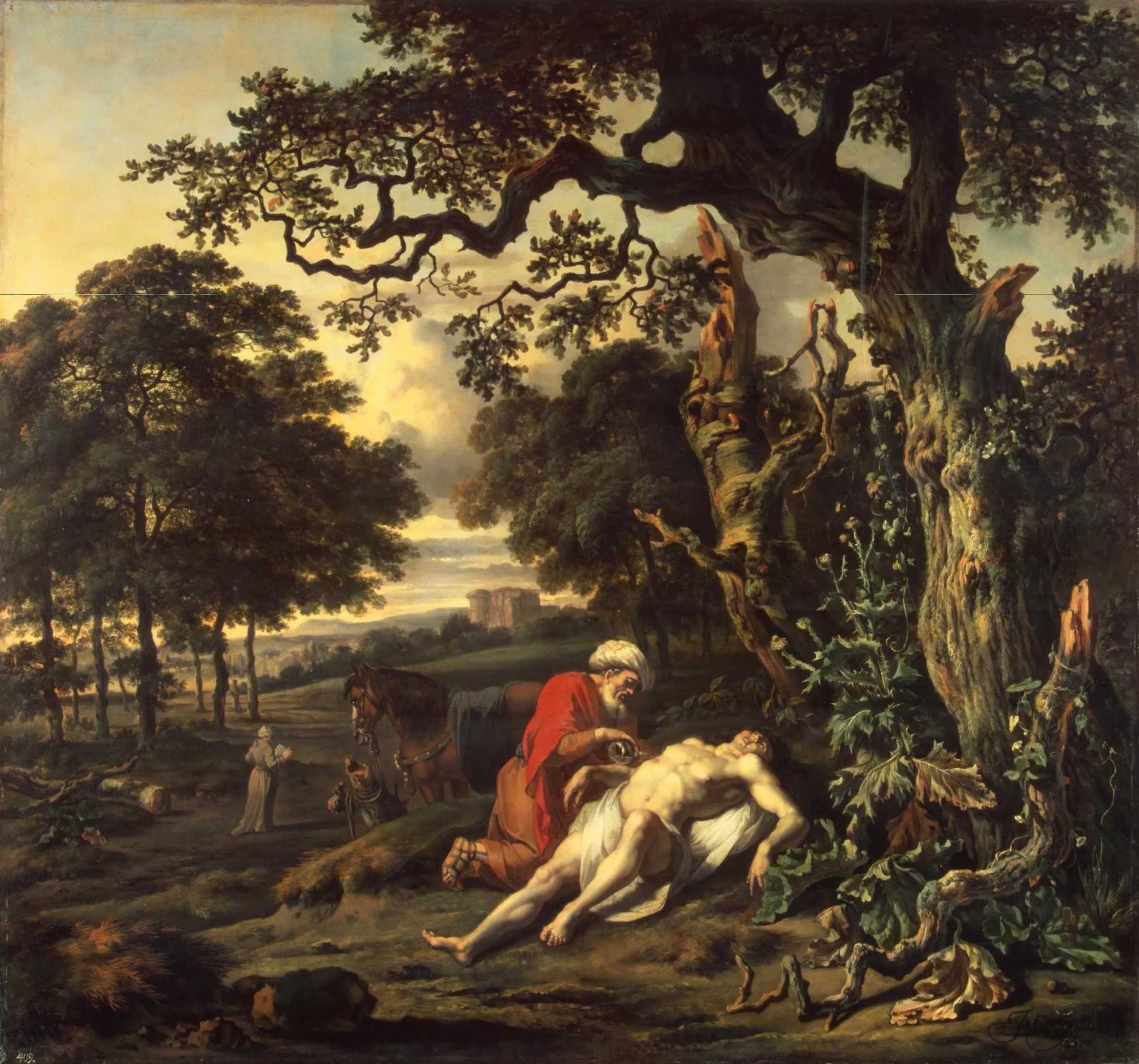
“But a certain Samaritan, as he journeyed, came where he was. And when he saw him, he had compassion” (Luke 10:33).
He had compassion — sympathy, guts turned over. This Samaritan, of course, is our Lord Jesus Christ Himself. He is the one man who ever kept the whole commandment, both tables, and no one can take that honor from Him. They called Him a Samaritan, too, not as a compliment. “Do we not say rightly that You are a Samaritan and have a demon?” (John 8:48). The heretic from the wrong mountain. He let the name stick to Him. And the old preachers noticed what the name means. Samaritan — keeper. “Behold, He who keeps Israel shall neither slumber nor sleep” (Psalm 121:4). They spat at Him, and it became an office. The Keeper came down the road.
And then, as Luther says, “now this \\alone\\ would be no special comfort for us.” Namely, that Christ kept the Law perfectly — that He loved God and took care of His neighbor — and that obedience remains His own. An obedience that remains His own, held at a distance, is no comfort to you. At that distance, it’s a score, His score, not yours. You can stand at the bottom of it and admire Him. You can say, no one has ever loved God like that — and you can say it lying in the ditch, bleeding out, with nothing changed.
That is the religion of a great many people who have never left the church — the religion of that priest and that Levite. Jesus is impressive. Jesus is the standard, the fulfiller. Every word of it is true, yet left there, you still die in your trespasses and sins. An obedience never given to you cannot save you. A perfect neighbor who walks past you is still a man who walked past you.
But He didn’t walk past you. Luther continues, “but that He has compassion on the poor wounded man, takes him under His care, binds his wounds, takes him into the inn and waits on him — this avails for us.”
He had compassion — on you, on me. That is the word the parable turns on, and it’s not a word about obedience. It’s not a lawyer word. It’s a word about His guts turning over at the sight of you. He kept the Law, yes, and He stopped — both. And the stopping is how the keeping reaches you — credited, handed over, put into your hands. It heals you.
And He didn’t stop the way I do. He went to him. He poured in oil and wine — His own, not the man’s. He set him on His own animal, which means He walked. The next day He took out two denarii and told the innkeeper, “Take care of him; and whatever more you spend, when I come again, I will repay you” (Luke 10:35).
Two days’ wages, and then a blank check. Remember, the lawyer wanted to know how far the obligation extends. Christ answers by extending it beyond the money and beyond the end of the day.
And Paul tells you this morning that it was always going to be that way. Four hundred and thirty years before the Law was spoken — before Moses on Sinai — God promised Abraham and his Seed, “who is Christ” (Galatians 3:16). The Law came afterward and never could give life. That’s where the lawyer is completely wrong. “What shall I do to inherit eternal life?” It is gift by promise. “But the Scripture has confined all under sin, that the promise by faith in Jesus Christ might be given to those who believe” (Galatians 3:22). It shuts you up in the ditch so the promise — the Keeper — can find you there.
When the story is over, Jesus hands the lawyer back his own question, turned around. The man asked, “Who is my neighbor?” Jesus asks, “So which of these three do you think was neighbor to him who fell among the thieves?” (Luke 10:36). Not: whom must you love. But: who did the loving. He wanted a boundary and got mercy. And even now the lawyer keeps his gloves on — he cannot make himself say the word Samaritan. “He who showed mercy on him” (Luke 10:37). “Go and do likewise.”
If you hear those five words as homework, hear them first as that man had to hear them. Well, there you go — now that you’ve had mercy shown to you, what’s next? Now you must do it. Go and do likewise. Learn what this means: go find your enemy in a ditch, pour in your own wine and oil, put him on your own animal, walk beside it while he rides, sign the blank check — and do all of it to justify yourself, and see how far down the Jericho road you get. He wants the lawyer to test it, to try to justify himself by the Law. To a man out to justify himself, that command is the door of the Law shutting behind him. And maybe, God willing, he will try and learn what Jesus meant. For it is not about obedience — it is about compassion, about mercy — to which there is no limit, thank God.
But you are the man in the ditch. You’re half dead and can’t ask for what you need — you don’t even know the words to say. And He had compassion.
He came where you are. He was stripped, beaten, and left for dead on a Roman cross, and He did that under you and for you. The oil and the wine aren’t a picture He left behind — He keeps pouring them into you here, this morning, in this room. You were washed at that font, and He put His name on you there. He christened you there; He anointed you there. That water killed you and raised you out of the ditch, and you have never gotten out of it on your own. He speaks over you, out of a man’s mouth, “I forgive you all your sins” — and it’s done, not because you could receive it, but because He said it. And in a few minutes He puts His body and His blood into your mouth, the same body broken on that road, the same blood poured out, for the forgiveness of your sins.
He brought you to the inn. This is the inn. He has paid the innkeeper. The bill isn’t yours, and He has said: whatever more it costs, I will repay when I come again. Paid for, finished.
Your wounds — bound. Your name — His. Your body — fed with His body. Your sin — forgiven out loud, by name. He had compassion. Indeed.
In the name + of Jesus. Amen.
Rev. Christopher R. Gillespie
St. John Ev. Lutheran Church & School — Sherman Center
Random Lake, Wisconsin