
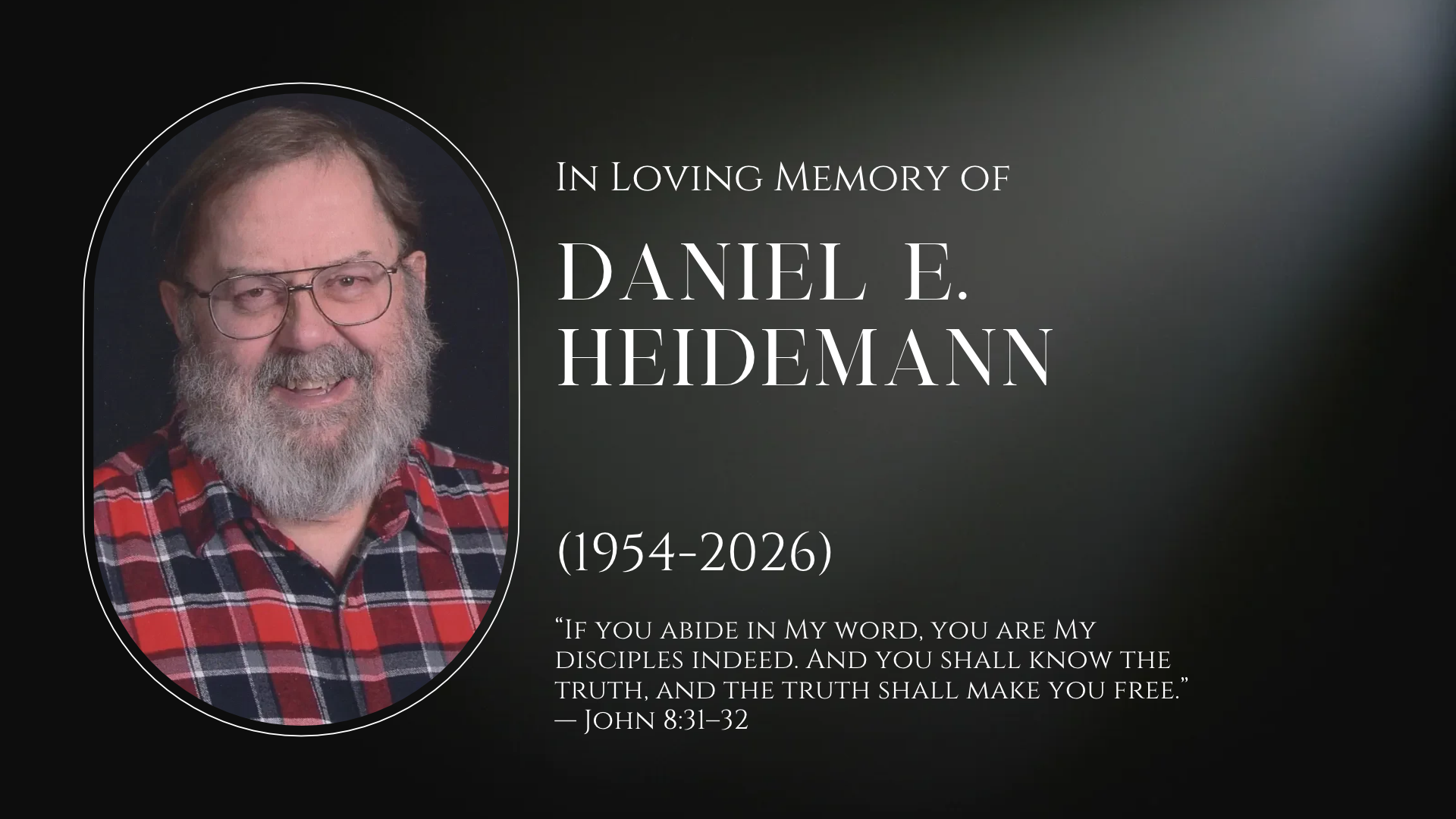

21 August 2026 • Funeral of Daniel E. Heidemann • John 8:31–36
Dear friends in Christ — Bonnie, Linda, Sandy, Susan, family and friends — grace, mercy, and peace are yours in Jesus Christ, your Lord. Amen.
Fifty-eight years ago, on the seventh of April, 1968, a fourteen-year-old Danny stood at this altar — with his classmates, some of whom I know: Edward Kurth, Keith Fisher, Joel Goetsch, Scott Friedemann, Cynthia Trott, Norm Winter, and Kathleen Goedde — and was handed this verse to take home with him from our Gospel:
“If you abide in My word, you are My disciples indeed. And you shall know the truth, and the truth shall make you free” (John 8:31–32)
If there is a good word for Danny, it’s abide. Stay put. Hold on. Keep believing, don’t let go. That’s how a fourteen-year-old boy would hear it — if he even remembered. I don’t know. I didn’t ask him. With his whole life in front of him.
Of course, he did hold on. This congregation was the only congregation he knew, from his baptism to his death. And that verse had fifty-eight years to prove itself in Dan. And it was put to the test.
As you no doubt know, and I only learned recently, in 2005 Dan very nearly died. There was the chainsaw, and then the months when nobody knew which way it would go. Touch and go, the family wrote in the obituary — and then something else happened: he was truly a walking, talking miracle. Prayers really do make miracles happen.
And that’s true, every word of it. I know you prayed for him, and then he lived, and God gave you twenty-one more years. Dan had always been the quiet one — I didn’t know he used to be quieter, but he was always quiet with me too — and I understand that afterward he did get talkative. He told people his Habeck side had finally come out. His mother’s side. I see you back there. God gave you those years. Thank Him for them.
But there’s something else we need to deal with today, and we should talk about it. We all prayed this time too. You prayed over the kidneys and the liver. We prayed together. The congregation prayed for him daily. We prayed at Sunny Ridge and in the car on the way home, when it was too hard to be in the building for one more minute. And on the seventh of August, he died.
So was this time different than 2005? Did our prayers stop working? Or was the kindness God had for him withdrawn?
Well, here’s what 2005 was. It was more time. A wedding, a wife, a smile that someone wrote online to Bonnie, to say she was the one who had given it to him — I believe it, I saw the pictures too. A real gift, and God really did give it.
But more time isn’t the same thing as the freedom Jesus spoke of today — the freedom from death and for eternal life. The chainsaw could be survived. Finally, the kidneys and the liver could not. That isn’t God losing. That’s what a miracle of that kind always was — a delay, and a good one. And yet, every person Jesus healed in the Gospels died later, too.
The prophet Isaiah says it directly: “All flesh is grass… The grass withers, the flower fades” (Isaiah 40:6–7). All flesh. Including flesh that survived a chainsaw in 2005. We prayed that it not be true, not yet, again. This time the Lord said it was His time.
So what about the confirmation verse? If abiding means stay put, hold on, don’t let go — well, Danny couldn’t hold on in the end. So where is our hope?
In the end, Dan couldn’t hold on to anything. Things were being taken from him. He was homebound, mostly. Then he was stuck in a bed, couldn’t walk. Then he was in that bed as we got to enjoy — not really enjoying it — being turned from one side to the other.
Should we have asked him to just abide harder, stay harder, try harder, as if he could have done it? No. He was honest with us. He said, in his abiding, he wanted to go home.
So listen to what Jesus says next in our Gospel:
“Most assuredly, I say to you, whoever commits sin is a slave of sin. And a slave does not abide in the house forever, but a son abides forever” (John 8:34–35).
A slave doesn’t get to stay in the house. That’s what it means to be a slave. We think like we’re slaves — we’re kept around as long as we’re useful, we think, and when we can’t produce, then we’re let go. No one owes a slave a room or a home.
So if Dan were a slave, well, then it’s true — in the end, Dan didn’t have anything left to offer, or not much. The farm he grew up on, Fleet Farm, the feed mill at Waldo, Gehl, Kohler — for all the years I’ve known him, decades of going out in the morning and coming home at night, all of it behind him now. He couldn’t work, even if he wanted to. He wasn’t going back out for deer or for bear, although I hear he did go fishing just a few weeks ago. And in the end, he couldn’t even get himself a glass of water.
If Dan were a slave, then his service was ended. But hear what we confess is true for every one of our days — be it times of need and suffering, or be it times of joy and pleasure: “The Lord will keep your going out and your coming in from this time forth and forevermore” (Psalm 121:8). Every one of those mornings, the good ones and the hard ones. Every one of those drives back and forth to dialysis. The Lord was with him. “He who keeps you will not slumber” (Psalm 121:3) — so not just the mornings, then, even through the evenings. Not through the working years, not through the hospital nights, and not even the last one, that morning.
Dan’s standing before God was never built on anything he could do. We thank God, of course, for all the things the Lord did through him. But our standing isn’t in the things we do either. Church attendance, being a decent guy, never having done anything truly terrible — at least not that he told me — having prayed when it counted. That’s how a slave thinks. And in the end none of it holds up, finally, when the last enemy comes that needs to be defeated — death.
That’s the fear behind a day like this one. Not only, will my prayers be answered — or weren’t they answered this time? It’s deeper than that. Am I still wanted by God when I have nothing left to give?
So hear the rest of Christ’s Word from our Gospel, His promise: “But a son abides forever.”
A son doesn’t get to stay just because he’s useful. He stays because of whose house it is. You don’t put a boy out of his father’s house just because he’s taken sick. He’s a son. And what belongs to his father belongs to him — the house is his too. So how can a slave become a son? A slave can’t promote himself out of the bondage that owns him. That’s the one thing he has no power to do. Is it even possible?
Of course it is. It was on the twenty-first of February, 1954. Dan was one month old to the day — born the twenty-first of January. Lester and Marion called for the pastor. They brought the pastor out to the house, according to our records, and Rev. Zapf poured water over a month-old baby and gave him the Name of the Father and of the Son and of the Holy Spirit.
What could a one-month-old Dan do on that day to make himself the son? He didn’t decide, or consent, or cooperate, or even abide — hold on. No, someone carried him. The Lord called him. We spoke of this already with the Shepherd who carries the lambs, and we have the picture to see it — the Lord carried him in. And in that water, God took a slave and made him a son. And God held fast to Dan.
That’s what we confess about Baptism: that it “works forgiveness of sins, rescues from death and the devil, and gives eternal salvation to all who believe this, as the words and promises of God declare.” Baptism works — not begins to, or offers, or something he had to finish himself. It was done, and done for Daniel Heidemann on the twenty-first of February, 1954. Now, with that, we can hear Dan’s confirmation verse again.
“If you abide in My word.” Take that in light of what we know about Baptism. The son’s abiding isn’t his grip on God — although we do — it’s God’s grip on the son. It was never Dan holding on to Jesus that kept Dan in the Father’s house. It’s Jesus holding on to Dan. And that grip on him didn’t loosen when he got sick. It didn’t slip when the chainsaw slipped. It didn’t loosen at whatever hour on the seventh of August when he stopped breathing. Jesus still hasn’t let go of him. Jesus abides with him, and he with Jesus.
“Therefore if the Son makes you free, you shall be free indeed” (John 8:36). Free indeed. Not free for a while. Not free as long as your health holds on. Free indeed — free forever.
Now, of course, that freedom cost something — not to Dan, but to the Son. The Son who says a son abides forever is the same Son who was put outside the house — outside the city, left in the dark, forsaken. Jesus took the slave’s death so Dan could have the son’s room in the house. Jesus was thrown out so Dan could stay. And on the third day He walked out of His own grave alive, which is the only reason His Word is trustworthy and true — and that we have confidence that Dan, too, will rise on the last day.
You sang it with this kind of confidence just a few minutes ago. Listen to what you were singing: Though He giveth or He taketh, God His children ne’er forsaketh — that’s old English, but you get it. Giveth: that was 2005. Taketh: that was the seventh of August. Ne’er forsaketh: that was both those days, and every day in between, from his baptism into Christ to his going home to be with the Lord. Though He giveth or He taketh, God His children ne’er forsaketh.
Which means that even your prayers weren’t wasted this last month, and they weren’t refused either. They were indeed answered — maybe not exactly in the way we would have liked, not with more time this time around, but with the thing they were always reaching for: for Dan to be free, for Dan to be home. Dan is in the Lord’s house.
And what you watched was real, but it wasn’t all that was happening. “Even though our outward man is perishing, yet the inward man is being renewed day by day” (2 Corinthians 4:16). We watched the outward man perish — the span of a week, and numbers on a chart. But there was also something in that bed we couldn’t see, and St. Paul calls it renewal — right up to the last day.
Carried to the font at a month old. Carried out of that bed at seventy-two. He never once got there under his own strength, and neither will any of us. That wasn’t how the Lord arranged it.
So maybe you’re sitting here too, still thinking about your standing before God. Maybe church hasn’t been part of your life for a long while, or it never really was, and some part of you is thinking like a slave — measuring up, thinking maybe you’ve fallen short of the glory of God. This is as much for you as for anyone here. We don’t do math in the church — I know he learned it over at school, but we can set it aside here. Slaves do arithmetic. Sons are simply home. This is home. Danny, it’s home.
Has the Name of God been put on you in water? Then what was done for Daniel Heidemann in 1954 was done for you. You didn’t earn it, and you can’t lose it — by being weak, or by being away, or by being tired, or sick, or dying. Each of us will finally be in a bed someday with nothing left to offer. On that day, this will be the only thing that holds. And it will hold.
The slave does not abide in the house forever. The son does. Thus, our brother Dan abides. Dan is the Lord’s son. Heaven is Dan’s home. He is with Jesus, and he always was.
In the Name of the Father and of the Son and of the Holy Spirit. Amen.
Rev. Christopher R. Gillespie
St. John Ev. Lutheran Church & School — Sherman Center
Random Lake, Wisconsin