

23 August 2026 • Trinity 12 • Mark 7:31–37
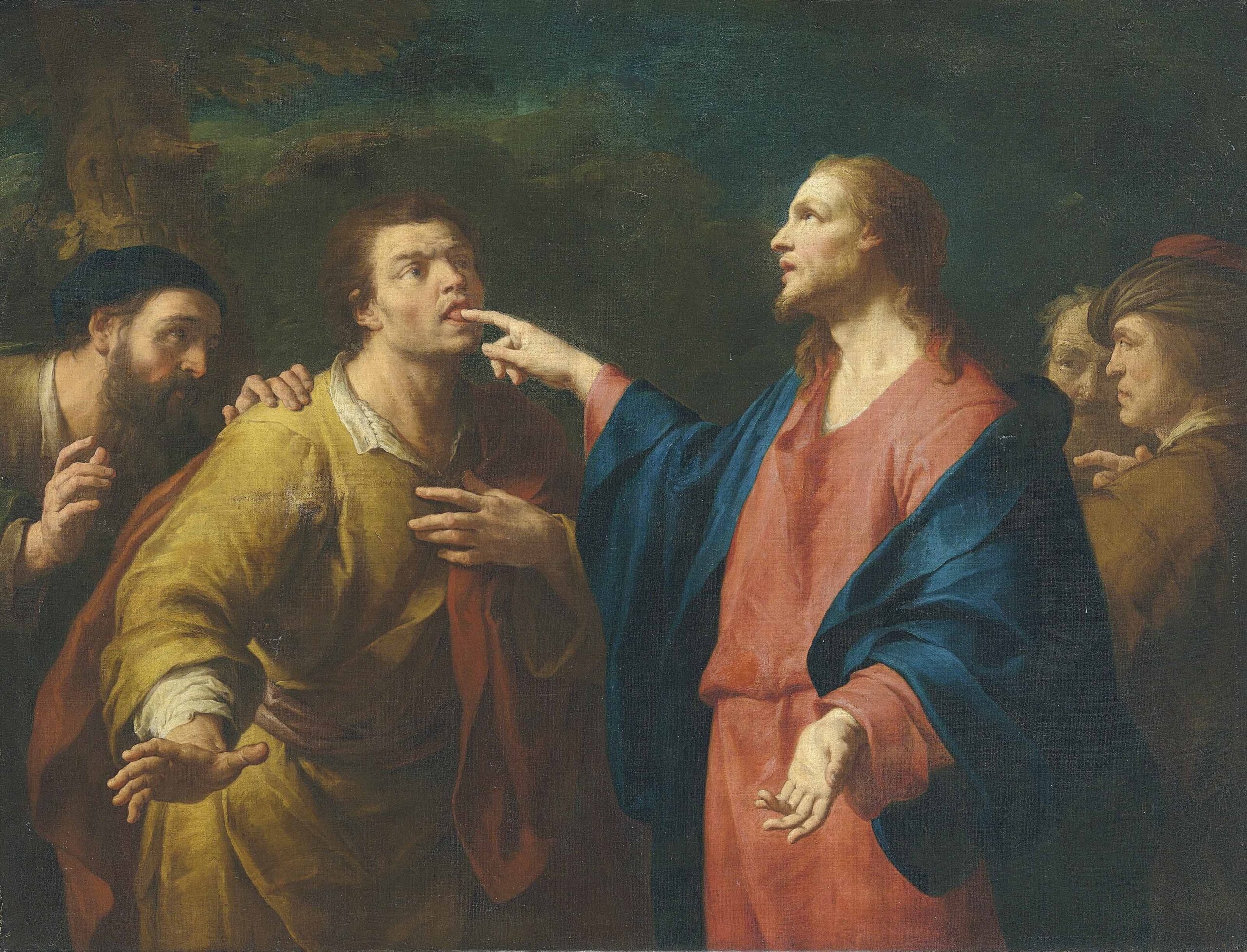
And He took him aside from the multitude, and put His fingers in his ears, and He spat and touched his tongue. Then, looking up to heaven, He sighed, and said to him, “Ephphatha,” that is, “Be opened.” (Mk 7:33–34).
In the holy Name + of Jesus. AMEN.
Sighing is a language everybody speaks. Nobody taught you. Nobody had to. It was in you the first time something broke — maybe a toy — that you couldn’t fix. We sigh at the kitchen table, with the bills spread out and the calculator saying the same thing month after month. We sigh in the truck in the dark. We sigh in the parking lot of the nursing home, and at the edge of a field that needed rain three weeks ago. We sigh over our children, who will not listen.
And in the Gospel today, Jesus sighs. Jesus acts bodily. Of all the things He does in this story — the fingers, the spit, the word of power — St. Mark writes down the sigh. Jesus looked up to heaven, He sighed, and said, “Ephphatha” (Mark 7:34). The Son of God, with a broken man in His hands. And He rightly sighs.
We sigh because we know this is not the way it is supposed to be. A sigh is the sound the curse makes coming out of a human being. Adam was not made to sweat over thorns until he returned to the dust. Eve was not made to bury a son. We were made for a garden, for a God who walked with us in the cool of the day and whose voice was not frightening but home. And we lost it. All of it. So now “the whole creation groans,” St. Paul says, and we groan with it, waiting for the redemption of our bodies (Romans 8:22–23). The cornfield groans. The nursing home groans. Your own chest groans.
And our sighs do nothing. We can’t sigh the tumor out of the body. We can’t sigh the checkbook balanced. We can’t sigh our dead back. We are small, the curse is big, and we cannot lift it. The curse does not care how hard we work. And we are tired. There’s lots to sigh about.
But our trouble goes deeper than tired. There is a deafness in us worse than the deafness in this man. His ears were broken; Scripture teaches our hearts are. God has been speaking to us all our lives, and how much of it gets in? We hear, and we do not hear. We sit in these pews the way that man stood in that crowd: present, and sealed shut. What are our prayers, most days? Sighings. Stutterings. Mutterings. Half a table prayer with our minds already on the food. Days of silence toward the God who has never once been silent toward us. We are that man. Deaf to God and tongue-tied before Him, born that way. And a deaf man cannot hear his way out of deafness, any more than a dead man can wake himself.
So look at what Jesus does. He is in the Decapolis, pagan country, where nobody is waiting for a Messiah. And they bring Him a man who has never heard one word in his life. Not his mother’s voice. Not his own name. Because he never heard, he never learned to speak — two losses that are really one.
First, Jesus takes him aside, away from the crowd. This is not a show. He is one man, and Jesus deals with him the way God deals with every one of us — one at a time, privately, as if there were nobody else in the world to save. Then Jesus does the strangest thing. He puts His fingers into the man’s ruined ears. He spits, and touches the man’s dead tongue. God has fingers now. God has spittle. The Maker of heaven and earth has come down far enough to reach into a broken man’s ears with His own hands. Our God is not an idea, not love-in-general above the clouds. He is this near. He touches. And then, looking up to heaven, He sighed.
What was in that sigh? Everything. In that one breath Jesus pulls the whole weight of it into His own chest — this man’s ruined ears, and behind them the whole ruin they came from. Your mother who no longer knows your name. Your child who will not come to church. Every casket or urn this congregation has ever carried out those doors. He does not merely pity our misery. He takes it into Himself. And what He breathes out is one word: “Ephphatha.” Be opened. And the ears opened, the tongue came loose, and the first thing it ever did was praise Him.
But that word cost Him. That sigh went where He went. On a hill outside Jerusalem, Jesus looked up to heaven one more time. This time heaven did not look back. The Son who opened deaf ears hung there with heaven shut against Him, crying, “My God, My God, why have You forsaken Me?” (Mark 15:34) — “Why are You so far from My groaning?” (Psalm 22:1) — and no answer came. He who made the mute to speak became the mute one; the psalm of the cross says it: “My tongue clings to My jaws; You have brought Me to the dust of death” (Psalm 22:15). He was deaf to no one, and heaven went deaf to Him. He took the deafness. He took the silence. He took the curse that makes us sigh. And when He had taken the last of it in, He sighed one last time — “It is finished” (John 19:30) — and gave up His spirit. He breathed the curse in. He breathed your blessing out. That is what a sigh from God can do.
Three days later that chest filled with breath again. He stood among His frightened friends, and He sighed on them — “breathed on them, and said, ‘Receive the Holy Spirit. If you forgive the sins of any, they are forgiven’” (John 20:22–23). His breath is loose in the world now, and it is full of blood-bought forgiveness.
And He does for you exactly what He did for that man. At that font He took you aside — you, by name, not mankind in general — and He put His Word into the water and His fingers into your ears. The old baptismal rites before Luther even said the word over the child at the font: Ephphatha. Whether your pastor said it or not, Jesus did. That is why the Word gets in at all — not because you are a better listener than your neighbor, but because Jesus opened your ears, and keeps opening them, Sunday after Sunday. And when your sins are forgiven — at the start of every service, and any time you bring your pastor the ones that will not let you sleep — that absolution is His breath on you, the same breath of Easter evening, and it does what it says.
And in a few minutes He will touch your tongue. Not with spit this time, but with His own body and His own blood, given and shed for you, laid onto the very tongue that could not praise Him and now can. This is where your sighs belong. Bring them here — the ones you can put into words and the ones too deep for words — the checkbook, the biopsy, the empty chair. Lay them on this altar, and He will breathe them in, and He will lay His life on your tongue. You will walk back to your pew carrying His body and blood, and He will keep carrying your curse. That is the exchange He died to make. It is extraordinary.
And the crowd, astonished beyond measure, said, “He has done all things well. He makes both the deaf to hear and the mute to speak” (Mark 7:37). They spoke better than they knew. The last time anyone said that over this world, it was God Himself on the sixth day: “behold, it was very good” (Genesis 1:31). Now the Maker stands in the Decapolis in flesh and blood, making it all good again — starting with one deaf man’s ears, and continuing this morning with you. He has done all things well. He has done you well. And He is not finished. The day is coming when the last sigh will be breathed; He will wipe every tear from your eyes, and everything will be very good again.
In the holy name of Jesus. Amen.
Rev. Christopher R. Gillespie
St. John Ev. Lutheran Church & School — Sherman Center
Random Lake, Wisconsin