
15 November 2026 • Trinity 24 • Matthew 9:18–26
But Jesus turned around, and when He saw her He said, “Be of good cheer, daughter; your faith has made you well.” And the woman was made well from that hour. (Mt 9:22).
This is the Word of the Lord that came to me, so that you may believe that Jesus is the Christ, the Son of God, and that by believing, you may have life in His + Name. AMEN.
People used to have a trick for remembering something. If there was something you didn’t want to forget, you tied a string around your finger, maybe a bit of red yarn or a piece of twine from the barn. Of course, that piece of string did nothing by itself. It sat on your hand all day, and every time you saw it, it said one thing to you: Remember. You have something to do, or someone to call.
God gave Israel a string like that. In the book of Numbers, He told Moses, “Tell them to make tassels on the corners of their garments throughout their generations, and to put a blue thread in the tassels of the corners. And you shall have the tassel, that you may look upon it and remember all the commandments of the Lord and do them” (Num. 15:38–39). So every faithful Israelite wore these tassels. Every time he looked down, the tassel said one thing to him: Remember. You have something to do. “Remember and do all My commandments, and be holy for your God” (Num. 15:40). So the Lord spoke through Moses.
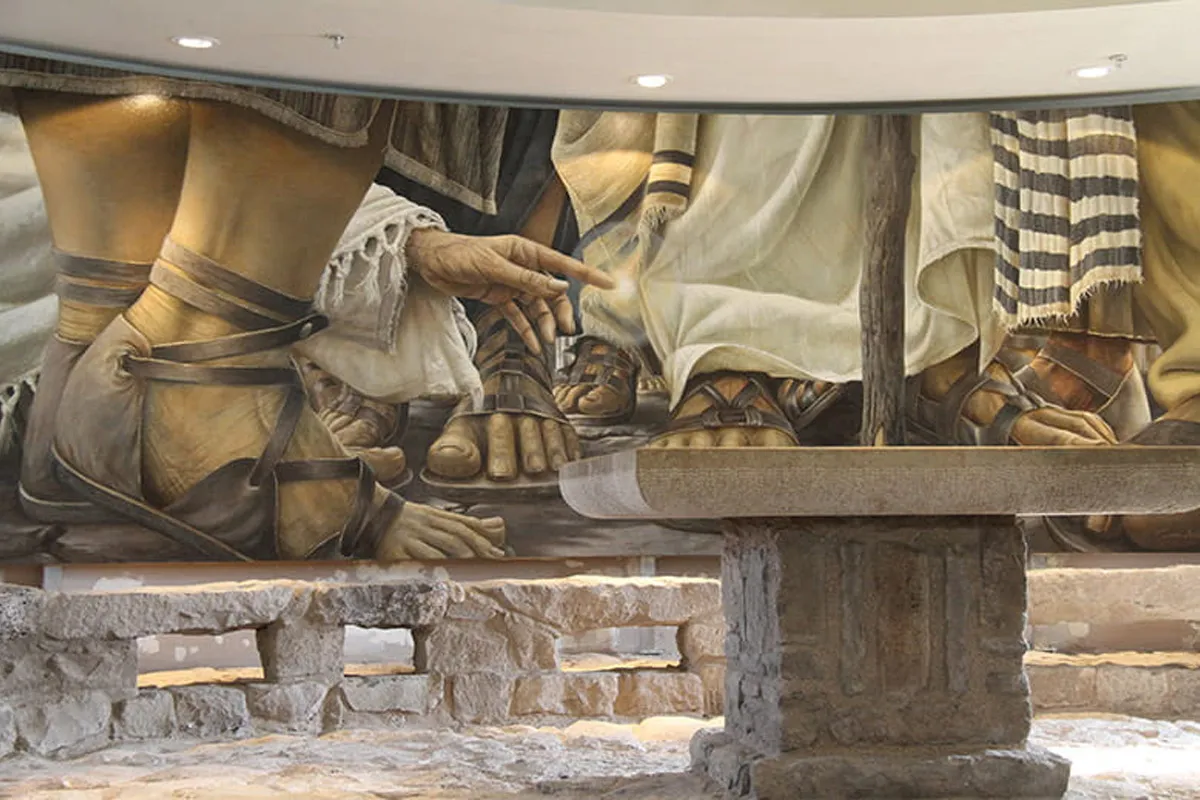
Jesus, too, wore these tassels. He was a faithful Israelite. And in today’s Gospel, a woman reaches through the crowd and grabs at one of them. St. Matthew uses the word the Greek Bible uses in Numbers. “A woman who had a flow of blood for twelve years came from behind and touched the hem of His garment” (Matt. 9:20). That hem, that tassel, was the Law’s own reminder, hanging from the corner of our Lord’s robe.
But first see what the tassel had become. Later Jesus says of the Pharisees: “All their works they do to be seen by men. They make their phylacteries broad and enlarge the borders of their garments” (Matt. 23:5). Same word there. The borders are the tassels. They made them longer, and they added more of them. The string that said, “Remember, you have something to do,” now said, “Look at me. Look how much I have done. Look how I’ve fulfilled the Law,” right there on the hem. The Law became a costume.
That’s the oldest religion in the world, and it is practiced here in Sherman Center as well as there in Jerusalem. It goes like this. You know the Commandments. You learned them by heart in confirmation. You didn’t even need the blue sheet. You can say them. And the old Adam in you treats them like a long tassel. He looks down at the Commandments and does not hear, “Remember, and do them.” He hears, “You’ve done pretty well.” I don’t steal. I don’t kill. I’m here on Sunday. I’m not like some people. That is a tassel worn not to remember, but to be seen. Look down and read what it actually says. We should fear, love, and trust in God above all things. Worn like that, the Law cannot do the one thing God made it to do. It cannot make you remember what you owe.
So look at the woman. She has no illusions about the tassel. For twelve years the Law has had one thing to say to her. A woman with a flow of blood “shall be unclean.” Every bed she lies on is unclean. Everything she sits on is unclean. “Whoever touches those things shall be unclean” (Lev. 15:25–27). For twelve years she could not go into the temple or into a synagogue. For twelve years every chair she sat on and every person she brushed against in the street, she made unclean, and they would have to go and wash. She did not need more and longer tassels. To her the Law was a diagnosis. Every time she looked at it, it did not say, “Look at me.” It said, “Unclean.”
So she comes to Jesus, not from the front, but from behind. That is how every sinner comes to Jesus: from behind, in fear and humility, counting himself or herself as nothing. She does not ask. Being unclean, she dares not even be seen by Him. She just wants to touch Him and slip away. “If only I may touch His garment, I shall be made well” (Matt. 9:21).
By the Law, her touch makes Him unclean. Her twelve years of blood go up her arm and into His tassel, and the Holy One of Israel is now the defiled one.
Instead, “the woman was made well from that hour” (Matt. 9:22). The uncleanness does not go to Him. The cleanness comes to her. Surprise! It runs the other direction, backward, against the current of the Law, from the one Man who kept every commandment the tassel ever reminded anyone of, into the woman the Law had shut out.
Of course, the cloth did not do it. An old Lutheran catechism, with its questions and answers, asks, “Did Christ’s garment heal her, then?” It answers no: “Not the garment, but her faith in Jesus Christ.” The tassel only marked where Jesus was. The power was His. So He does not let her slip away. “Jesus turned around, and when He saw her He said, ‘Be of good cheer, daughter; your faith has saved you'” (Matt. 9:22), or, if you like the softer translation, “made you well.” She came to steal a cure from behind. Then He turns around to face her, and He gives her a new name. For twelve years, when she came near, everyone cried out “Unclean,” as at a leper. Jesus calls her “daughter.” The Lord here “goes to work and absolves her” (Luther). That is what it sounds like when Jesus turns around.
And then He does it again. He goes into the ruler’s house, where the flute players are already playing, the crowd is wailing, and the girl is dead. The Law has a word for that one too. “He who touches the dead body of anyone shall be unclean seven days” (Num. 19:11). Jesus puts the crowd out. “He went in and took her by the hand, and the girl arose” (Matt. 9:25). Again the Law says He will now be defiled. But again it runs the other way. Death does not get into Him. His life goes into her. Twice in one afternoon He touches what the Law says will make Him unclean, and twice the uncleanness loses.
How can this be? What makes Jesus different? He is the only one who ever wore the tassels on the hem of His garment and kept what they said, who remembered and did them. He is the only Israelite who looked down at every commandment and did it, and was holy for His God. He did not even need the reminder. They are His Word, His commandments. And still He wore those tassels, for her and for you.
And the Law of God is not mocked. The uncleanness He took away had to go somewhere. Turn a few more pages in St. Matthew’s Gospel, to chapter 27. “Then they crucified Him, and divided His garments, casting lots” (Matt. 27:35). The soldiers gambled away the robe with the tassels on its corners under the cross. They stripped the Holy One and hung Him outside the city, now truly as the unclean thing. Or, as St. Paul says, “He made Him who knew no sin to be sin for us, that we might become the righteousness of God in Him” (2 Cor. 5:21). That was our memory verse a few weeks ago. So the woman’s blood, the girl’s death, your sin, my sin, the long tassel and the short one, all of it went onto Him there. He was made unclean so that the cleanness would run backward into you and me.
So we might ask, where is that hem with its tassels today? You are not in the crowd pressing on Jesus in Capernaum. But Christ “has garbed Himself” for you today “in the Word and in the holy Sacraments of Baptism and the Lord’s Supper” (Gerhard). That is where the tassel hangs for you now. In the font, where the water touched you and God put His Name on you. In the absolution, where He does not turn His back to you. He turns, faces you, and says, “Your sins are forgiven you.” And at this altar He does not leave you only the edge of His robe. He puts His own body into your mouth and His own blood on your lips. “Take, eat”; take and drink. Not a sign. Honest-to-goodness body and blood.
And here the Law speaks again, just as it did to the two in our Gospel. You will make Him unclean. You will defile the Sacrament. You know what you did this week. Maybe you have sat back for a long time, coming from behind, so to speak, in fear and trepidation, thinking even today that you are too unclean to come forward. But hear what happens when the unclean come to Jesus in repentance and faith, however weak, be it the woman with the flow of blood or the dead girl. His cleanness runs backward. Every time. You would make Him unclean, but His body cleanses you. The same body and blood go out to you and to me, to our homebound, to the bed and the chair the Law would call unclean, and it does the same there as it does for you here.
So you don’t need tassels on your garment. You don’t need a list to remember. But you do need Jesus to remind you who you are. You are not the one who wears tassels to be seen: “Look at me and my obedience.” You are not the one shut out behind the crowd like that woman. You are the one He turned around for. You are His son. You are His daughter.
Remember the string on the finger? It said, “Remember, you have something to do.” The tassel said the same thing, and it was true: keep the Lord’s commandments. But it could not make anyone clean. The Law only accuses, always accuses. So today Jesus gives you a different reminder. “This is My body which is given for you; do this in remembrance of Me” (Luke 22:19). He gives you His body and His blood, and they remind you not of your disobedience and uncleanness, but of what He has paid. On His side there is a remembering too, and a forgetting. “I will forgive their iniquity, and their sin I will remember no more” (Jer. 31:34), says the Lord. The tassel said, “Remember the commandments, and do them.” The Lord of the tassel says, “I remember your sin no more.” Come and take hold of Him, as He turns to you in His grace and mercy.
This is the Word of the Lord that came to me, so that you may believe that Jesus is the Christ, the Son of God, and that by believing, you may have life in His + Name. AMEN.
Rev. Christopher R. Gillespie
St. John Ev. Lutheran Church & School — Sherman Center
Random Lake, Wisconsin