

27 September 2026 • Trinity 17 • Luke 14:1–11
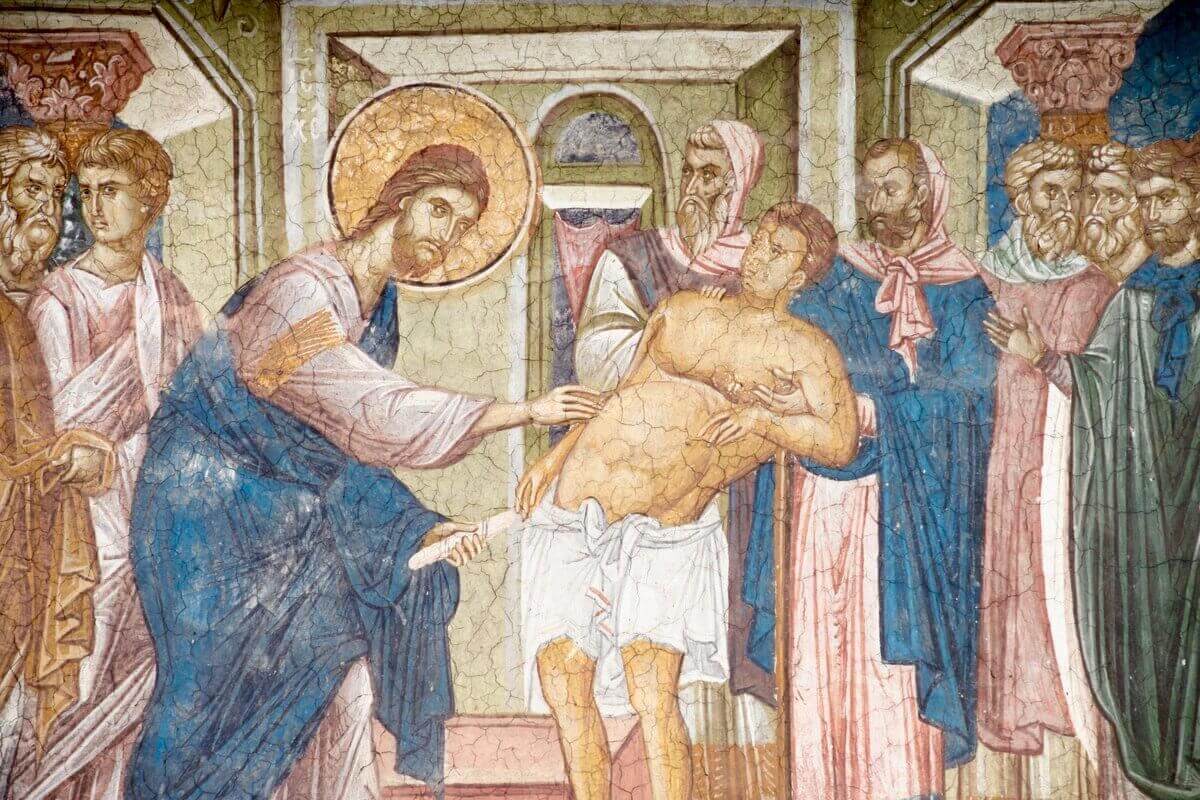
“And behold, there was a certain man before Him who had dropsy. And Jesus, answering, spoke to the lawyers and Pharisees, saying, ‘Is it lawful to heal on the Sabbath?’ But they kept silent. And He took him and healed him, and let him go” (Luke 14:2–4).
In the Holy Name of + Jesus. Amen.
Behold. It’s a word the evangelist uses to make you stop and look. Here Luke uses it at a dinner party. Jesus is at dinner in the house of a ruler of the Pharisees, and it’s the Sabbath. All the best people in town are at the table, and they’re watching Him closely. And behold! You expect Luke to show you something magnificent. Heaven opened and the angels singing, or something. But what he shows you is a man with dropsy.
Today we call dropsy edema, as you know. The body fills with fluid it can’t get rid of. The legs swell, or the belly swells. The skin stretches tight and shines. Something deeper has failed, and the swelling is how we see it from the outside. Some of you might even know this sickness. You’ve watched it in your father’s ankles or your mother’s hands in their last years.
So the sick man, the man with dropsy, is also thirsty. His body is drowning in water, but part of the sickness is that he still wants more of it. So he drinks. And the more he drinks, the more he swells. And the more he swells, the thirstier he gets. In other words, the thing he craves is killing him. An old saying fits it. It comes by the pound, and it leaves by the ounce.
Now, this Gospel may have sounded like two stories, because after the Sabbath healing there’s a parable, a lesson on where to sit. But Luke gives you one table, both events on the same afternoon, and the old preachers of the Church, I think, saw why. The man with dropsy is a picture of everyone else in the room. What is swollen on the outside of that one man is swollen on the inside of everybody else at the table. It’s only that his sickness shows.
So let’s look at them. They watch Jesus closely, the way you watch a man you hope will slip up. The sick man is standing in front of them, and they don’t see him. They see a chance to catch Jesus breaking the Sabbath.
Jesus, of course, knows. And so He asks them a plain question. “Is it lawful to heal on the Sabbath?” (Luke 14:3). If they say yes, they lose their case against Him. If they say no, they have to say out loud, with the sick man standing there, that he ought to stay sick. So they keep quiet.
So He asks them again. “Which of you, having a donkey or an ox that has fallen into a pit, will not immediately pull him out on the Sabbath day?” (Luke 14:5). And of course every one of them would. Every farmer here would. If a steer goes into the ditch on a Sunday morning, you don’t keep going to church and wait until Monday. You go get it out. The law bends for the ox. But the law won’t bend for this man.
Then Jesus watches them go to the table. He sees them sizing up the seats, who gets to sit nearest the host, the jostling, the jockeying, who gets the place of honor. And the point is, it’s the same story. They have the same kind of thirst. You get the good seat, but immediately you want the better one. You get noticed, and now you need to be noticed even more. You’re respected, and then you worry about losing that respect. Every drink of pride makes you thirstier for more.
And Jesus tells them where that thirst ends. You take the higher seat. Someone more honorable than you walks in, and the host comes over, and in front of everyone he says, “Get up. Give place to this man” (Luke 14:9). And you have to get up, and pick up your plate, and walk past all of them, in shame, to the far end of the room. “You begin with shame to take the lowest place” (Luke 14:9). And the same people you wanted to impress have to watch you leave in shame. As Jesus said, “Whoever exalts himself will be humbled” (Luke 14:11).
Of course, a day is coming when the Host of heaven and earth will arrange every seat Himself, and no one will argue with Him about where they belong. Some who were sure of their seats will not get to go to the table at all. There’s many a parable about that.
Now, I know this sickness of pride doesn’t actually feel like a sickness, exactly. A man swollen with water can look well fed. Pride is like that. It can feel like fullness. The man with dropsy knew he was sick, and he still let himself be seen. The men around the table thought they were fine. I think they’re in more danger than he was. They don’t even know their sickness.
Dear Christians, you have this thirst too.
You probably know it best with money, as we heard from Proverbs today. You get what you’ve been working for, and then it’s not enough. The better price, the bigger yield, the next thing. The old Lutheran preacher wrote that the greedy man forever thirsts for more, and the more he acquires, the more he thirsts. It never says, “That’s enough. I am content.”
Or maybe you know it with your name, your reputation. In this small community, everybody knows who’s who. Whose family has been here the longest. Who sits where. Who got asked and who didn’t. So you want to be thought well of. That’s not a problem so far as it goes, but when someone else gets honored before you, then you feel the sting, and you’re ashamed of it.
And of course, you can’t cure any of this by just trying to be more humble. That’s another trap. If you hear Jesus tell you to take the lowest seat, and you sit low so that you’ll get moved up, well, then you haven’t really been cured yet, have you? You’ve found a smarter way to get the good seat. Clever. You’re still arranging, though, where you sit. A man with dropsy can’t drink his way out of it, and you can’t humble your way out of your pride. The sickness is in the heart, and it came in by the pound.
So what does Jesus do with a man like that? Be it edema or pride? “He took him and healed him, and let him go” (Luke 14:4).
He took him. In other words, Jesus came close enough to take hold of him. He put His hands on that swollen body, the one nobody else would even be willing to touch, and He healed him all at once.
You see, there was already a more honorable Guest at that table, in the Pharisee’s house that day, the One they had invited to catch Him in His words. He had every right to the highest seat in that house. Indeed, the King’s seat. But He didn’t take it. He stood with the sick man. When Israel found the water at Mara bitter, the Lord made it sweet and revealed His name to them: “I am the LORD who heals you” (Exodus 15:26). And that is the Lord at the Pharisee’s table, the Lord who heals, in the flesh, with His hands.
This is not like a doctor who treats the disease from the outside, or applies some kind of medicine that only makes the symptoms better. Jesus takes the sickness into Himself. “He Himself took our infirmities and bore our sicknesses” (Matthew 8:17). The Son of God takes the lowest place so that He can take the sick man’s place, even in death. He took your pride, and your thirst, and your grasping for the best seat, and He carried all of that to His cross. And there He cried out, “I thirst!” (John 19:28). There they lifted Him up to die. There He bore the shame that belonged to you, so that it’s gone. And the Father raised Him and gave Him the highest place, at His right hand.
That’s how His kingdom works. The Host gives the seats. And the Host calls you “Friend” and says, “Go up higher” (Luke 14:10). Go up higher. You don’t sit at God’s table, or kneel, because of your merits. You sit there because of His mercy. He invited you. He gives to you. Solomon said it long before: “It is better that it be said to you, ‘Come up here'” (Proverbs 25:7). And the King has said it. To sinners. To the sick. To you.
So the people seated by His mercy at His table don’t have to fight each other for the best seat. Who gets to go up first? You’re welcome to sit farther forward, by the way, if you want to come up before the others. No, we don’t fight for our seats. St. Paul writes, “with all lowliness and gentleness, with longsuffering, bearing with one another in love” (Ephesians 4:2). And you don’t have to watch each other, either. Let me see who is more important, or who has more of this or that. No, you bear with each other, he says. And you can, because your place at the Lord’s table is secure. It was given.
The man with dropsy didn’t earn his seat at the Pharisee’s table that day. He didn’t have to win any argument. He didn’t have to be anything, at least in Jesus’ mind, except sick, and in need of his Healer, his Physician, Jesus. And when he walked out, the whole table watched him go, now with the swelling gone. That is the “glory in the presence of those who sit at the table with you” (Luke 14:10). And his thirst was gone too, satisfied in Jesus.
That’s where you are this morning. Sick, of course, but before Jesus, and thirsty. All week the world will offer you more to drink, and it won’t satisfy: the better price, the good seat, someone’s good opinion, a better job. Every drink, though, will make you thirstier. But Jesus gives you something better to drink, a different water. As He says, “Whoever drinks of the water that I shall give him will never thirst” (John 4:14). His Word does that. His forgiveness does that. It fills you without swelling you. It’s the one drink that ends the thirst, and He gives it to you for free today.
In the Holy Name of + Jesus. Amen.
Rev. Christopher R. Gillespie
St. John Ev. Lutheran Church & School — Sherman Center
Random Lake, Wisconsin