
23 September 2026 • Friday of Trinity 16 (observed) • Mark 8:22–26
In the name of the Father and of the Son and of the Holy Spirit. Amen.
Bethsaida is not a town you can visit anymore. It was the town Andrew, Peter, and Philip came from, and today two teams of archaeologists each say their pile of stones is Bethsaida, but of course neither can prove it. The town is gone, and that is no surprise. Jesus said it would be. “Woe to you, Chorazin! Woe to you, Bethsaida! For if the mighty works which were done in you had been done in Tyre and Sidon, they would have repented long ago in sackcloth and ashes” (Matt. 11:21). In other words, it was a town that saw Him and did not really see Him for who He was.
That is the town they bring the blind man to, and the first thing Jesus does is take him out of it. “So He took the blind man by the hand and led him out of the town” (Mark 8:23). They had begged Him to touch the man, and before there is any healing, He gives them what they asked for. He takes the man’s hand. The blind man is walking a road he cannot see, out of a town that cannot see, and all he knows about the road is that there is a hand around his, leading him.
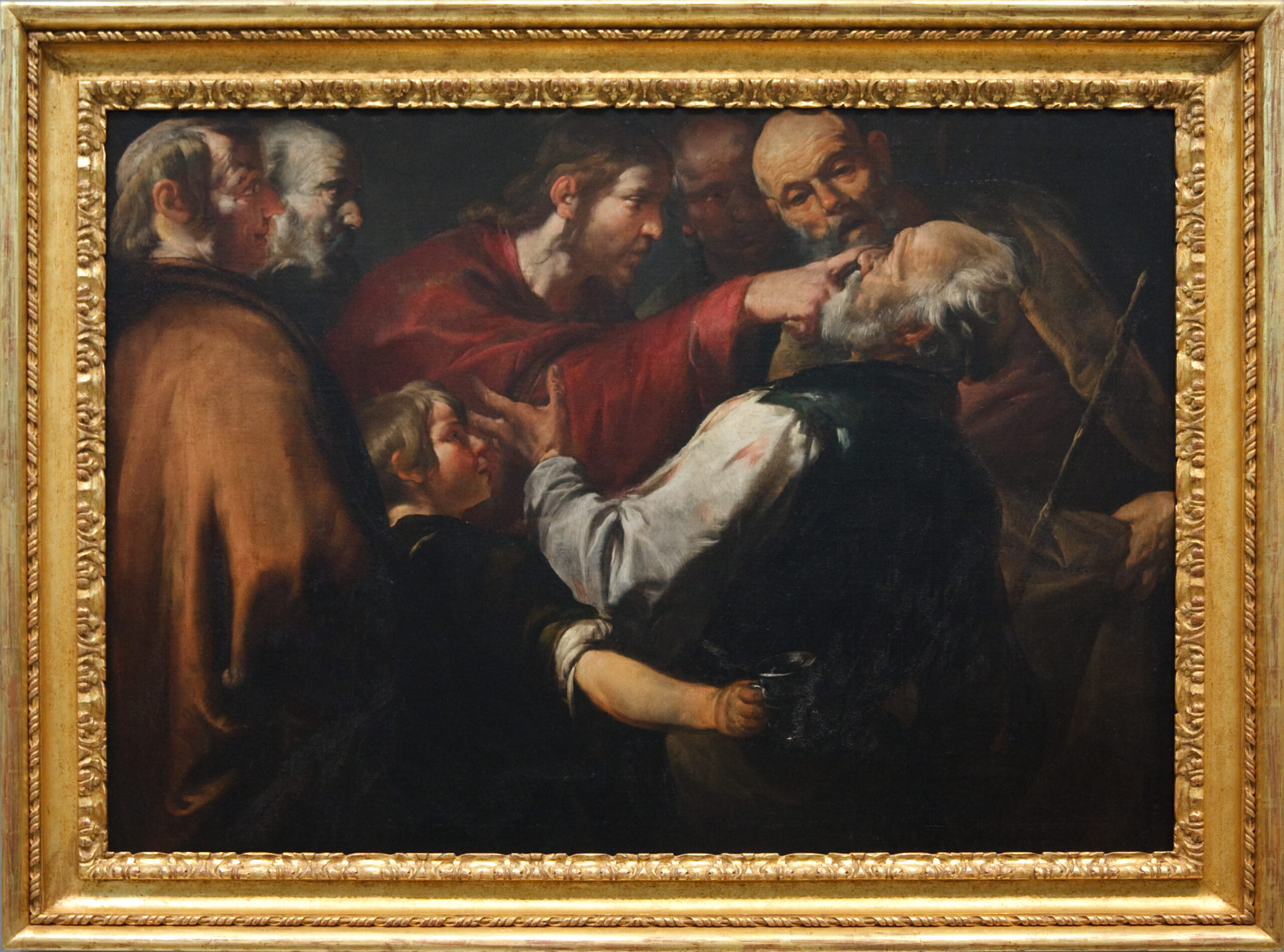
Then Jesus spits in the man’s eyes, which is extraordinary in itself, lays His hands on him, and asks him if he saw anything (Mark 8:23). The man looks up and says, “I see men like trees, walking” (Mark 8:24). What a vision that is. Half sight: shapes without faces, men that look like furniture. And then, the only time in any Gospel that I know of, Jesus does the miracle again. “Then He put His hands on his eyes again and made him look up. And he was restored and saw everyone clearly” (Mark 8:25).
Now, like you, everyone wants to know why he was healed twice. The two touches, they say, teach that faith comes in stages: first you see a little, then you see a little more. You may have heard the sermon your eye doctor preached to you. “Better one, or better two?” That’s how it goes, right? It’s comforting, and of course it’s a lie, because it makes you think the healing is something you are doing, when it is Him flipping the lenses. If the second touch is about your progress, then your sight depends on the one thing the text never mentions. In the first touch and in the second, the blind man does nothing. He does not cooperate. He does not even ask to be healed. We have not one word from him. He is led, touched, asked, and touched again. Everything that happens to him is done for him.
Mark puts this healing between two pages of disciples who see halfway. On the page before, Jesus turns on His own men: “Having eyes, do you not see? And having ears, do you not hear?” (Mark 8:18). On the page after, Peter confesses the Christ, and in the same breath Jesus calls him Satan for refusing the cross. In other words, Peter sees men like trees. He has the right word and the wrong Christ. He sees, but he cannot see.
Of course, Jesus could have healed the man with one miracle. That is the point. He raised the widow’s son at Nain with a sentence, as you heard on Sunday. And this is strange for Mark’s Gospel. His favorite word is immediately, but here he does not use it. It is the one healing in this Gospel that does not happen immediately, the one healing that takes two touches. Why would the Son of God spit in a man’s eyes and then do it again?
We get some insight from our Confessions. The Church answered that in 1577, in the Formula of Concord, in the article on the person of Christ, and here is the key: “He did all His miracles by the power of this personal union. He showed His divine majesty, according to His pleasure, when and as He willed.” According to His pleasure, when and as He willed. That is the key phrase. Two touches do not mean Jesus is weak. Two touches are His will, for the man and for us. The Lord who could have opened those eyes from the other side of the lake chose, outside a cursed town, to do it by hand, with spit, slowly, twice. Not because He had to. Because He willed it.
And the passage the Formula reaches for to explain why Christ hid His majesty is this evening’s Epistle. Christ Jesus, “being in the form of God, did not consider it robbery to be equal with God, but made Himself of no reputation, taking the form of a bondservant” (Phil. 2:6–7). He emptied Himself. The Lord who healed slowly is the Lord who emptied Himself. It is a sign of His humility. The two touches at Bethsaida, the manger, and the cross are the act of one and the same will, and that will is to save you.
At the start of that Epistle, Paul tells the Philippians what is wrong with them: “Let nothing be done through selfish ambition or conceit” (Phil. 2:3). The word he uses for conceit means empty glory. Four verses later, when he tells them what Christ did, he uses the same word: Christ emptied Himself. This is the marvelous thing about language. I don’t know if you’re as interested in it as I am, but the same word can be used a few verses apart in two very different ways. The word Paul uses for your sin is the word for your salvation. They share a root. You are full of empty glory. He was full of glory and emptied it, and He did not empty it into nothing. He emptied it into a manger, into a road outside Bethsaida, into the hand of a blind man to heal his eyes, and into a cross.
So Paul does not say, “Be humble.” He says, “Let this mind be in you which was also in Christ Jesus” (Phil. 2:5). You do not have to imagine what that mind is like, and you do not manufacture it. It is already in Christ Jesus, and you are in Him, and He in you. He is not your example; He is your Lord. What you have is what He has, because He took what you had. That is the great exchange. You are full of empty glory. He is full of glory, and He empties His glory into you, so that you are full of His glory.
Now, remember that Jesus said the day of judgment will be more tolerable for Tyre and Sidon than for Bethsaida, because Tyre and Sidon never saw what Bethsaida saw. You have had a font in this room your whole life, the body and blood of Christ set upon this altar more times than you can count, and absolution spoken over you by a man who was commanded to speak it. The mighty works have been done in you. But maybe you see them only halfway, like the blind man who saw men like trees.
Maybe you see this congregation and see furniture. Empty glory does not see faces. And you audit God the same way. You count the touches. You prayed, and the answer came halfway. The diagnosis came back. You still struggle with a child who will not come to church. And maybe you have concluded that a God who takes two touches is a God who failed the first time. Of course, we want it all immediately. What we get is what the blind man got: a hand that leads us on a road we cannot see, and the sound of Him spitting.
But there is a second touch, and it is the Gospel. He did not leave that man looking around at what he called trees. He was not embarrassed by the first touch, and He did not walk away. He put His hands on the man’s eyes again. Mark says the man “was restored” (Mark 8:25), and that is the word the Scriptures use for the restoration of all things. What God intends for the whole creation He did that day in miniature, on a road, by hand, for one man.
And there is a second touch for you, but it was not on that road. The second touch that gives you sight was accomplished on a hill, where a Roman soldier watched Him die and said, “Truly this Man was the Son of God!” (Mark 15:39). The spit that healed the blind man is the spit that lands on His own face: “they spat in His face” (Matt. 26:67). Isaiah saw it coming: “I did not hide My face from shame and spitting” (Isa. 50:6). He put the sign of contempt He would receive at the cross on a blind man’s eyes, and that is what gave him sight. It seems out of order, but you see the connection. They put the sign of contempt on His face, and He gave them, gave you, everything. The hands that touched the man’s eyes twice are the hands that were later nailed. That is where the majesty was finally shown, when and as He willed. A Christ who used His power whenever it suited Him would have come down. He did not. He stayed on the cross. That is why you are saved. The spit and the touch at Bethsaida were the power of the cross, given ahead of time.
What He did on the hill He delivers now, here, in the means of the Spirit. The same hand that took the blind man’s hand is the hand at the font, the hand of blessing and absolution, a pastor’s hand, and the hand is Christ’s, taking you and leading you before you can even see. The touch that came again is the touch at this rail, where He puts His body into your mouth and His blood upon your lips, again and again, because your eyes go back to seeing each other like trees walking. He heals when and as He wills, and what He wills, here, is to keep touching you, to heal you. And the word said over the blind man’s eyes, restored, is the word that will be said over you and over your body. Your body will rise from the ground and see everyone clearly when He comes again. Not shapes. Not trees walking. Faces. And most of all, His face.
After all this, He sent the man home and told him not to go back into the village. Bethsaida is gone, and nobody can find it. But the man who was led out of it by the hand, and spat on, and touched twice, and sent home with his eyes, is home at last with Christ, and is with you here, with all the saints and angels, at this holy rail.
Thanks be to Jesus, in His holy name. Amen.
Rev. Christopher R. Gillespie
St. John Ev. Lutheran Church & School — Sherman Center
Random Lake, Wisconsin